
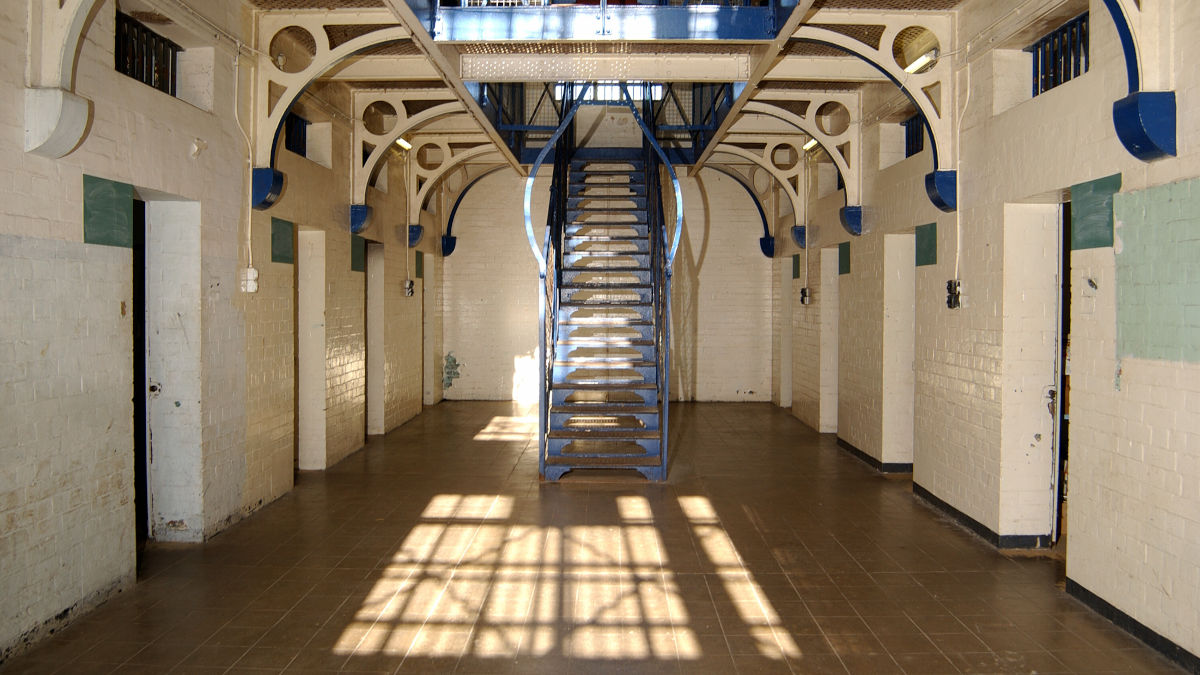
Above: Inside of a Boggo Road cellblock. (Boggo Road Gaol Historical Society)
The idea of transforming the former Boggo Road prison into a thriving arts and heritage hub has been around for a few years now. It would be a brilliant achievement to take an old prison that is ingrained with decades of negativity and pain and transform it into a living place of positive creativity and community life.
The place is currently closed due to nearby construction works, but it will reopen and so now there is an opportunity to do something great there.
But what is actually meant by a ‘Heritage and Arts Hub’?
- Well-managed utilisation of the internal prison spaces, opening them up to a range of community history and arts organisations, and also pop-up businesses, meaning that the place is in use for a majority of the time each day.
- There would be professional-standard and innovative historical interpretation, including a variety of respectful tours, digital experiences, museum displays, and quality educational programmes for children.
- A dynamic programme of boutique drama, acoustic music and fine arts events. Nothing big, just very creative use of some of the interesting spaces in there.
- Stimulating and thought-provoking seminars and debates about the story of Boggo Road.
- Arts classes, workshops, and studio and workspaces, again using those unique internal spaces.
- A Prison History Library and Research Centre that underpins the historical interpretation of the site.
- Affordable access prices for visitors and tenants.
Opening Boggo Road like this means that it would be used from early morning until night time, and by a wide range of people doing different things. The varied menu of quality arts and heritage events would also get people coming back regularly to see something new, so it is not just a place that you go to once.
Live music and drama performances, visual arts, tours, exhibitions and the written word could explore themes of punishment, rehabilitation, reconciliation and redemption. For the first time, there will be an emphasis on the First Nations perspective. Boggo Road would become a centre for creative discourse about its own history, where we think about and explore what happened there, through ‘many stories, told by many voices, in many ways’.
In this way, Boggo Road will become a truly living cultural hub, a place whose own meaning and significance is being positively transformed and challenged through an ongoing process of creative engagement with its own history.
However, it will not be easy to create such a place, and it may well not happen.
The Queensland Government has displayed little interest in unlocking the potential of the site. It is in the Public Works portfolio, despite their proficiencies elsewhere, are not really attuned to the needs of the heritage and creative industries. As a result of this, the place has been managed for the last decade by an inexperienced small business that was installed there in dubious circumstances by then-premier Campbell Newman, making it the only major heritage prison in Australia under private management.
Compared to the success of not-for-profit, award-winning heritage sites such as Fremantle Prison, Port Arthur. Old Melbourne Gaol and Old Dubbo Gaol, the results at Boggo Road speak for themselves:
- The site was underused and empty space for most of the week.
- Site interpretation has had an emphasis on presenting it as a ‘haunted house’.
- Promises of creating around 60 staff and generating millions in revenue have fallen short.
- There has been no voice for First Nations or professional historians in site interpretation. The current management had to be told to stop promoting ‘ghost hunting’ in cells where Indigenous people died (some as recently as the 1980s).
- Community organisations have been locked out in the name of private profit.
- Access prices to Boggo Road are the most expensive of any heritage prison in Australia.
The previous management had enough time to prove itself but fell short. This fact adds to the solid commercial argument for transforming Boggo Road into an innovative and highly popular community and tourism treasure.
The idea of a thriving, living cultural hub seems like a natural fit for the old prison. Let’s hope the decision-makers have the vision and energy to make this happen. This is a significant heritage site with an important story to tell and the Queensland Government can do so much better with Boggo Road than it has to date. The public own this building and it should be a major community asset, run for public good.
Professional historian Chris Dawson founded the Boggo Road Gaol Historical Society in 2003, and worked as a museum curator at the heritage prison prior to 2005. He established the Queensland Prisons Museum Collection, and has written books, journal articles, and delivered talks and tours about Boggo Road.
 Christopher Dawson