
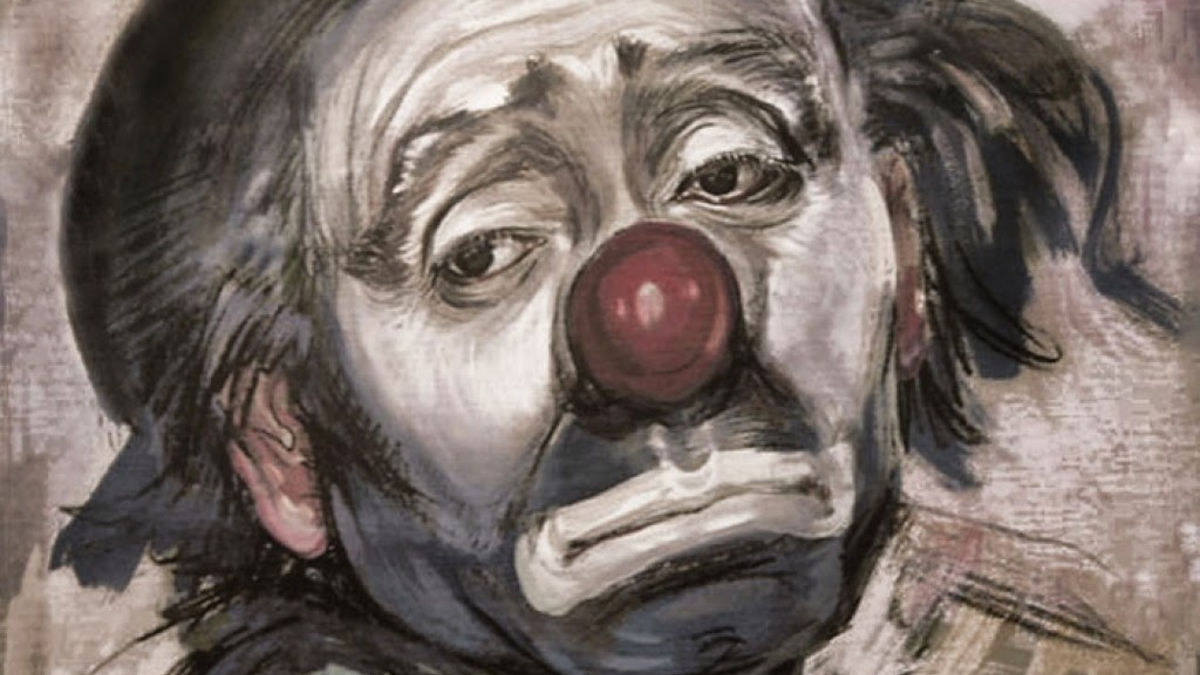
The release of the ‘evil clown’ movie ‘It’ in 2017 was accompanied by the amendment of a Wikipedia article on ‘evil clowns’ to include several paragraphs about an alleged evil clown in Brisbane. While the anonymous author had obviously put a lot of effort into making this seem like a real story, it contained many obvious falsehoods from the first sentence to the last.
What I will do here is run through the story and debunk each bit of misinformation in turn to show how this story was ‘fakelore’ – that is, fabricated folklore.
‘There is a popular urban legend in Brisbane, Queensland, Australia in which the fiendish entity at the centre of the tale appears to be an early representation of the odd crimes and violent behaviour of a mentally disturbed vagrant in the city parks of Brisbane Australia in the late 1930s.’
To begin with, there is no such ‘popular urban legend’ in Brisbane. There is no record of this story even existing before the Wikipedia entry appeared in July 2017. However, the use of the phrase ‘urban legend’ is interesting because the author then starts making claims of official records to back the story up, even though none of these alleged records are ever cited. Almost every paragraph they added ends with the standard Wikipedia warning of ‘citation needed’.
‘Queensland Police records details of a handful of petty assaults in which various women and children were set upon by a fiend who resembles the modern idea of the evil clown. The victims were pushed around and subjected to a tirade of taunts and bawdy humour by a man dressed as a clown. The assaults which lasted only a few minutes saw the victims pinched, pushed and barraged with taunts by a painted joker. The man behind the makeup was dock worker Franklin Smith.[citation needed]
Smith, a notorious drunk and thief, was well known to the local constabulary. The case turns strange when arrest records show that Smith refused to take off the clown outfit he was wearing. Smith stated that it was gifted to him by a dying gypsy woman and had been reported to be the very same outfit worn by a jester clown who had murdered a Romanian King due his amorous intentions for the victims Queen. Whenever constables tried to remove the garments Smith became violent and animalistic. Refusing to be quiet at his trial and mocking the presiding magistrate with foul humour and ridiculous gestures Smith was sent to what was then known as the Goodna Insane Asylum.
The events which led to the institutionalization of Franklin Smith were further compounded by the hospital records of another inmate whose detailed sessions bear witness to Franklin reportedly talking to the clown suit at night.[citation needed]’
No evidence is provided to support these claims, and no records of any incident like this seem to exist. The absence of dates is telling, as is the fact that the author starts the next bit of the story with ‘legend says’ before again referring to detailed records. Which is it – urban legend or historical fact?
‘Legend says that even the staff of the asylum could not force or convince Smith to remove the jester garments. However, fellow inmates swear that he would often take the suit off in the dead of night. Hanging the outfit on his cell wall he would converse with it like a second party. One inmate claims that he had heard the suit answer back. The myth became even more mysterious in light of the actions that led to Franklin’s death. Smith was feared and despised by all the other inmates despite him never having spoken or interacted with any of them. The hospital medical examiner records in great detail that Smith was attacked by a vast number of inmates when undertaking his routine bath. A senior guard at the hospital diarised the event and made note of a second group of inmates banding together to ensure the cell holding the clown suit remained locked while the mob lynched Smith in the bath house.[citation needed]’
That is quite a sensational event. Fortunately, it never happened. No proof is provided in the story, even though such events would have been reported upon very prominently at the time, as were four suicides at the asylum during 1937-38 and an accidental death there in 1941. Any murder there would have also prompted a criminal investigation.
‘According to hospital records the clown suit was fitted within a state issued body bag of the times and transferred to the Dutton Park mortuary for internment in the lower section of the Dutton Park Cemetery. Mortuary documents reveal a complaint to the State government health board over the apparent gluing of a clown outfit onto the cadaver of Franklin Smith.[citation needed]’
Once again, no evidence or reference is provided for these claims, and – even more telling – there never was a mortuary at the cemetery.
‘State government investigations further detail a war of letters between the hospital and the funerary staff with hospital staff oblivious to how the clown suit had even been transferred along with the body let alone glued to the corpse. Enraged by the complaints, hospital official Dr Basil Stafford sent his head of staff Dr Peter Novel to view the body. Correspondence between the two doctors reveals a perturbed account from Dr Nobel who confessed that not only was it the suit that Franklin had worn but it was in fact glued or somehow tarred to the body of the murdered thief come jester.[citation needed]
Dr Nobel further added that attempts to remove the costume were only successful in tearing away large chunks from the corpse and the decision was made to bury the infernal thing with the body. Franklin Smith was buried in an unmarked grave in Dutton Park Cemetery in 1941. The cemetery was made famous by the 1974 Brisbane floods in which a large section of the graveyard was washed away with some coffins still unaccountable. Further scandal over the council allegedly tampering plot records and using headstones for landfill have also brought the cemeteries name to the news headlines.[citation needed]’
Lots more allusions to the existence of records here, but still no citations of evidence. The cemetery paragraph is particularly misleading. There is no record of a Franklin Smith ever being buried in any Brisbane municipal cemetery, and there is not even a Frank Smith buried around that time. Also, ‘a large section of the cemetery’ was NOT washed away in 1974 (or ever), and so there are no ‘unaccountable’ coffins. There was also no ‘scandal’ with ‘tampering plot records’ (mistakes were sometimes made in record-keeping, but there was no ulterior motive). I suspect this was only raised here to provide cover for the fact that the burial records contradict the story.
‘It is however the growing number of sightings and accounts of people being pushed or prodded by an invisible assailant and various sightings of a creepy phantom clown at the cemeteries river edge that are sparking news interest and growing the legend. If local historians are accurate the site of this spate of phantom clown activity falls right at the area in which Franklin Smith was interred 12 feet down at the request of the then commissioner Johnathan Lairborne.[citation needed]’
Again we go back to the story being a ‘legend’, even as the author continues to allude to official (and conveniently unreferenced) records of these events. We also have claims of a ‘growing number’ of sightings of a ‘creepy phantom clown’, although once again there is no record of any such sightings prior to this article appearing in July 2017. And as for ‘news interest’ – the story has never been mentioned in any news outlet. Also, which ‘local historians’ have researched this? The answer appears to be ‘none’.
A perusal of the history of edits of the article (all detailed on the Wikipedia ‘view history’ facility for that page) reveals little. The story first appeared on 16 July 2017 and underwent several editing changes over the next few weeks. At a couple of early points the editor provided citations before quickly removing them. One of those citations went up on the 16 July and linked to a now-removed page on the Brisbane Ghost Tours website. Another citation was added on 20 July, this one linked to a ‘hauntedbrisbane.com’ address that redirected to the same Ghost Tours site. Another short-lived link went to the clearly irrelevant National Trust of Queensland homepage. Although the editor promised on 22 July that ‘state archive documents to support article will be published August 15th 2017’, nothing was ever produced.
This of course raises the question of who wrote the story, although it appears that the author was making a determined effort to remain anonymous. Their style is amateurishly affected and often cringe-worthy, while the plot is ridiculous. All the mentions of unnamed official records indicate a desire to present themselves to be a historian, but the author and their alleged sources were never identified.
No part of the history in this story holds up, and no citations of evidence are provided. Somebody was trying to invent a non-existent ‘urban legend’, but we can safely dismiss this as a piece of fakelore, planted on Wikipedia for whatever motive.
A problem with this sort of fake history is that it creates a genuine threat to the historical integrity of the cemetery. It distracts people from the real stories of real people interred there, and undermines the spiritual values of the place.
I edited the Wikipedia page to remove the fake story from the ‘evil clown’ page. It might reappear again sometime, but I suspect the author will continue to hide their identity and their alleged ‘sources’. Sadly, when it comes to people producing fake history, ‘citation needed’ seems to be a mandatory modus operandi.
 Christopher Dawson