Exploring Cemetery Heritage: Highlights from Stories in Stone 2025

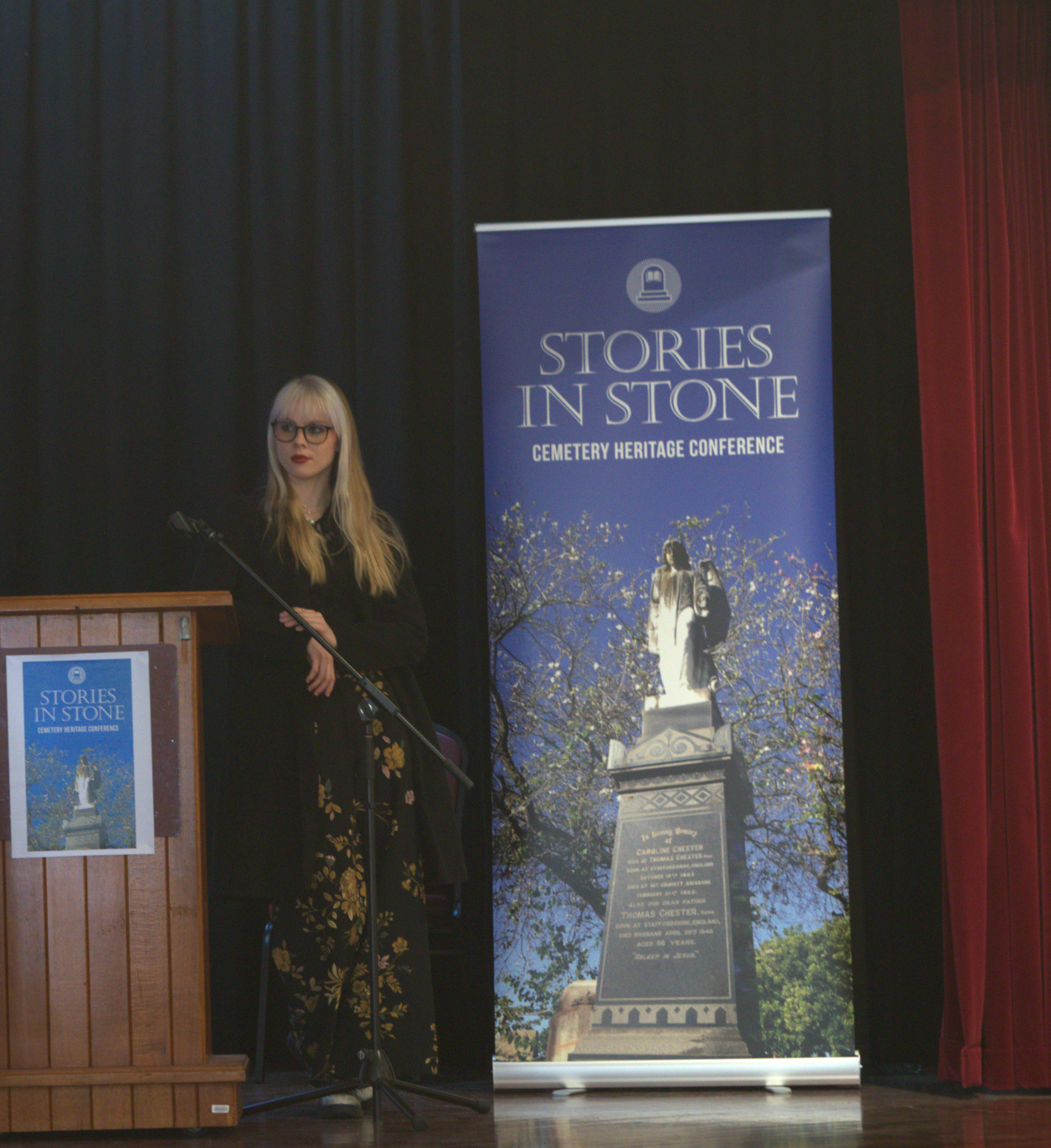
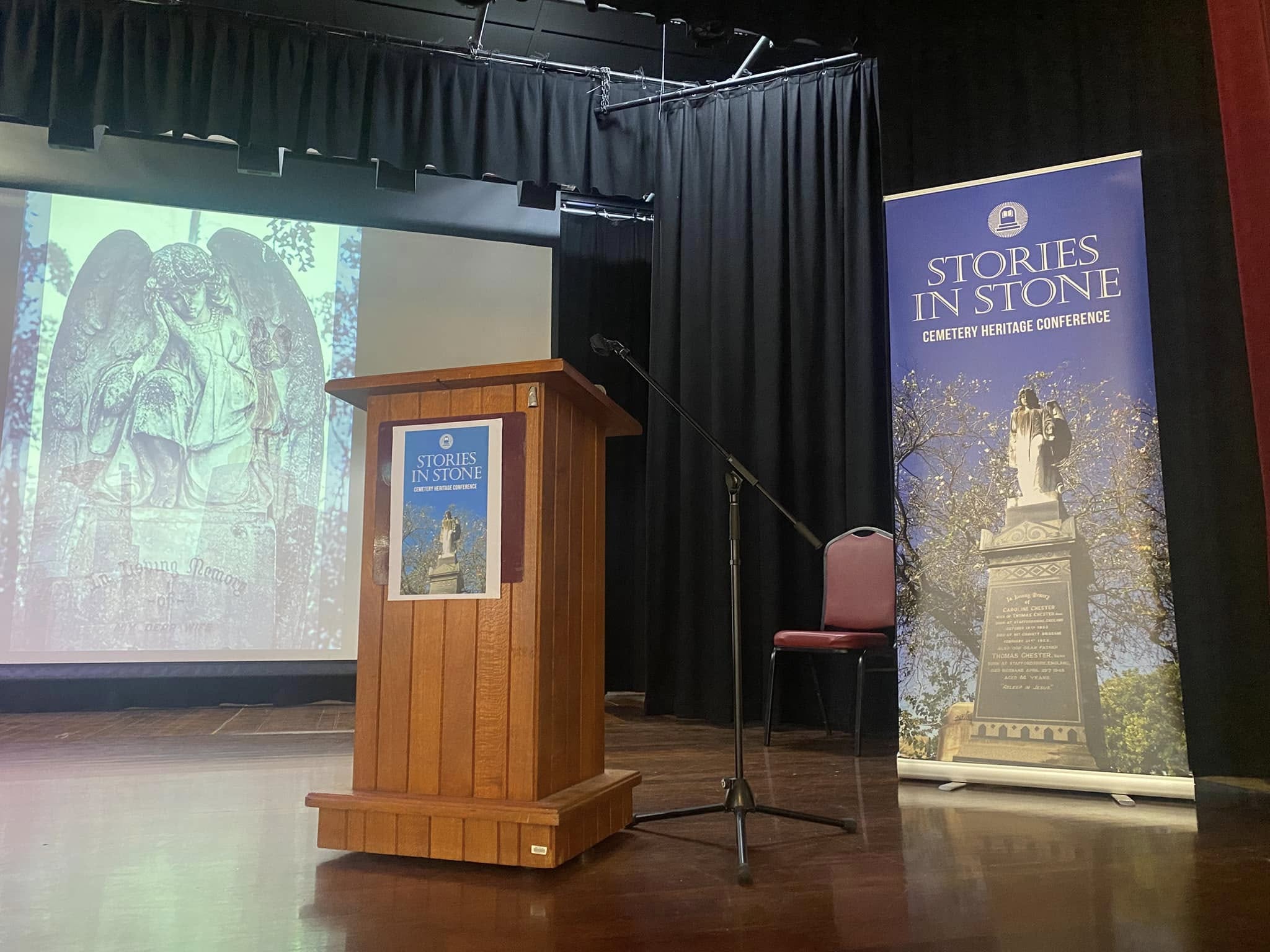
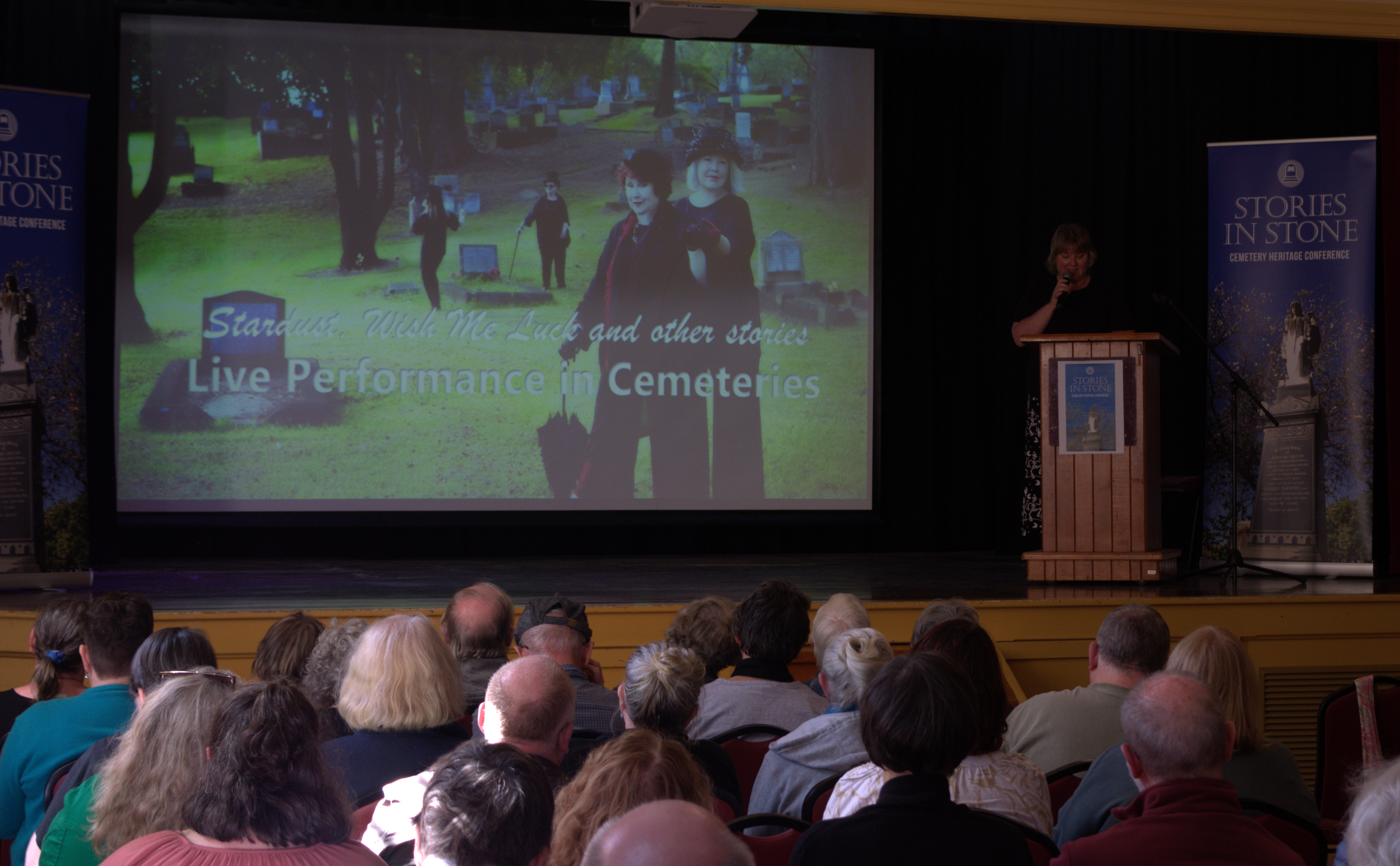
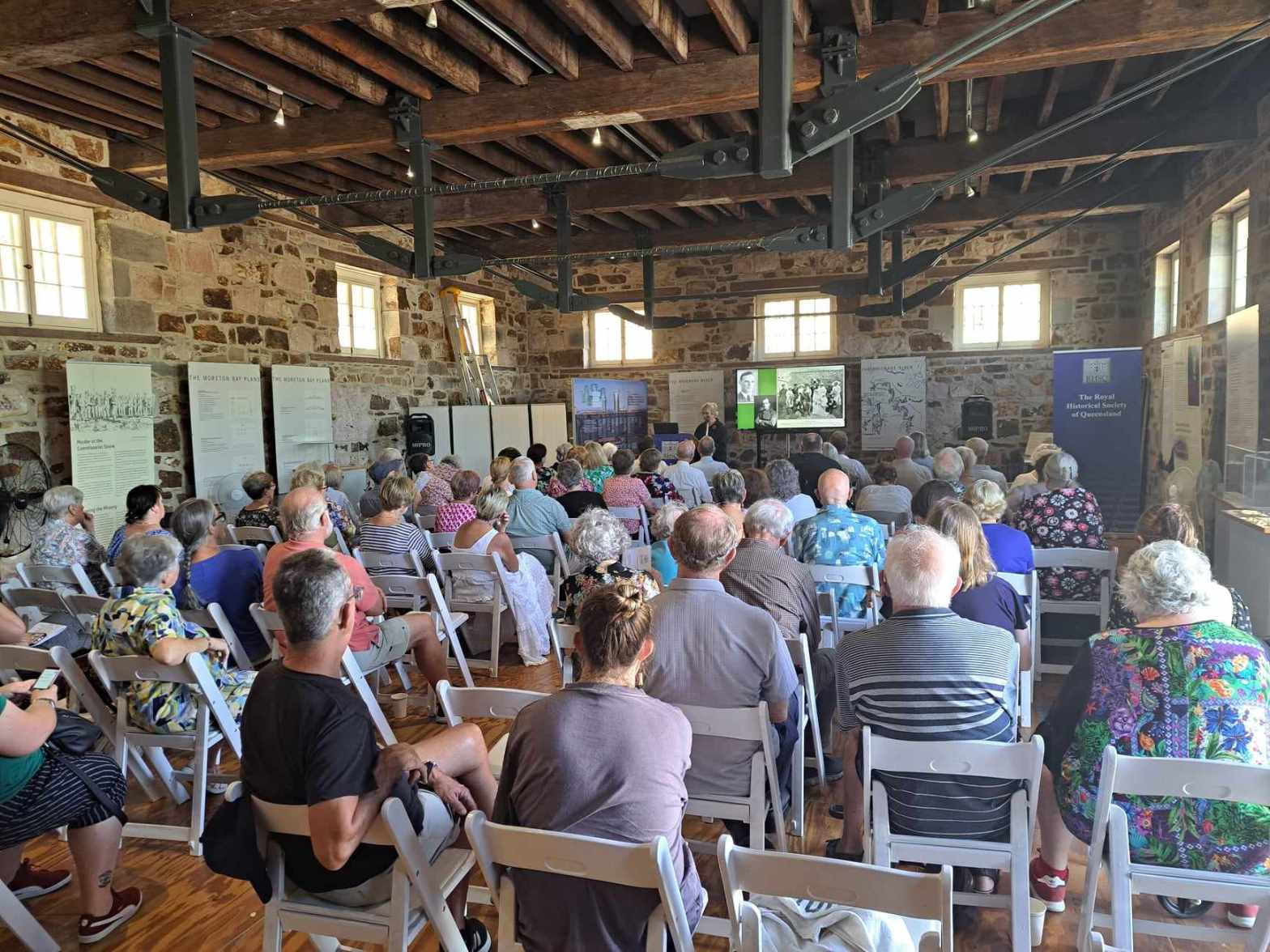
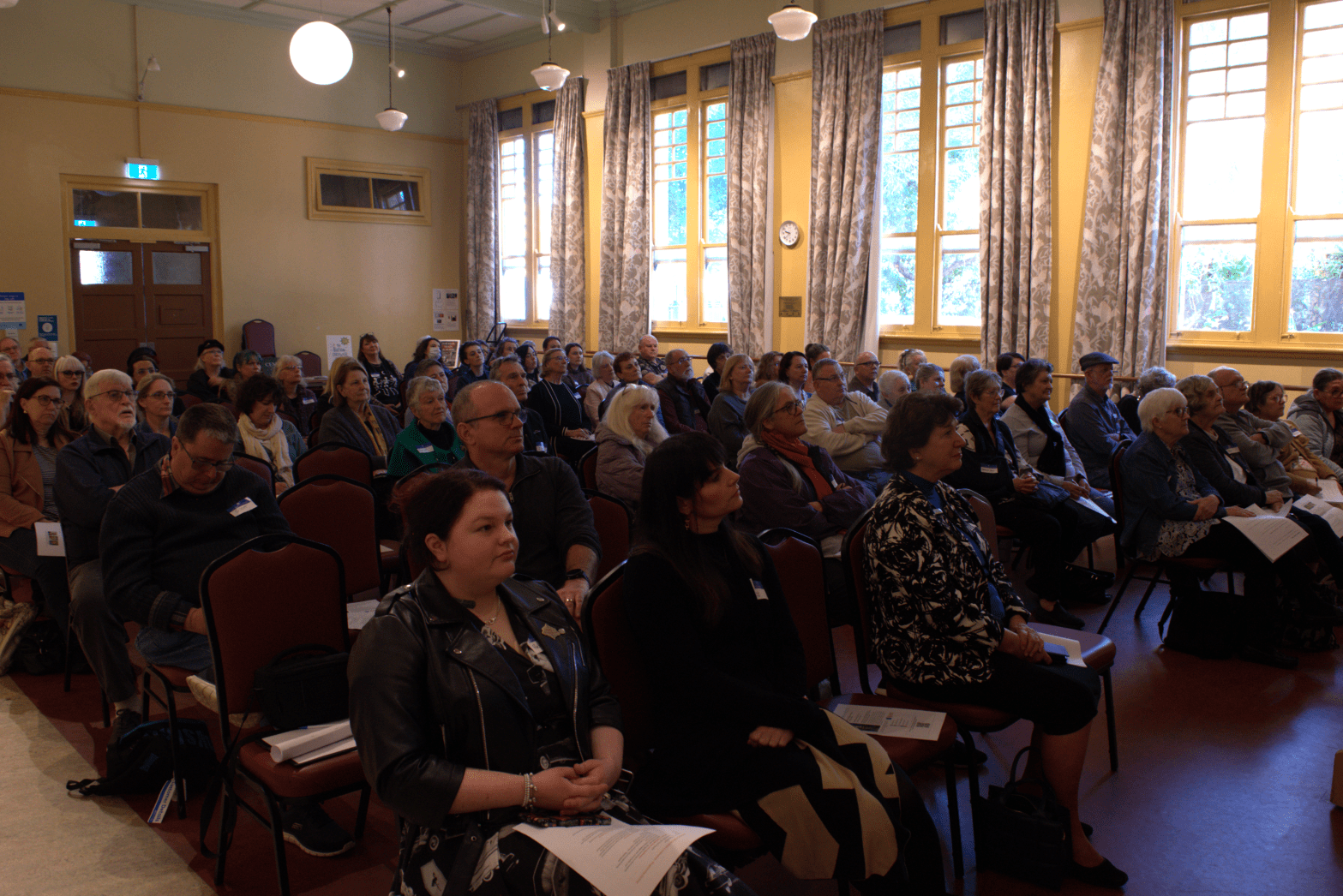
The second ‘Stories in Stone’ cemetery heritage conference took place in Brisbane back on Sunday 16 August and I’m still buzzing from just how well it went.

For me, this was the second such event I’ve been involved in organising. The whole cemetery conference idea took hold in late 2023 when I attended a local history conference organised by the Stephens-Annerley History Group and thought, ‘what if there was an event like this but just about cemeteries?’ I checked around and it looked like nothing like that had ever been done before, so it would be something of a first.

I discussed this idea with Stephen Sheaffe, one of the Annerley conference organisers, and we got the ball rolling. He approached the Royal Historical Society of Queensland, who organised the sales and in-event logistics, while Stephen and I did the rest, such as putting together the programme. The first Stories in Stone conference took place at the RHSQ’s Commissariat Store in early 2024 and proved to be a success (you can read about that one here).

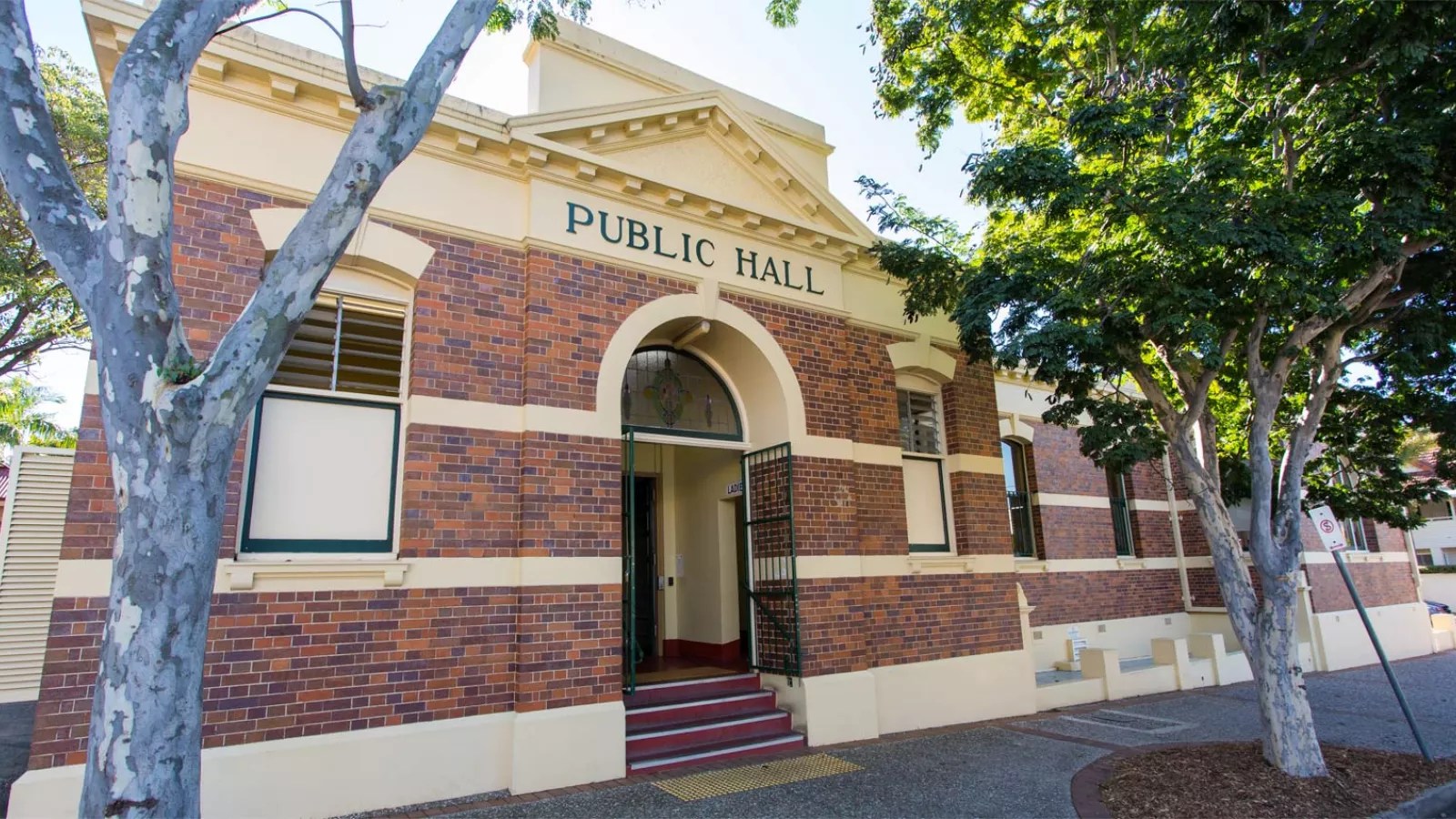
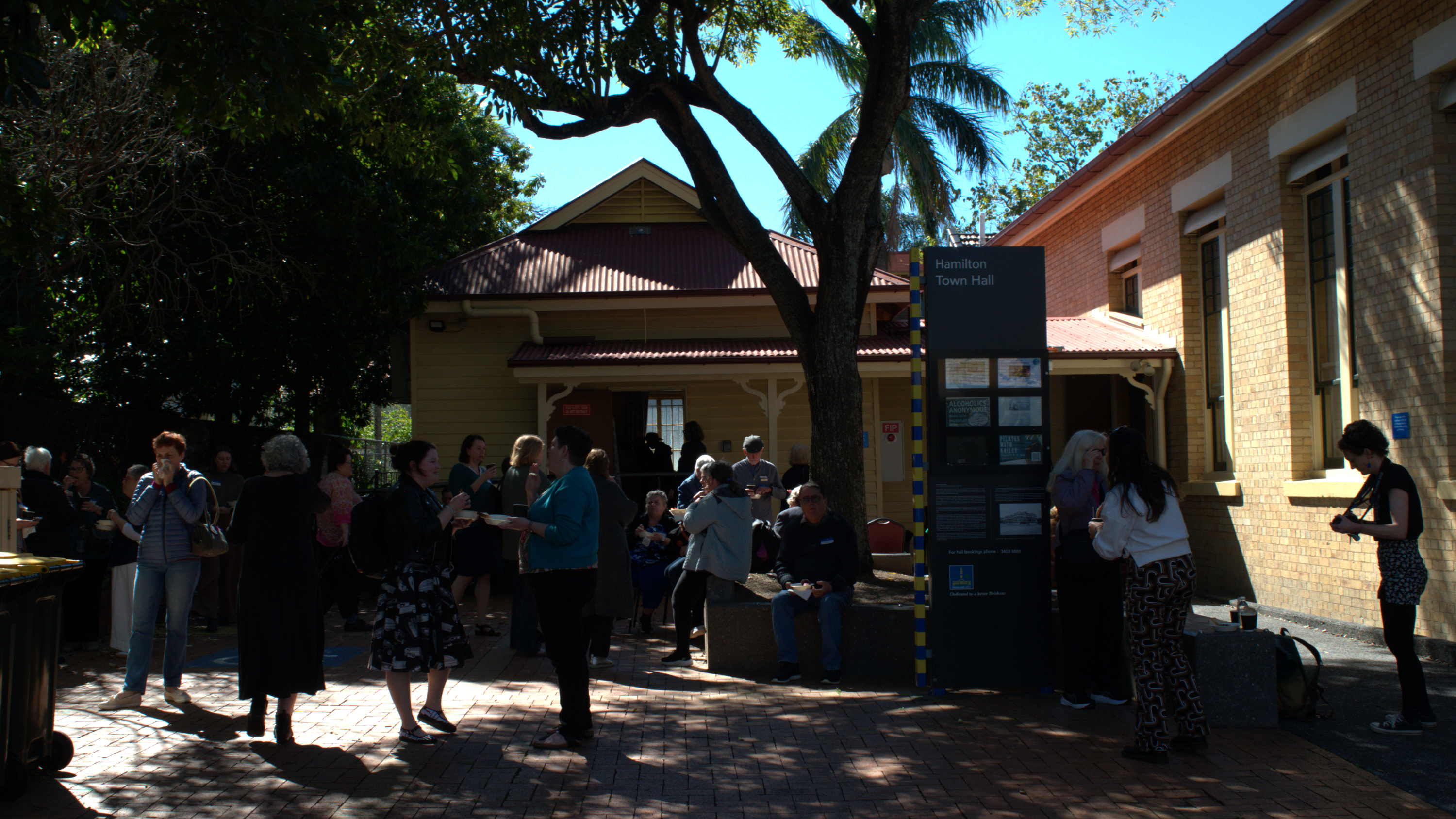
There was immediate talk of a follow-up, but as the RHSQ had a full plate of events planned for the Brisbane council centenary in 2025, I set out to put together another Stories in Stone with a small independent committee. This turned out to be me, Jenny Clark (Friends of Balmoral Cemetery) and Jess Parker (cemetery history researcher), all of whom had spoken at the first Stories in Stone conference. We then partnered with Brisbane Living Heritage to book the beautiful and heritage-listed Hamilton Town Hall as the conference venue.1

Expressions of Interest were sent out for presenters with the initial aim of involving the various cemetery Friends groups around Brisbane, but for various reasons that involvement never happened, except for the very splendid Friends of Balmoral Cemetery who proved to be invaluable. What we did get, however, was a fine range of passionate presenters including cemetery historians, authors, academic researchers, headstone cleaning volunteers, cemetery management professionals, musicians, and social media creators.

The programme and info on each presenter can be seen on the Stories in Stone website.

Over the following months the committee pored over every possible logistical aspect of hosting a conference and planned accordingly. For me, a personal highlight of Stories in Stone was how all that planning paid off, with the conference being successful in three key areas – Programme, Delivery and Attendance.

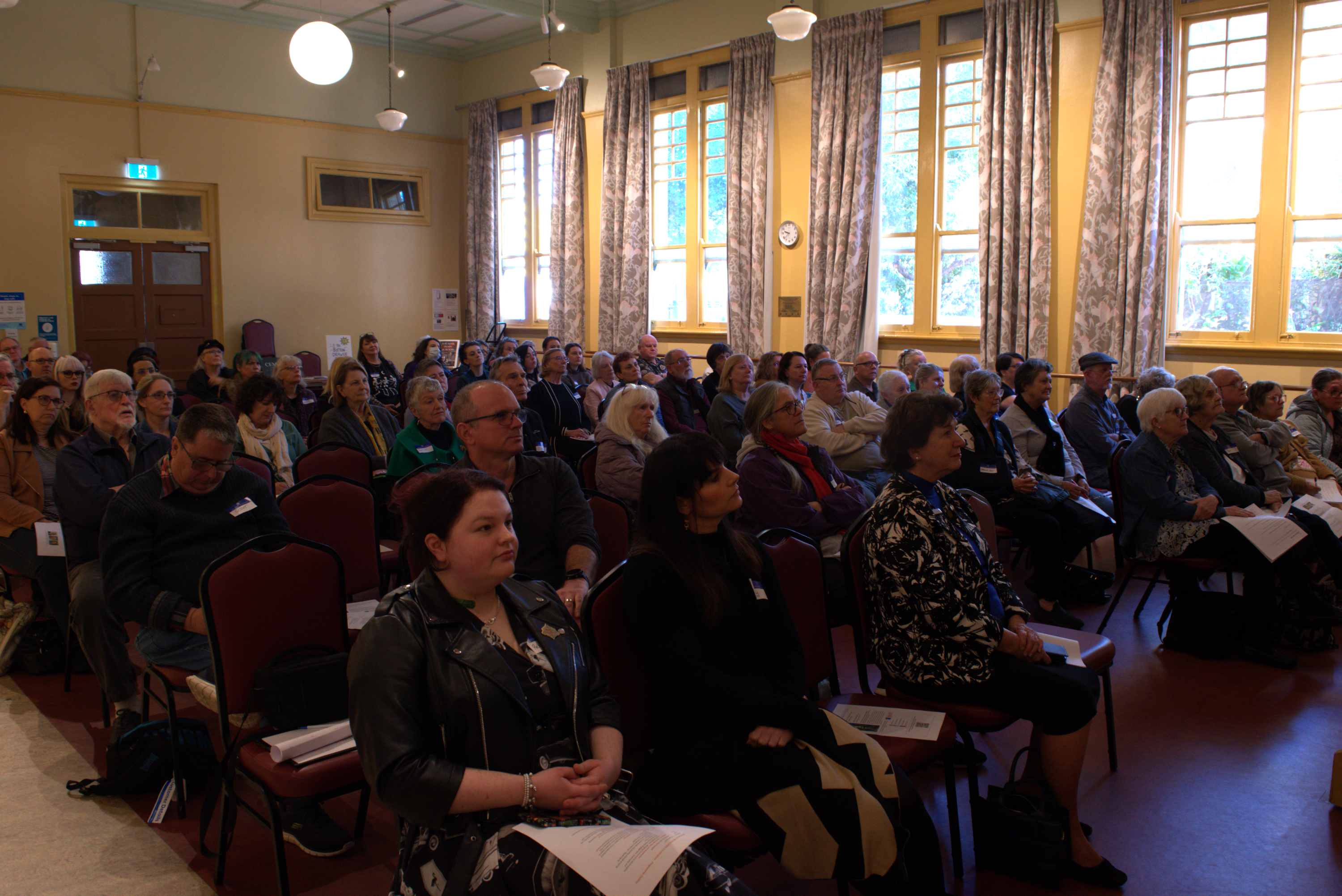
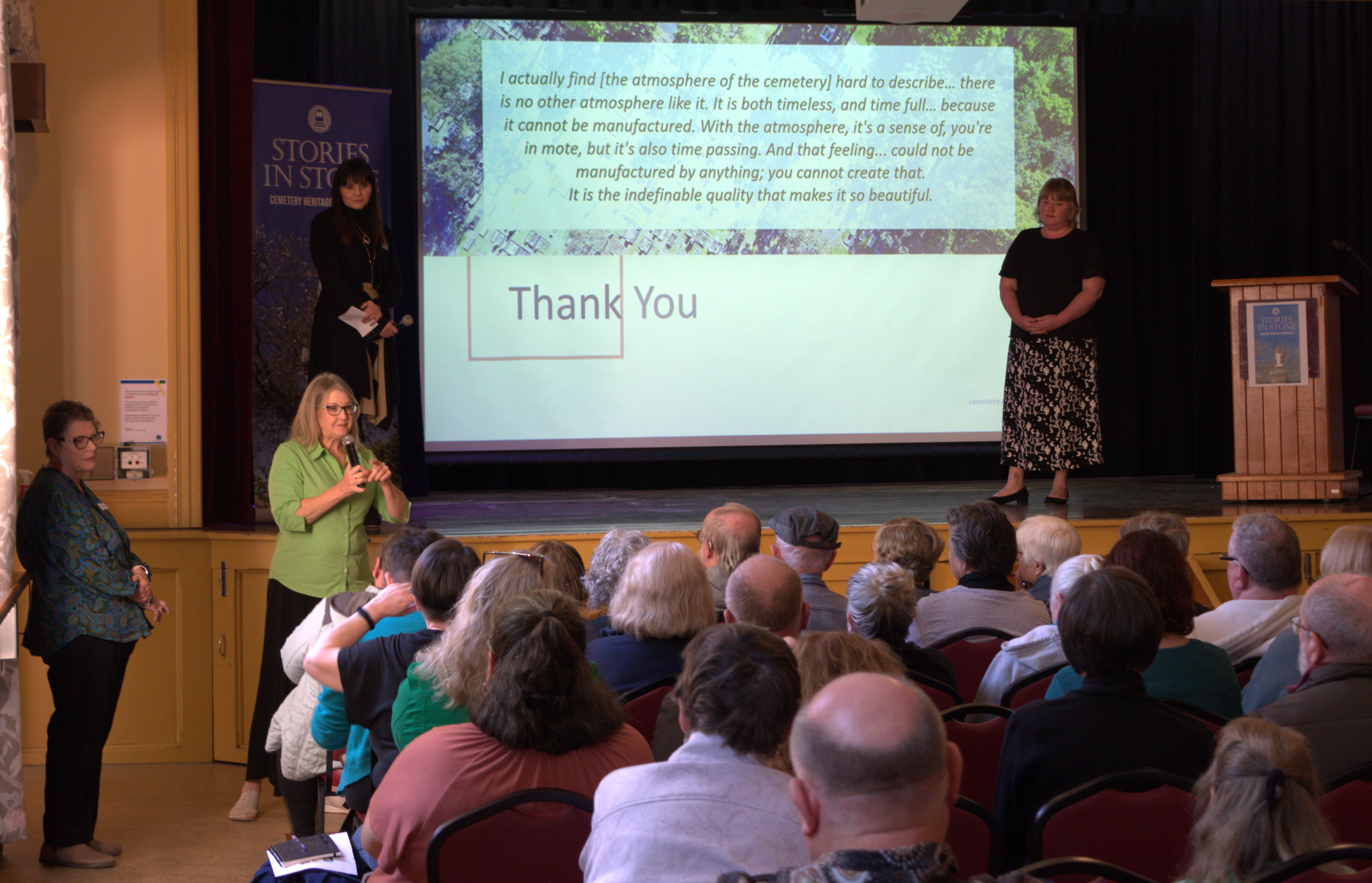
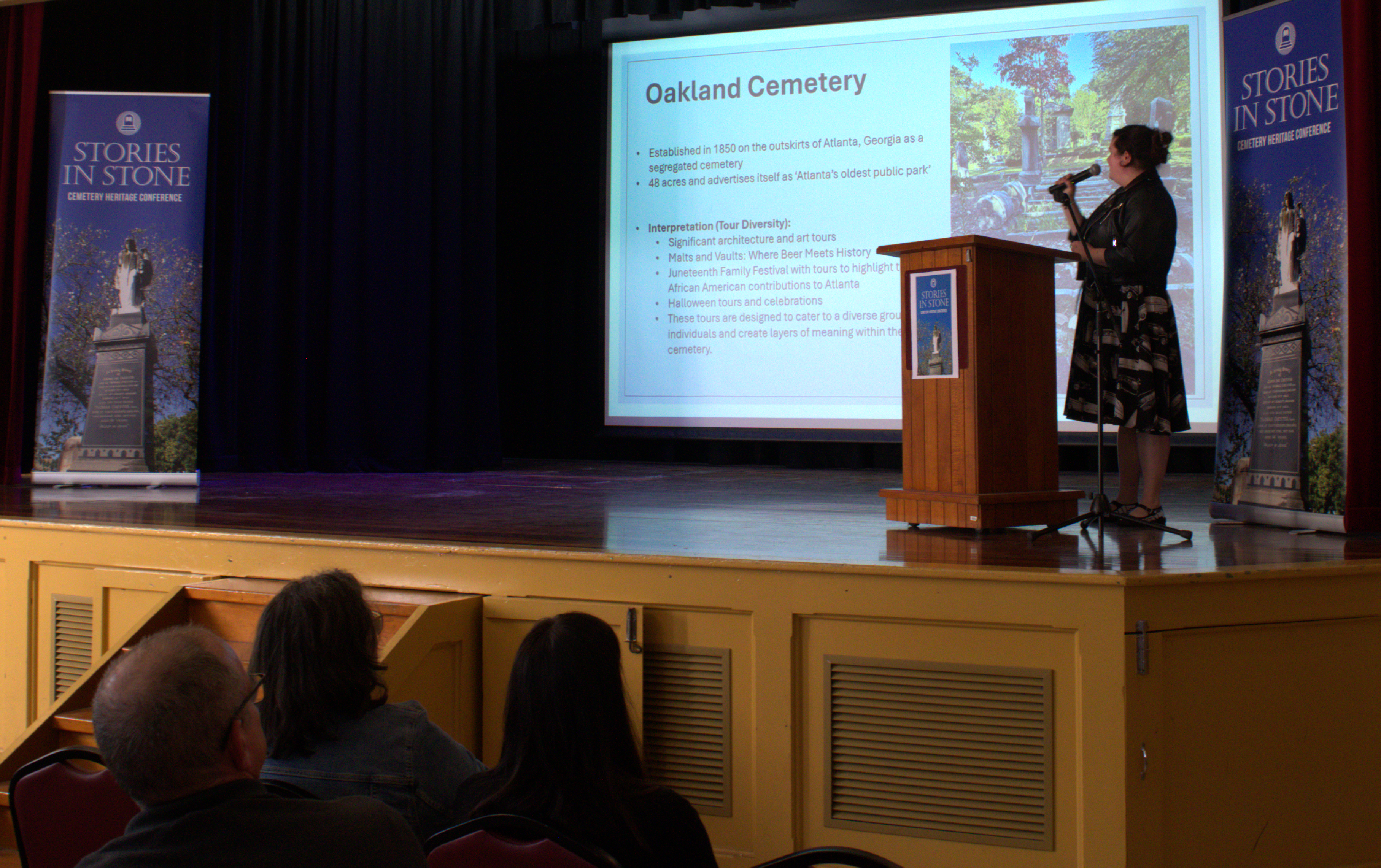
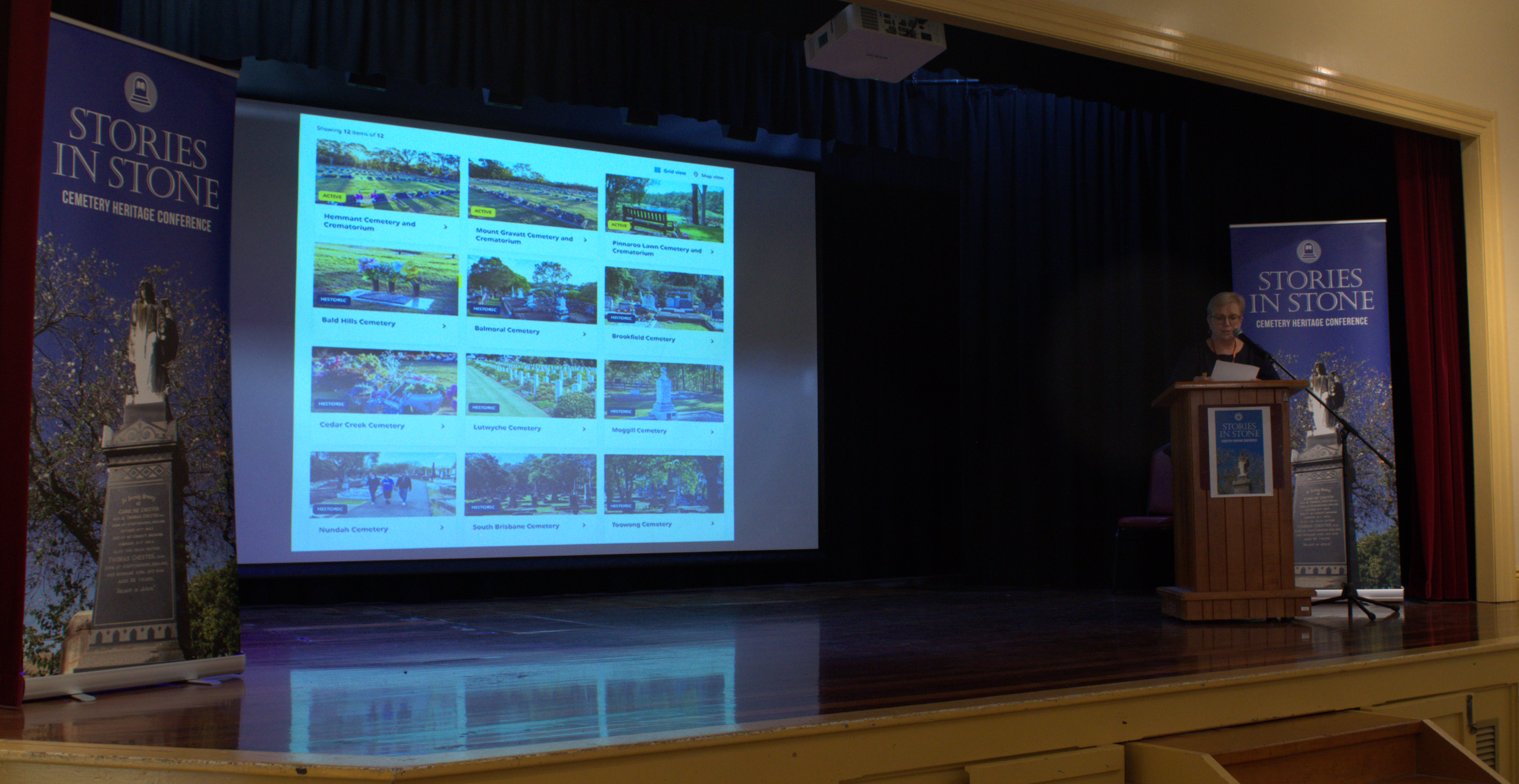
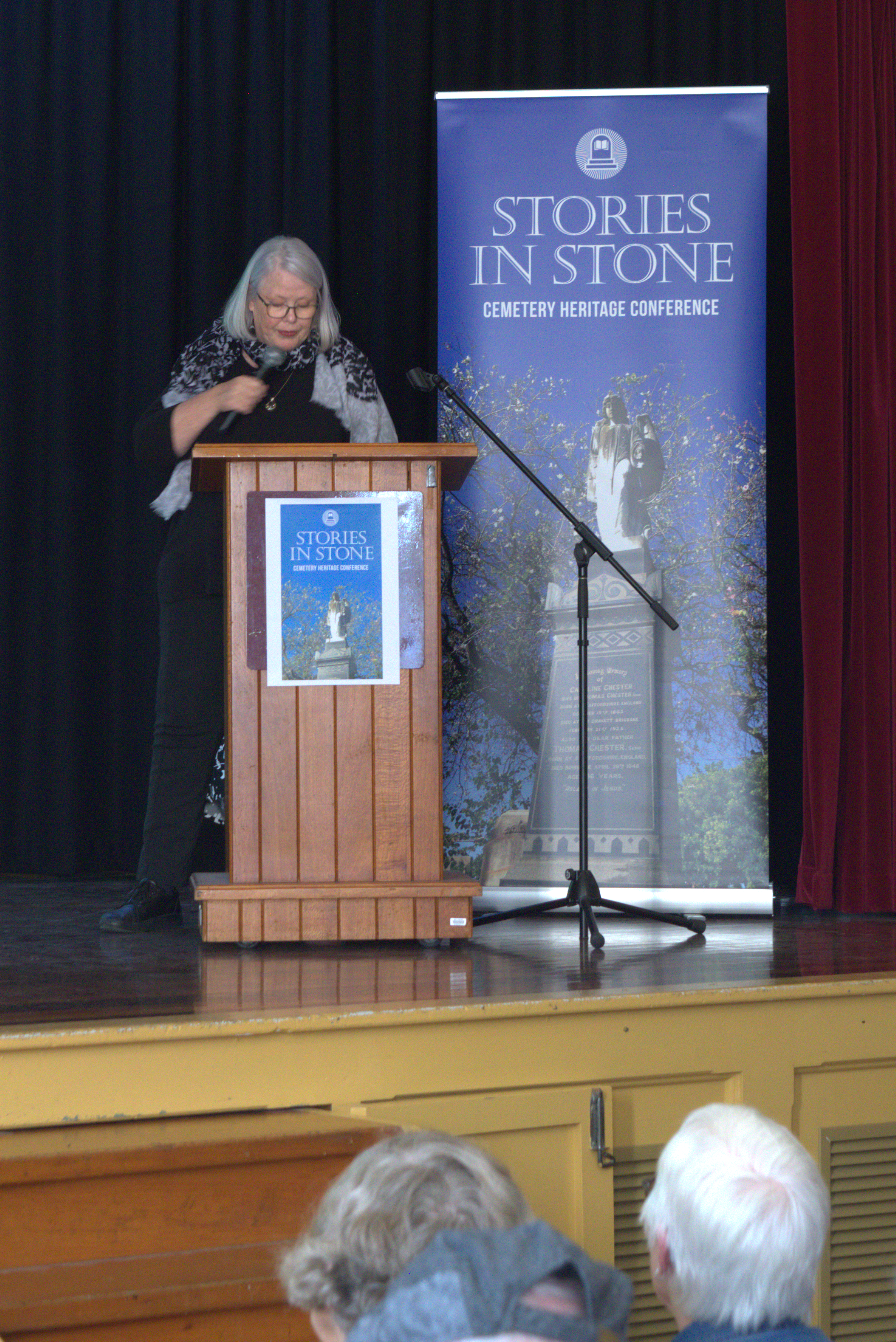
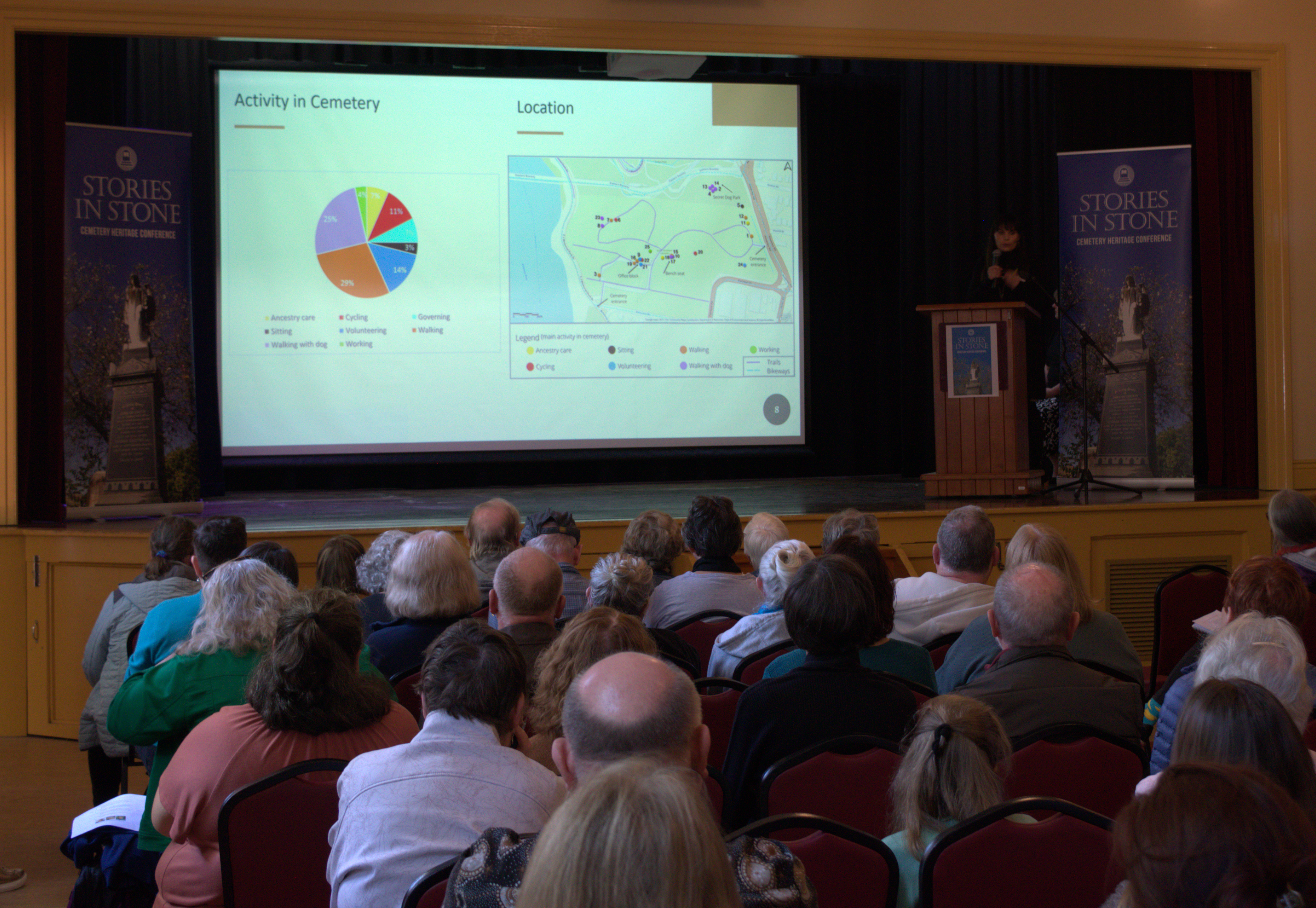
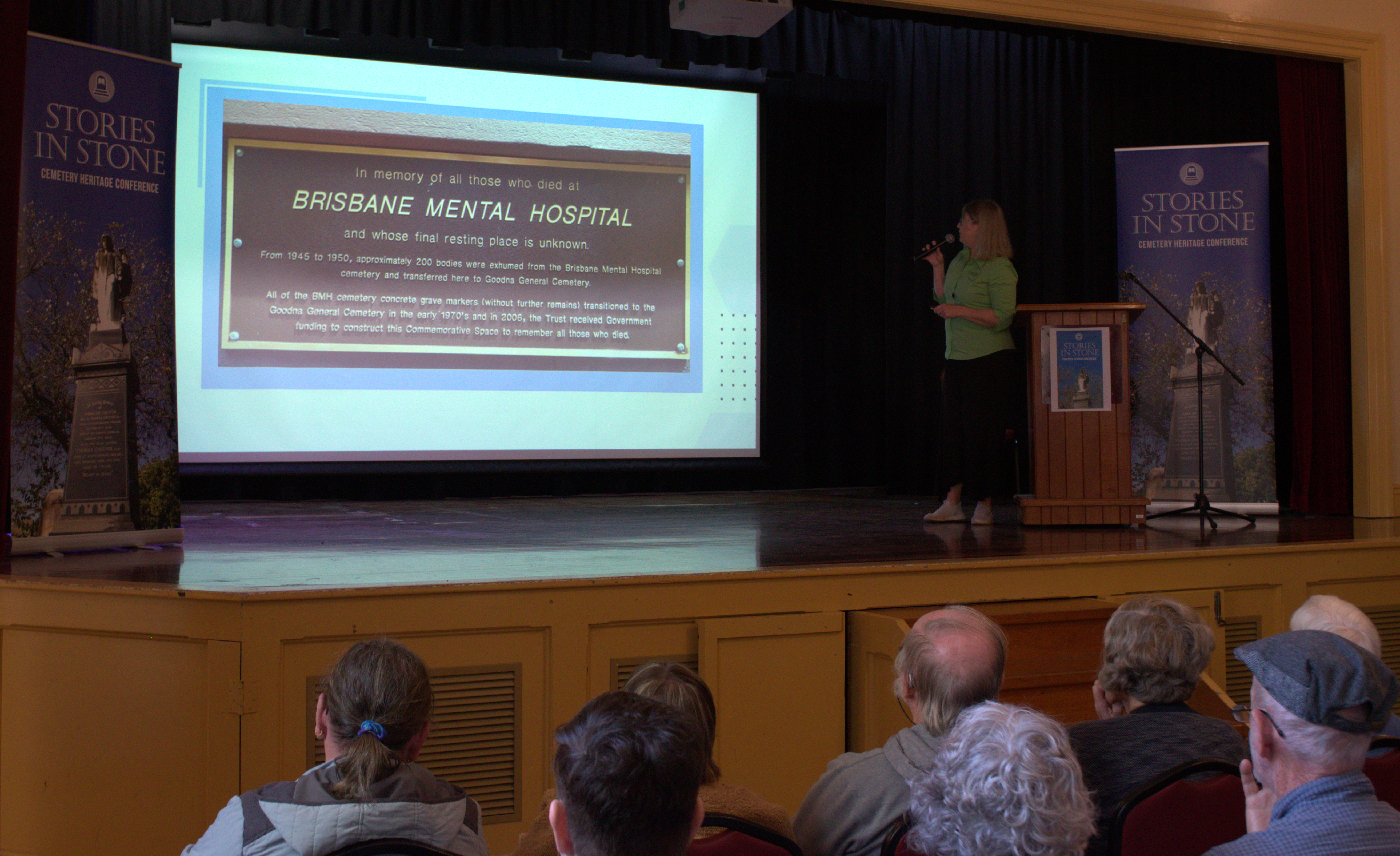
The programme turned out to be exceptional as the presenters did a fantastic job. There was a lot of variety in subject matter and presentation styles, and each person on the stage proved to be very knowledgeable and entertaining. I think it was this expertise, presentation experience, and especially the variety of perspectives that really set the tone for the day. A lovely welcoming speech from Cllr Vicki Howard also lent the conference a crucial degree of authority. The immediate feedback I heard during and after the event was hugely positive.

While the presenters delivered the goods on stage, I was particularly relieved that everything ran smoothly in terms of delivery and logistics. This included audiovisual technology, session timing, stage set-up, MCing, and registration and seating. It is quite rare that you get through any conference or seminar without audiovisual issues, but we avoided those. The catering for lunch and two tea breaks was superbly handled by the Friends of Balmoral Cemetery, whose volunteers were some of the real heroes of the day.

The attendance was also excellent. Our sales target, based on hall capacity, was 85 people. In the end we hit 90% of that target, which we were satisfied with given that some anticipated marketing outlets had not been available to us, for various reasons. We had around 90 people (including presenters and volunteers) present at the conference.

Aside from numbers though, the composition of the audience itself was really good, with lots of good questions and discussion points coming up through the day. Socialising around the lunch and tea breaks was also an absolute pleasure.

So yes, I was very happy with how it all turned out, especially as I had spent some time imagining all the things that might have gone wrong. I think Jess and Jenny can be absolutely proud for having been a central part of creating this unique event and pioneering conference.

As for the future, a Stories in Stone 3 is definitely on the cards for next year. We are still reviewing the outcome of the recent event, but we are in a solid position as we have been through an invaluable learning experience and in the process established a successful brand, a network of contacts, and a financial and administrative base.

  1. Thanks to the Brisbane City Council for allowing community bookings for these venues. ↩︎

Scenes From a Cemetery Industry Conference

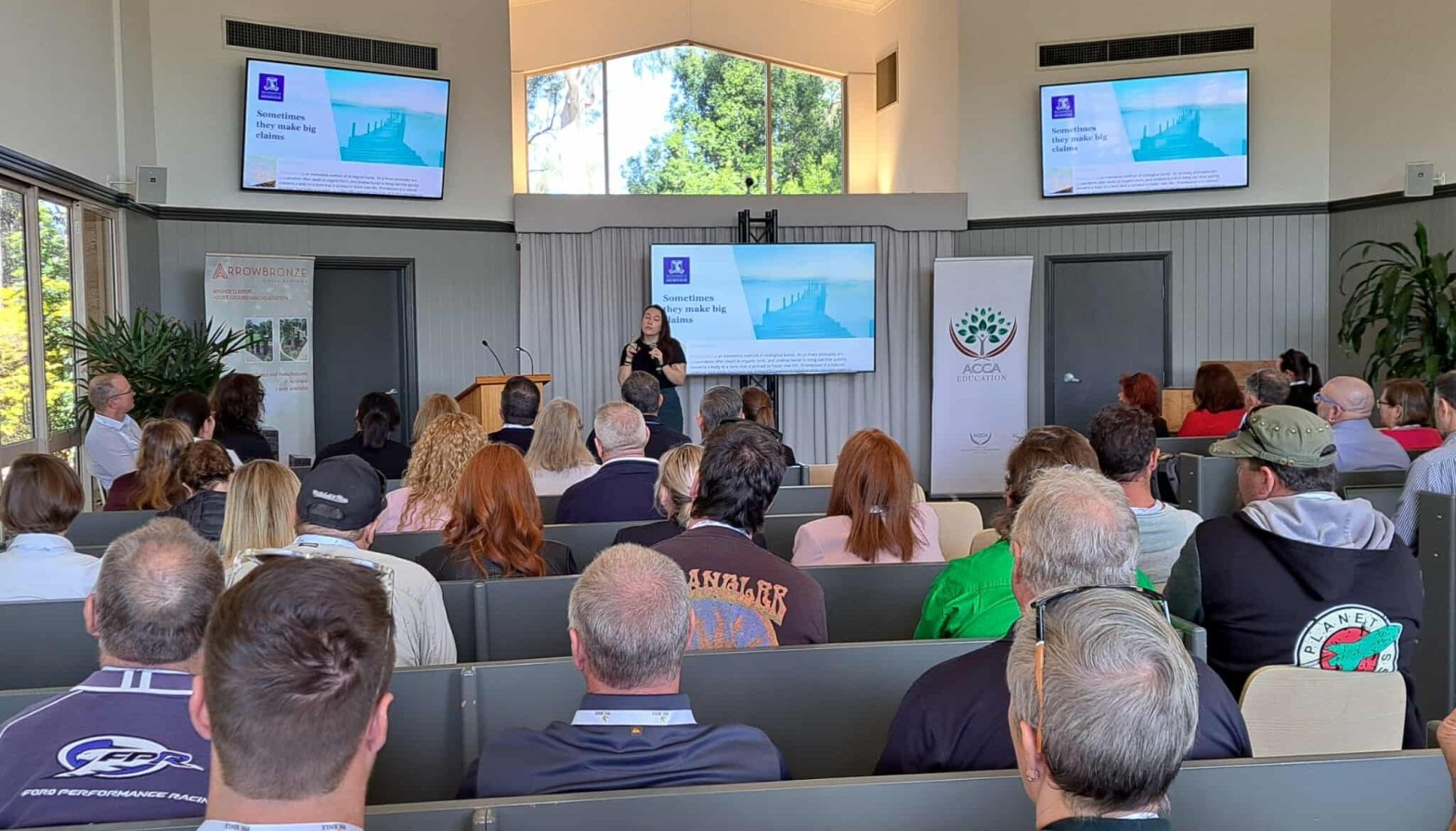
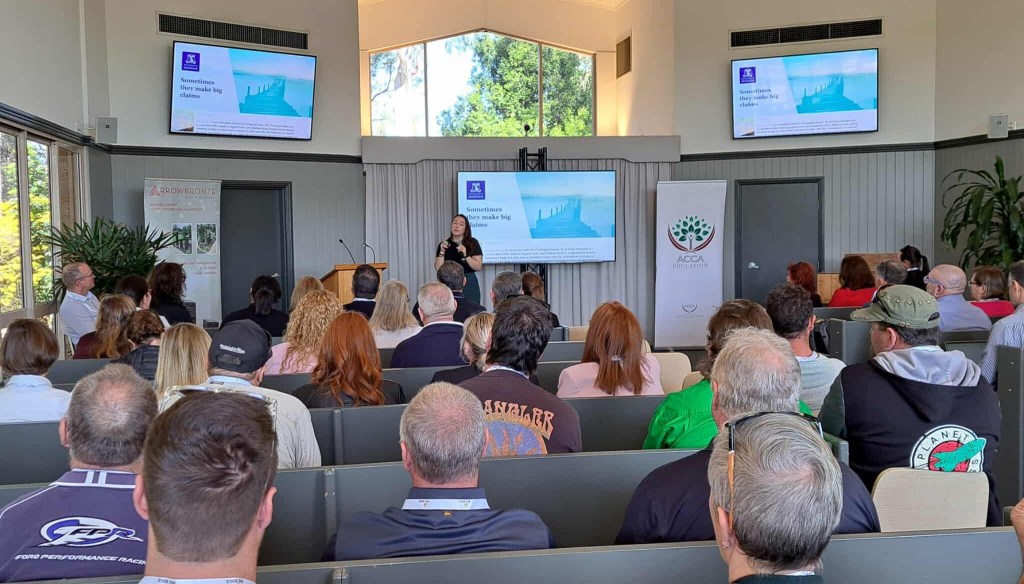
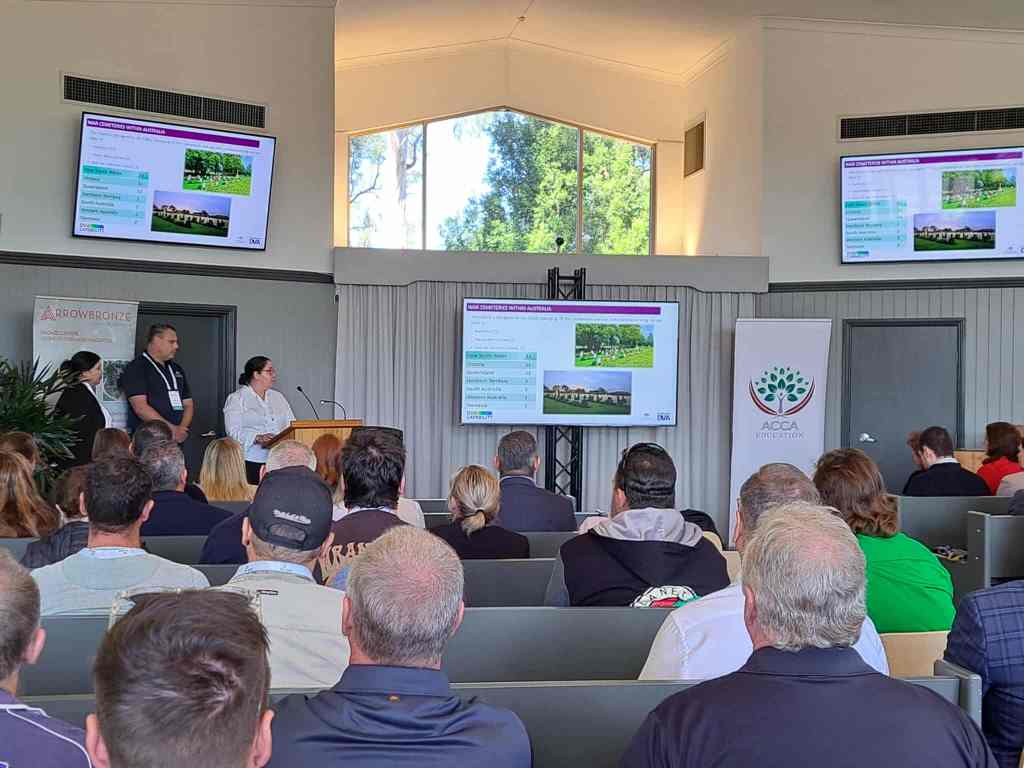
I was intrigued to attend the Mid-Year Conference of the Australian Cemeteries and Crematoria Association (ACCA) at Mt Gravatt Cemetery last Wednesday (16 July). I had originally been invited to speak and had accepted (to talk about cemetery ‘Friends’ groups) and then had to withdraw for various reasons but was still invited as a guest after all.

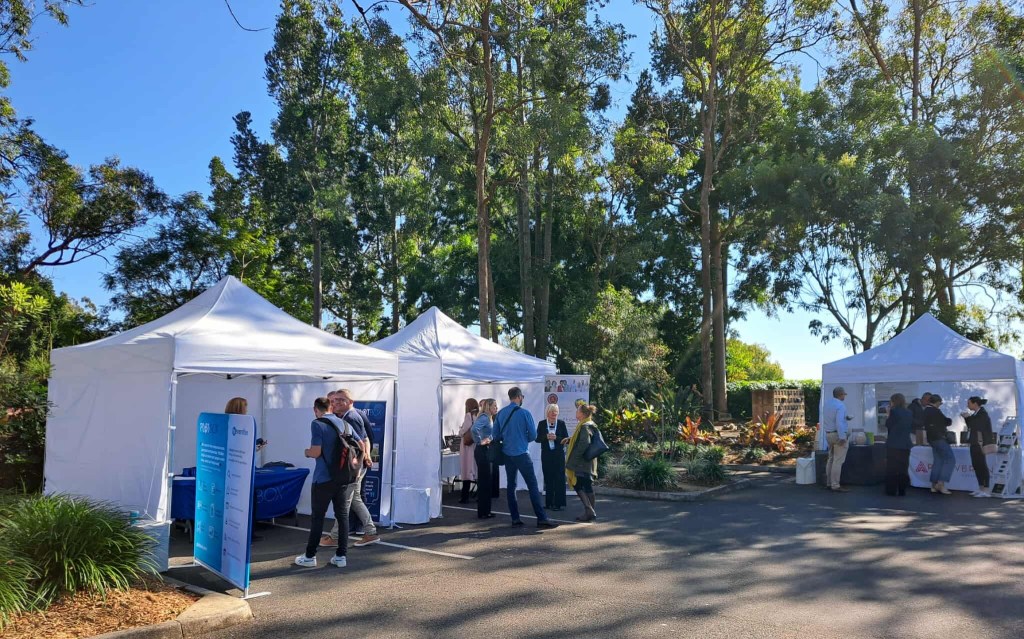
As the conference was also a ‘trade exhibition’ with lots of ‘sponsor updates’ I wasn’t sure what to expect, but it was all really interesting. There were excellent presentations on ‘Public Health, Death & Innovation’ (casting a critical eye on claims behind some of the latest ‘eco-friendly’ burial techniques), workplace safety, Muslim funeral practices, the Headstone Healing Project in Toowoomba, and monument safety inspections. The shorter sponsor talks including subjects such as brass plaques, urns, funeral equipment, cemetery mapping techniques, the Office of Australian War Graves, and digital memorials.

Sadly I was unable to attend Thursday’s conference visit to North Stradbroke Island (Mijerribah) to hear first-hand from First Nations Elders about local Indigenous burial customs before visiting Dunwich Cemetery with the team from Redland City Council.

For an industry outsider like me, it was genuinely fascinating to look behind the scenes and chat at the stalls with industry reps. This included talking with the people working on the ‘Everafter’ mapping programme with Brisbane City Council and the challenges they have faced with some of the data. I also had good chats at the Byond Cemetery Mapping software and Office of Australian War Graves stalls.

It was a very memorable day and a valuable insight into the workings of conferences a month before the Stories in Stone cemetery heritage conference in Brisbane (at which a couple of the ACCA conference speakers will be presenting).

A History of Queensland Bunyips (Part One): The 19th Century

‘The bunyip, though its fame has spread over all Australia, and though nearly every large reedy swamp boasts of one, has never been captured; and it is regarded by most people very much in the same light as the unicorn is viewed – as a myth.’ (Warwick Argus, 14 January 1893)

By the time the country beyond the Moreton Bay region was opened to non-Indigenous ‘settlement’ in 1842, the ‘bunyip’ of First Nations lore was firmly established in the consciousness of non-Indigenous Australia. These mysterious water creatures had many names across Australia, including Mochel-mochel (Condamine River, Queensland), Moolgewanke (Lake Alexandria, S Australia), Kuddimudra (Diamantina River, S Australia), Kadimakara (Lake Eyre, S Australia), Banib (Lake Albacuytya, Victoria), Tunatpan (Port Phillip Bay, Victoria), Kajanpratic, Tumbata, Toor-roo-dun (Victoria), and Kianpratty (New South Wales). The white arrivals generally referred to them all simply as ‘bunyip’.

Early Non-Indigenous Reports of Bunyips

European interest in the bunyip had been kindled – but then largely doused – by a series of fossil discoveries during the early 19th century. A reference to the creature was included in a pamphlet published in 1812 by James Ives, who spelled it ‘Bahnuip’ and referred to a ‘black, seal-like creature that has a terrifying voice’. Large bones found at Lake Bathurst in New South Wales in 1818 were described as being much like a hippopotamus or a dugong, but the discoverer never returned to the find site. It has been suggested that the bones were similar to those of a Diprotodon. A significant discovery was made in 1830 of very large fossilised bones in the Wellington Caves, New South Wales. These were later identified as megafauna Nototherium and Diprotodon.

A bunyip as depicted by a First Nations man. (Geelong Advertiser, 1845)

One of the first recorded mentions of a ‘bunyip’ came in an 1845 Geelong Advertiser article titled ‘Wonderful Discovery of a new Animal’. This was a story about fossils found near Geelong. A local First Nations man was shown one of the bones and reportedly claimed it belonged to ‘the bunyip’, which he then drew. That image can be seen at the top of this article. He also related a story of a First Nations woman killed by a bunyip, and a man named Mumbowran ‘who showed several deep wounds on his breast made by the claws of the animal’. This description was provided by the reporter:

‘The Bunyip, then, is represented as uniting the characteristics of a bird and of an alligator. It has a head resembling an emu, with a long bill, at the extremity of which is a transverse projection on each side, with serrated edges like the bone of the stingray. Its body and legs partake of the nature of the alligator. The hind legs are remarkably thick and strong, and the fore legs are much longer, but still of great strength. The extremities are furnished with long claws, but the blacks say its usual method of killing its prey is by hugging it to death. When in the water it swims like a frog, and when on shore it walks on its hind legs with its head erect, in which position it measures twelve or thirteen feet in height.’ (Geelong Advertiser, 2 July 1845)

There was an outburst of ‘bunyip-mania’ in 1846-47 after a squatter found a strange skull by the Murrumbidgee River, New South Wales. He showed it to local First Nations people who reportedly told him it was a ‘bunyip’. A number of experts studied the skull and by 1847 it had been identified as the deformed foetal skull of a foal or calf. Despite this, the skull was displayed to large numbers of enthusiastic visitors for two days in the Australian Museum in Sydney, prompting many of them to claim their own ‘bunyip sightings’.

The skull found at Murrumbidgee, NSW, in 1846. (Sydney Morning Herald, 9 February 1847)

Most Europeans did not seem to take the bunyip stories too seriously, but this was – to them – a new continent and the possibilities for discovering exotic new fauna were very real. In that sense, the term ‘bunyip’ seems to have been used in much the same way as ‘Unidentified Flying Object’ was in the 20th century. The term UFO technically refers to something that has not yet been identified but probably has a rational explanation, but it also carries cultural connotations of extra-terrestrial origins. Likewise, the European use of ‘bunyip’ merely signified an unidentified aquatic animal, while also conjuring up popular notions of a fantastical and almost supernatural creature. 

Nevertheless, newspaper accounts of bunyip sightings were imbued with a strong sense of scepticism that often bordered on outright mockery. This was clearly demonstrated in 1853 after wealthy members of the New South Wales government attempted to create an Australian aristocracy with themselves. This idea was famously derided by politician and democracy advocate Daniel Deniehy as a ‘bunyip aristocracy’. The message was clear; much like the bunyip, the proposed aristocracy was a colonial fake.

A Colonial Queensland Bunyip Chronology

Waterhole at Bromelton, near Beaudesert.

The first recorded European account of an alleged bunyip in what would become Queensland came in 1850, when a woman walking near a waterhole on the Bromelton property near the Logan River claimed to have witnessed a huge horned creature with eel-like features and a platypus-like bill. She estimated that the visible portion above the water was about 10 metres in length. She left and returned with two witnesses but they only saw the tail for a short while before it disappeared below water. She did, however, provide the most detailed and fantastical description of any ‘bunyip’ sighting in Queensland history. A fuller account of this incident can be read here.

Many other reports of bunyips appeared in Queensland newspapers over the following century, and most were unconvincing to say the least. What is noticeable about these accounts is the geographically sporadic nature of the data. Not one single location seemed to sustain a consistent record of bunyip sightings. The usual pattern was that somebody would claim to have seen ‘something’ in a particular river or waterhole, and then that alleged bunyip would never be heard of again. While this might tally with the First Nations concept of a supernatural being, the scattered nature of the sightings combined with the complete lack of a physical record nullify the notion of the bunyip as an undiscovered animal.

In 1868, a letter signed ‘Alex Warder, Boom Boombah’ appeared in the Brisbane Courier, telling of the bunyip tales that station workers shared with each other. He claimed that men acquainted with the Logan, Upper Mary, Fitzroy, Condamine, Laidley and other rivers all had stories to tell, and that:

‘There being so little variation regarding the bunyip in the accounts of these men, is it not reasonable to suppose that there is truth after all in what not a few only scoff and jeer at? The blacks to a man believe in the bunyip, and look horrified when it is mentioned.’ (Brisbane Courier, 12 December 1868)

In 1873 Alderman Eastaughffe of Dalby claimed that while he was out shooting ducks near a creek there, he saw what he described as a ‘huge monster, with a head like a seal and a tail consisting of two fins, a large and a smaller one.’ No further details, such as an estimated size, were recorded.

It seems to have been a commonly accepted theme among non-Indigenous writers that First Nations people were terrified of bunyips. An 1876 newspaper series titled ‘A Strange Exploring Trip’ mentioned this scene near the Barcoo in central west Queensland:

‘You would have been astonished if you had heard all the noises on a big waterhole like that early in the night. Such groans, harks, cackles, whistles, gobbles, and noises as never seemed to come from beast or bird. The fact is that a waterhole like that brings them all together, and in the cool of the night they have a grand corroboree. The blacks won’t go to the water at night, not of the big holes, as they say the bunyip lives there. I can’t say whether he does or not, as I never saw one, but he couldn’t make a more terrible noise than what was going on already.’ (The Queenslander, 22 April 1876)

A stockman and two South Sea Islander labourers witnessed a strange creature while fishing in a waterhole on Gigoomgan station near Tiaro in 1877. They turned and ran, but from their descriptions it sounded like a 4-metre crocodile. It was never seen again, but a few weeks later a reporter from the Darling Downs Gazette investigated the place and:

‘An extraordinary animal was seen. It had four legs, a head, a long tail, and two humps on its back. These are undoubted facts. Now for the theory which accounts for them. The bloated carcase of a kangaroo was floating in mid-water and on the protruding surface were seated two fresh water tortoises, engaged in the congenial operation of sucking the putrid flesh. Disturbed by the human intruders, the reptilians slipped into the water, and their ‘floating island’ turned over, displaying its legs, and appeared to the affrighted spectators to perform a somersault and a plunge simultaneously.’ (Maryborough Chronicle, 20 March 1877)

Sketches of Australian Scenes, 1852-53, JG Sawkins – Gigoomgan (Messers Hays), State Library of NSW.

An article in the Queensland Figaro in 1888 referred to a bunyip sighting, although the description seems to be very much of a land animal. The name of the witness was not provided, nor a specific location apart from it being somewhere in the vicinity of the Mary River. It is doubtful that much credence can be placed on this report.

‘He saw the animal, lying asleep in the hollow end of a log. It was stretched along on its stomach, its chin resting on its paws, similar to a dog; it was, without doubt, as large as a tiger, its limbs, apparently, quite as strong, the forelegs being as thick as a man’s arm, and the chest wide and seemingly very powerful. The head was nearly round, nose short – not unlike a cat’s – ears short and pointed, and the mouth, which was firmly closed, was clean and beautifully formed, having no loose skin hanging from the jaws. A large brush of hair stood out from either side of the upper lip, and the eyes tightly closed, apparently, quite round. The body was clean built and very neat; the hind quarters were not so plainly visible; in fact, it could not be seen whether the animal possessed a tail – at any rate he had got it curled round by his side, as is customary with dogs, cats, &c. But the most remarkable feature in connection with the creature was its beautiful color, a deep-brown, thickly studded over with jet black spots about the size of a shilling, the hair, which was quite short, having a nice glossy appearance.’ (Queensland Figaro, 7 July 1888)

More reputable information was provided in 1891 when Dr Joseph Lauterer presented a talk about he called the Yerongpan languages of Brisbane and Ipswich to the Royal Society of Queensland. He claimed that:

‘The Yerongpan natives believe in a kind of bugbear, who kills and eats the blackfellows. They do not call it bunyip (which is an imported name) but worridziam.’ (Brisbane Courier, 16 March 1891)

This is the only reference to the word ‘worridziam’ that I have so far found.

Lake Elphinstone, about 100 km west of Mackay, was the scene of the kind of elaborate bunyip hoax that was perpetrated decades later at Lowood. A large number of police and civilians set out to investigate the lagoon after hearing new tales of a strange monster from local First Nations people. They claimed that a ‘huge, hairy, horned monster had risen from the lake near their camp, his eyes shone like globes of fire, and lit up the shores of the lake’.

The investigators set up an overnight camp on the banks of Lake Elphinstone:

‘At midnight the monster appeared gliding from the centre of the lake towards the shore. A thrill of horror ran through the crowd. Shot after shot was fired, but still the monster steadily advanced. They could discern his great thick horns and shaggy head, while his eyes glared as the blacks had described. A whole volley was now fired, and replied to by a peal of demoniacal laughter from the monster, who still advanced. Every man skedaddled for his life, save one Jack Fortescue, the biggest dare-devil in the north, who, without a moment’s thought, threw himself on the enraged bunyip in a struggle for life or death. Jack had recognised the cackling laugh of his mate, Jim Playford, the most inveterate joker in Nebo, and penetrated the hoax. Jim had mounted the hide and bend of an old scrub.bull, carefully stuffed with straw, on the bows of a small bark canoe. Swimming behind, he pushed the canoe along in front of him, with the mock bunyip for a figurehead. The eyes of the monster were two skilfully placed bullseye lamps, highly burnished with Kangaroo Brand Alumina Polish. The little boys of Nebo now call out to the custodian of the peace, “Who shot the bunyip ?” and Bobby hangs his head and looks tired.’ (The Telegraph, 19 March 1892)

Lake Elphinstone, Queensland.

During that same year, the fishermen on the Condamine River became very wary of a spot in the river about 20 km from the town of Warwick. Several lost their lines there to an animal that was reported to ‘resemble, in appearance, a bunyip’. No further description was provided.

‘It does not roam about much, but confines itself to one very deep hole in the river. Some people here believe it to be a fresh water seal. A very strange feature is that where it habitates no fish of any description are to be found. Several people of late have tried to “sneak” on it from behind trees, while basking in the sun, but can never succeed.’ (Warwick Examiner and Times, 6 February 1892)

In a rare example of bunyip reports coming from the same region within a short time frame, fisherman on the Condamine claimed to have seen a bunyip near Darkey Flats (now known as Pratten), northwest of Warwick. They described it as being;

‘About as large as a medium-sized dog, skin covered with fur the color and appearance of that of a platypus, legs short, head shaped like a pig’s, and the ears pricked and inclining forward.’ (Warwick Argus, 14 January 1893)

The reporter added that ‘…people (unscientific) are apt to class the bunyip with those visionary snakes so often seen by those that love the bottle not wisely but too well…’ It was a comment that well summed up attitudes to the bunyip at the end of the 19th century, but there would be plenty more sightings in Queensland during the decades to come…

Stories in Stone: A Conference for Taphophiles

In late 2023 I co-presented a talk about South Brisbane Cemetery at a conference organised by the Annerley Stephens History Group. Through the day I sat and listened to a particularly enjoyable array of presentations, and I thought, ‘what if there was a conference like this, but all about cemeteries instead?’

Three or four months later the first ‘Stories in Stone’ cemetery heritage conference was held in Brisbane before a sell-out audience. And now, in mid-2025, I am knee-deep in organising the second ‘Stories in Stone’ conference, this one due to be held in August 2025.

The original idea was quite a simple one, but it immediately grabbed me as a winner. I mulled it over and scribbled early plans. The aim was to involve presenters from various ‘friends of cemetery’ groups, but after explaining the concept to Stephen Sheaffe of the Royal Historical Society of Queensland (who then organised the first Stories in Stone with me), we realised that there were other experts with experience and specialist knowledge who would also make good speakers.

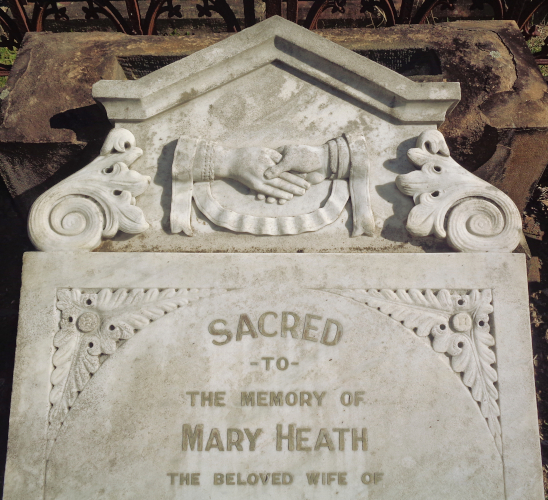
The six speakers we put together for the programme were Dr Jon Prangnell (on the archaeological excavations at the North Brisbane Burial Grounds), Dr Jennifer Harrison (on the convict-era burial grounds in Brisbane), Jess Parker (on the ‘clasped hand’ headstone motif), Dr Hilda MacLean (on South Sea Islander burial grounds near Logan), Jenny Clark (on World War memorial projects at Balmoral Cemetery), and myself talking about historical religious segregation in local cemeteries. John Pearn also spoke on the role of cemeteries in family and community life.

That first Stories in Stone conference took place in March 2024 at the RHSQ’s Commissariat Store and was a success. All 75 tickets were sold out, and the speakers went down really well. Some papers based on these presentations were featured in the February 2025 edition of RHSQ’s Queensland History Journal.

As soon as the conference ended there was immediate discussion of holding another one. This made sense, but as the RHSQ already had a full event schedule for 2025 (which is the bicentenary of convict Brisbane and the centenary of the Brisbane City Council), I looked to organise the next one independently. A ‘Stories in Stone’ committee was soon formed with Jenny Clark (Friends of Balmoral Cemetery) and also Jess Parker, both of whom had been presenters at the first conference. Wayne Dale from Nundah Cemetery was also involved in the early planning. We were able to secure the Hamilton Town Hall as a venue with the wonderful assistance of Brisbane Living Heritage.

Once again we sought Expressions of Interest from the ‘friends of cemetery’ groups but for various reasons there was little feedback. So the net was cast wider and we eventually put together this excellent line-up:

  • Kalila Matthews – Bringing Community to Life Among the Graves: Social Media Engagement, Community, and Cemetery Care
  • Lisa Herbert – A case study: the benefits of students taking part in cemetery and grave cleanups’ / Repairing the vandalism: a case study
  • Kelly Burstow – Uncovering the Layers of Cemetery History
  • Jennie Duke – Unique Information from Cemetery research
  • Lisa Herbert – The search for the missing Wolston Park patients: what happened to the cemetery and remains?
  • Rebecca Lush – Cemeteries Reimagined: Interpreting Cemeteries as Heritage Places
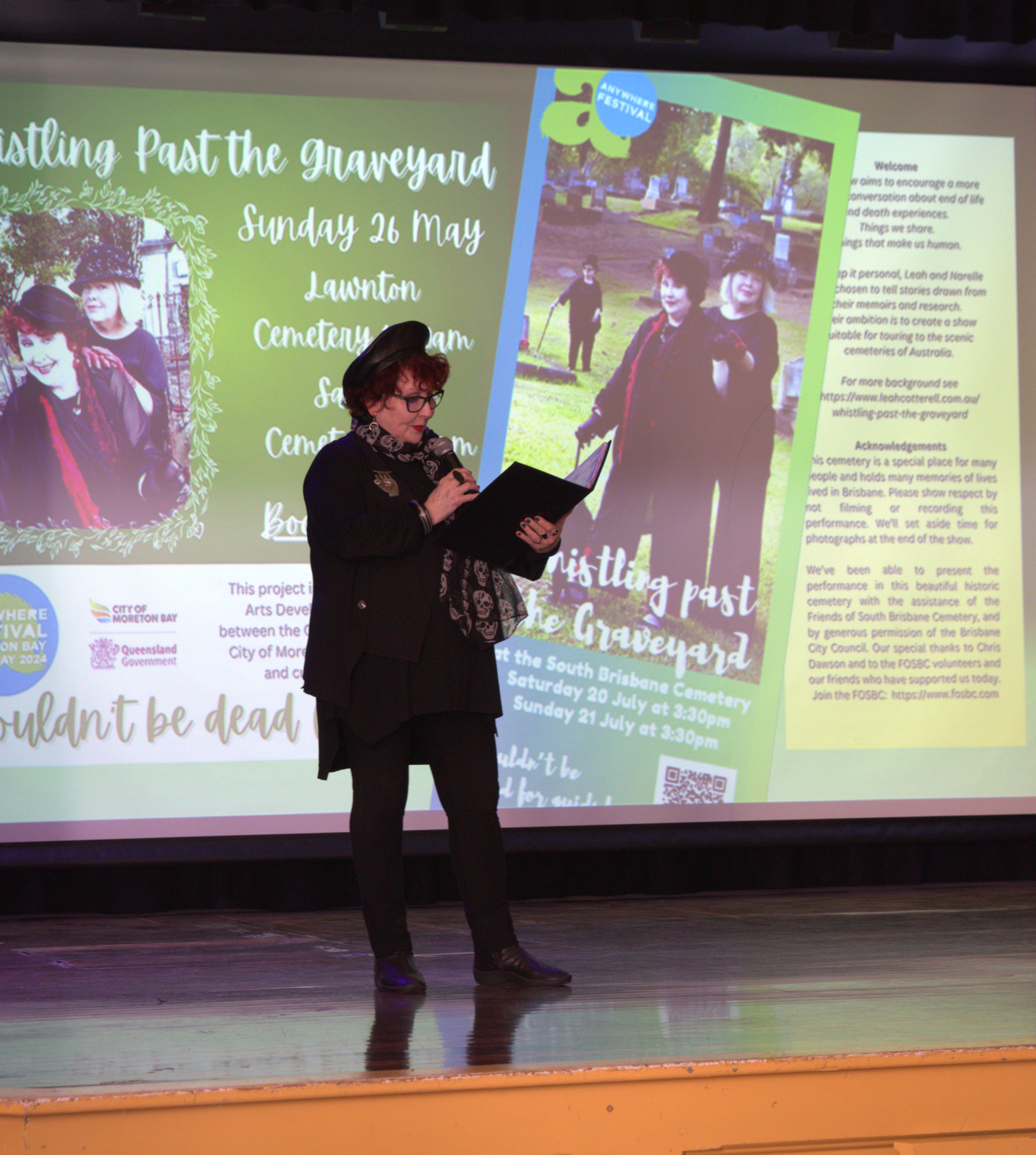
  • Dr Leah Cotterell and Narelle McCoy – Stardust, Wish Me Luck, and other stories: Live performance in cemeteries
  • Jenny Clark – Why Does the Brisbane City Council Have so Many Cemeteries?
  • Ben Kelly – Managing Our Cemeteries: The Next 100 Years

So things are going well and we are already looking to the future, hoping to establish these conferences as an annual event. When it comes to old cemeteries, there is an endless supply of subject matter to explore, be it from the perspectives of history, anthropology, heritage, sociology, the Arts, religion, administration, and urban planning, to name a few.

While there is no shortage of material, there is still the challenge of involving some of the ‘friends of’ groups in future events, mainly because of the usual issues with community group politics and personalities. But hopefully Stories in Stone will become an annual fixture and everyone will have their chance to be a part of it and help to spread the word about just how utterly fascinating and precious our historical cemeteries are.

Links for ‘Stories in Stone 2025’:

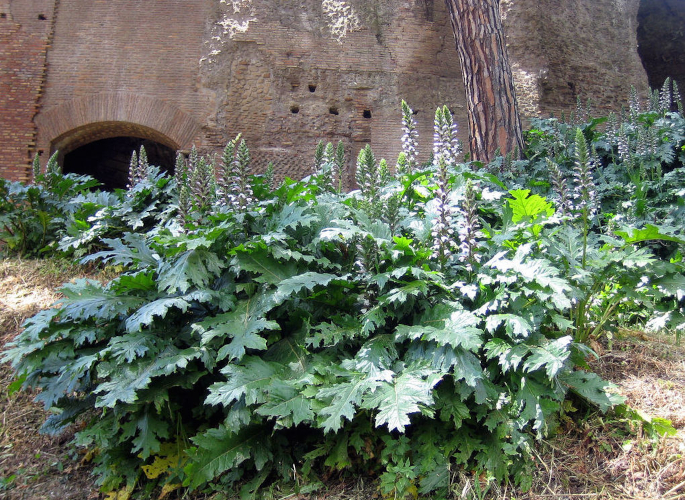
The Everywhere Plant: Why is the Acanthus so Common in Funerary and Civic Architecture?

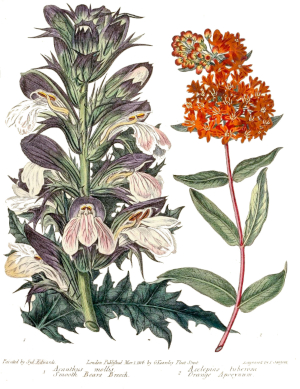
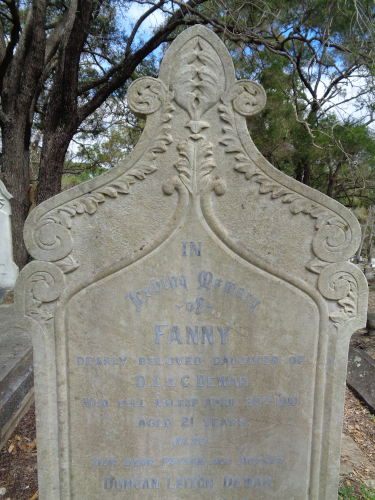
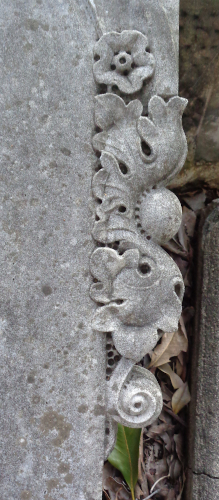
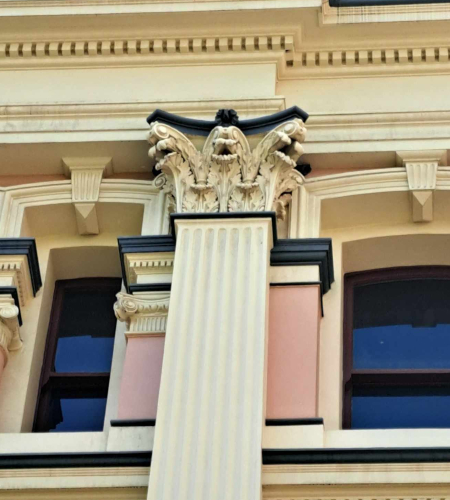
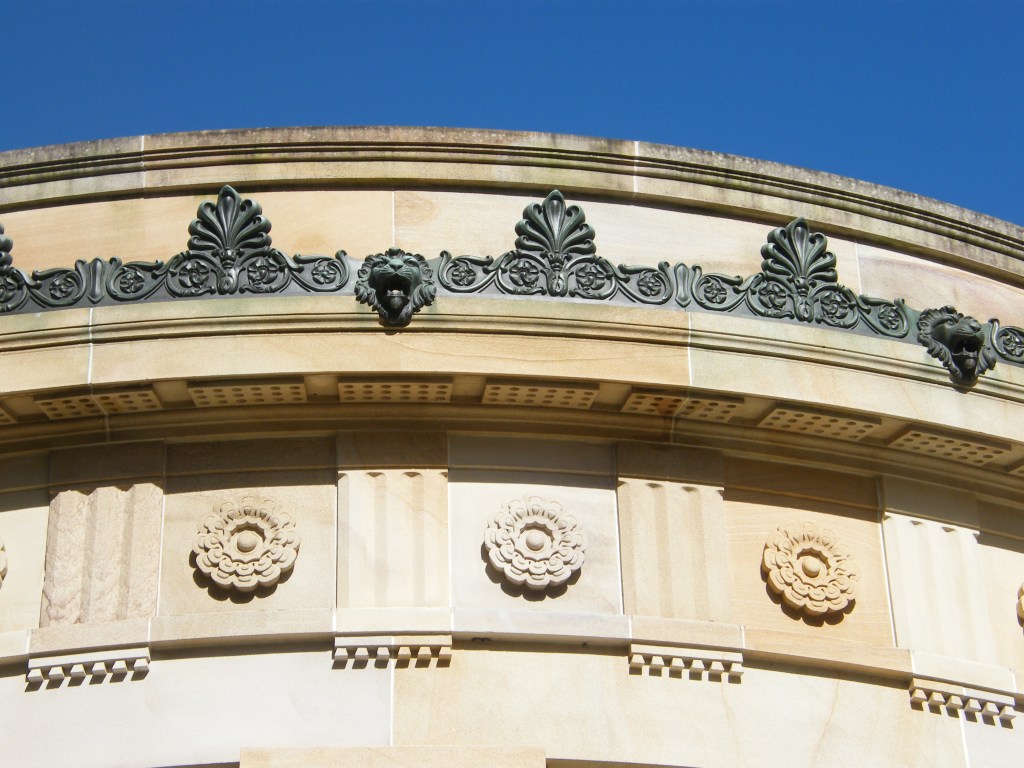
We’ve all seen them somewhere before, although most of us would not have given them a second thought. Weird, curly, slightly alien leaves carved in stone on the borders of headstones, atop classical columns, and adorning the edges of friezes. You don’t realise how ubiquitous the Acanthus mollis is in architecture until you start looking for it, then you can’t stop seeing it.

I first became aware of this plant during field surveys of cemetery symbols. Acanthus was rarely a featured motif on 19th-century headstones in its own right, unlike for example the rose and the lily, but it was used as peripheral decoration on a surprisingly large number of them. I have yet to see an example that includes the flowers.

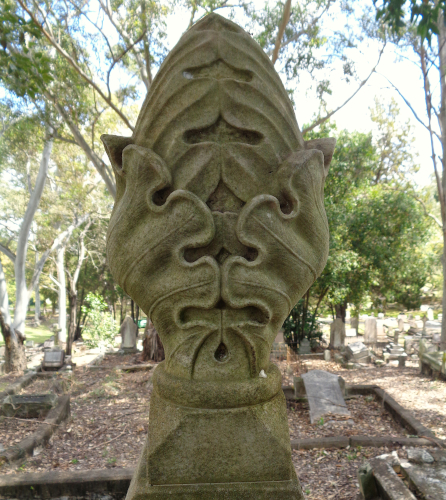
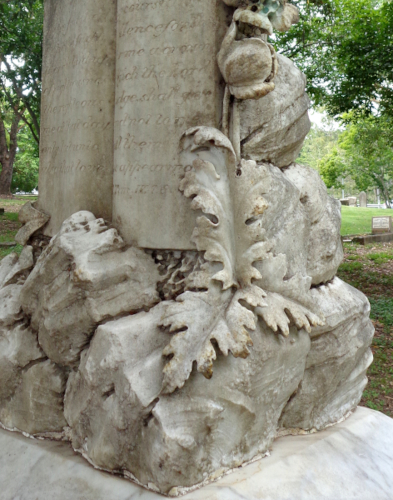
A selection of acanthus motifs to be found in the South Brisbane Cemetery are shown below. Usage varies from primary symbol to secondary ornamentation, with leaves being closed or open, and natural or stylised. As seen here, when closed acanthus leaves are carved as a stand-alone sculpture, they can look unsettlingly like the eggs from Alien!

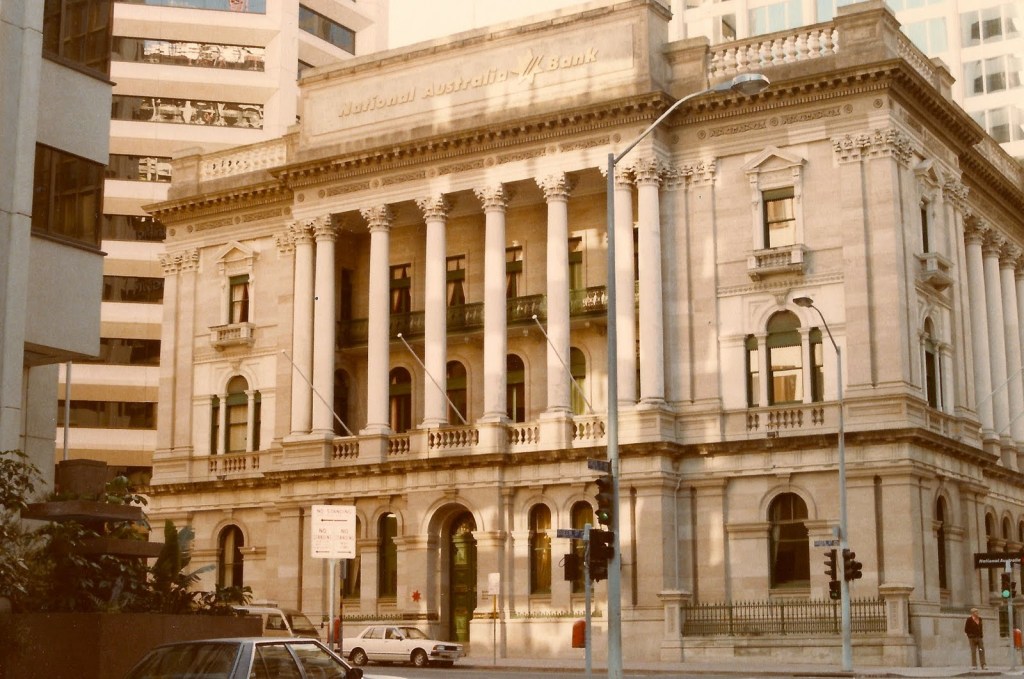
Then, during my subsequent wanderings around the Brisbane city centre, I began to notice the acanthus being used frequently elsewhere. Look up and there they are, on old city buildings, facades, columns and monuments. Their use is often discrete, but once you know what to look for, you really do start to see it everywhere.

So why is the acanthus such a common architectural feature? To begin with, a lot of Victorian-era Western architectural design was inspired by the Neo-classical movement which had developed during the 18th century and took inspiration from the symmetrical and simple forms of classical antiquity, particularly the Greeks and Romans. Advocates of this style had quite a secular philosophy and were seen by opponents as being ‘radicals and liberals’, although over time the movement became linked with Protestantism.1

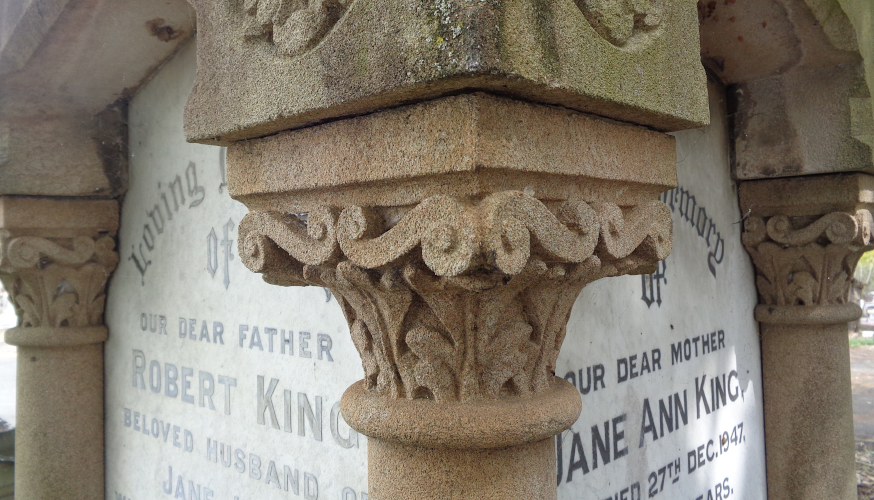
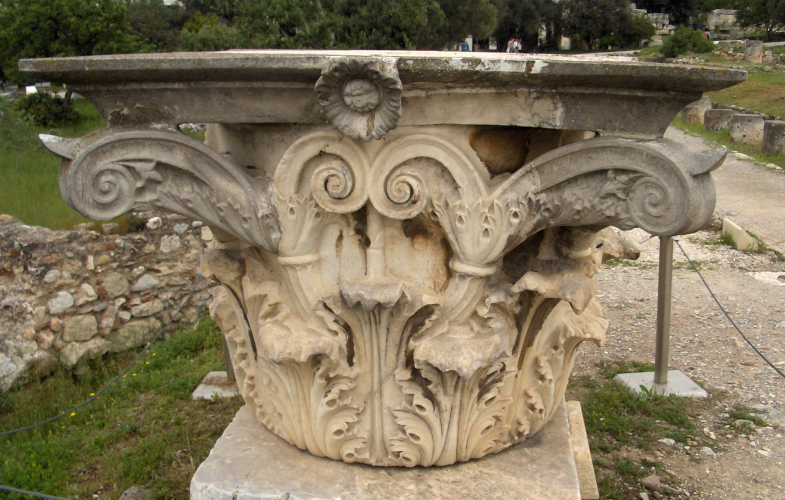
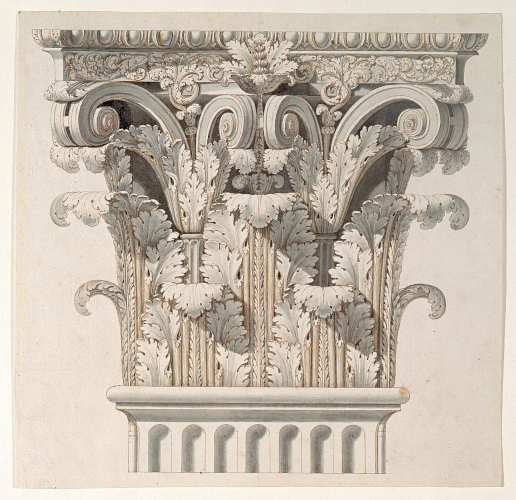
Columns were a prominent feature of the Neo-classical style, and the acanthus was often used as decoration for the tops (capitals) of these columns as it had an association with ancient Greece. It was native to the eastern and central Mediterranean, where its use as an ornamental design originated. The acanthus became one of the oldest cemetery symbols as this hardy plant could be found on the rocky ground where most ancient Greek burial grounds were located.2

In Victorian-era cemeteries, Neo-classicist markers included broken columns and symbols such as urns, willow trees, mourning women, and drapes.3 The acanthus found a home on headstones because Christians had a tendency to appropriate older pagan symbols and give them new meanings, and so it was with the acanthus, whose scalloped leaves came to represent the heavenly garden. Attributing religious meanings to random objects led us down the path where acanthus thorns symbolised ‘a difficult problem that has been solved’, specifically the struggle of the spiritual journey to heaven. Going even further, some folklore traditions claim that whoever wears the leaves or has them decorating their grave monument has overcome the sin of Adam and Eve in the Garden of Eden.

‘Thus talking hand in hand alone they pass’d
On to thir blissful Bower; it was a place
Chos’n by the sovran Planter, when he fram’d
All things to mans delightful use; the roofe
Of thickest covert was inwoven shade
Laurel and Mirtle, and what higher grew
Of firm and fragrant leaf; on either side
Acanthus, and each odorous bushie shrub

– Adam and Eve in the Garden of Eden. Excerpt from Paradise Lost: Book 4 (1674 version), by John Milton

Another factor in the widespread use of acanthus must be its versatility, with a wide variety of styles to employ, and the visual complexity of the leaves adding a touch of depth and intricacy to the carvings. As seen on Corinthian capitals, this can be a quite grand effect.

All this is why the acanthus became so ubiquitous in 19th-century Western funerary and civic architectural design. So the next time you’re in an old cemetery or the streets of a city, have a look around or up and see if you can spot its curly ancient leaves.

Footnotes

  1. These ‘opponents’ were advocates of the ‘Gothic Revival’ which emerged in the 1740s and was influenced by medieval architectural forms such as arches, steep gables and heavy decoration with a religious element. Its proponents had a generally conservative outlook and associated more with Catholicism. ↩︎
  2. The plant was introduced to Australia in the 19th century, where it is classed as a weed. ↩︎
  3. Obelisks were also very popular at this time, as you will notice in most old cemeteries, but they had classical roots in Ancient Egypt, which is a story for another day. ↩︎

How Many ‘North Brisbane Burial Grounds’ Were There?

This article is a reminder of why the mindful use of historical placenames matters.

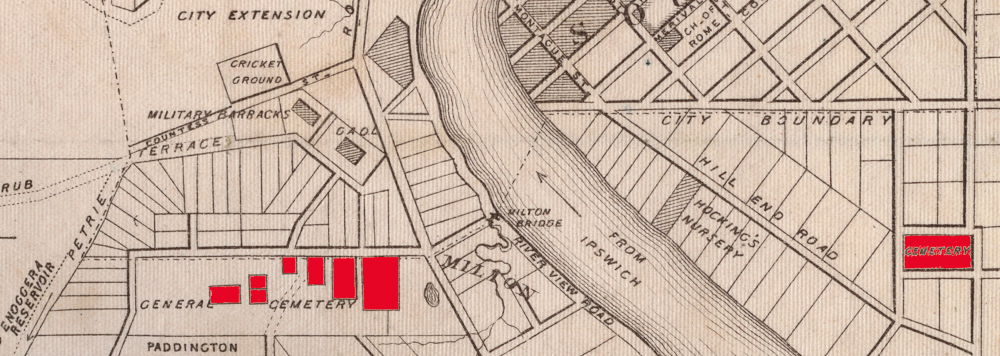
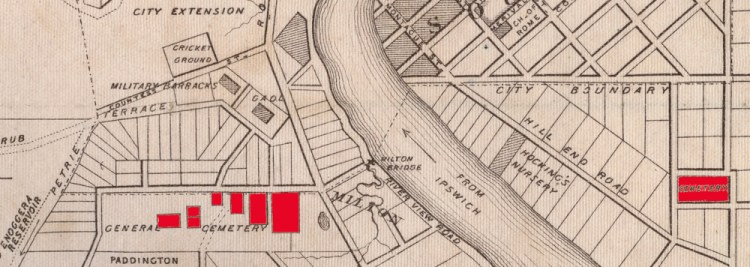
The former convict settlement of Brisbane became a free town in 1842, and during the following year two burial ground reserves were set aside there. The one in South Brisbane was a rectangular five-acre block split into seven separate denominational sections, named as Episcopalian (Church of England); Independent (Congregationalist); Jewish; Presbyterian; Roman Catholic; Wesleyan; and Aboriginal. No trustees were ever appointed to manage this reserve, and it appears to have never been used.

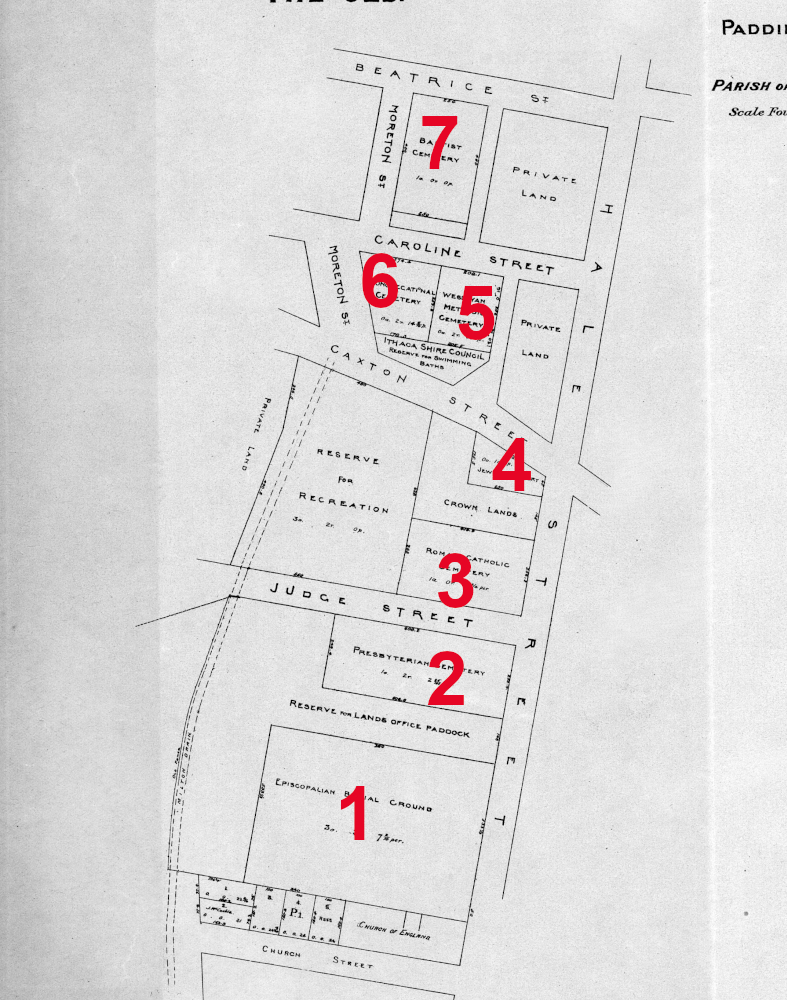
It was a different story on the northside. A reserve in what is now Milton also held seven sections allocated to the same denominations, and of a similar size to those on the southside, but these were spread over a 50-acre site, probably due to uneven terrain caused by creeks and hollows. Estimates of the number of people interred within there before its eventual closure in 1875 range from 5,000-10,000.

This place was variously known as the North Brisbane Cemetery or Burial Grounds, the Paddington Cemetery, or the Milton Cemetery. Recently, however, I have seen references to this cemetery as the ‘Seven North Brisbane Burial Grounds’, a name no doubt meant to reflect that the cemetery started life with seven separate sections and closed with seven.

I think it is important to avoid the use of this numerical nomenclature. Why? Because changes inside the cemetery reserve over time meant that there were actually EIGHT separate burial grounds at the site during 1843-75. The one that the ‘Seven’ name would exclude is the one that was no longer there when the reserve closed in 1875 – the Aboriginal burial ground, which was closed around 1862, around the time that a new Baptist section opened. The story behind the original existence of that burial ground and its subsequent closure is emblematic of early First Nations/European history in Meanjin/Brisbane.

The location of the northern and southern burial grounds in Brisbane. Slater’s Pocket Map, 1865.

The allocation of cemetery space reflects changing local demographics. In 1843 the dominant religious communities of Anglicans, Catholics and Presbyterians were granted an acre each in the north and south Brisbane reserves, while the Jewish, Congregationalists, Wesleyans and First Nations people received half an acre each.

First Nations people being given the same amount of space as these other communities demonstrates their strong presence in the local population in the 1840s. Having said that, burial within cemeteries was not standard practice within their culture (there were of course many different funerary practices across the First Nations of Australia, and that is another subject for another day).

I do not know how many times the ‘Aboriginal burial ground’ was used, and the historical use of that place would make an interesting research subject. There would certainly have been a lack of marked graves in that section, as headstones were an alien concept for First Nations people, and also rather expensive to provide. They received no obituaries or funeral reports in the press of the day, although some of those executed in Brisbane during the 1850s were sometimes described as being buried in the ‘bush’ outside the cemetery fences. This probably means the unconsecrated ground between the sections – but could it also refer to the Aboriginal burial ground itself?

The experience of First Nations people laid to rest the new South Brisbane Cemetery that opened in 1870 suggests that this anonymous funerary treatment continued for a few more decades at least. They were interred in ‘public graves’, which were used for people who could not afford a private grave plot, or who had no family or friends on hand to organise the purchase of one. These public graves had no markers, and deceased First Nations people were usually entered in the late-19th-century cemetery register under a single Anglo moniker such as ‘Billy’ or ‘Mary’. However, it is at least possible to trace the graves of these people.

The denominational divisions in the cemetery changed in the early 1860s as local demographics evolved. The late historian Rod Fisher suggested that the ‘dwindling number’ of First Nations people in Brisbane by the 1860s ‘cannot have warranted a separate cemetery’. This would appear to be a reasonable deduction, as the Aboriginal burial section was closed and absorbed into the extended Church of England grounds around 1862. A new Baptist section was added to the north of the reserve at this time, and the Presbyterian grounds were also expanded. This is an example of how changing demographics affect burial space allocation, as a major contingent of Presbyterians had arrived in Queensland in the late 1840s as part of John Dunmore Lang’s immigration scheme. Similarly, Baptists first arrived in Brisbane about 1851 and their first local church was built in 1859. The Primitive Methodists also applied for their own burial section at this time, but this request was refused and a new general section for all denominations was approved instead, although that addition never eventuated.

So these changes were all symptomatic of the displacement of local First Nations people from their country, and the concurrent growth of the European immigrant population. As we have seen, the Aboriginal section existed as one of EIGHT different burial grounds at the North Brisbane reserve during 1843-73. Any insistence on retroactively renaming that reserve as the ‘SEVEN North Brisbane Burial Grounds’ only serves to erase another piece of local First Nations history.

In History, place names matter.

Some more reading:

‘A Lang Park mystery: Analysis of remains from a 19th century burial in Brisbane, Queensland.’ M Haslam, J Prangnell, L Kirkwood, A McKeough, A Murphy, TH Loy. Australian Archaeology, no. 56, 2003.

Rod Fisher, ‘That controversial cemetery: The North Brisbane burial grounds 1843-75 and beyond.’ In R Fisher and B Shaw (eds) Brisbane: Cemeteries as Sources. Brisbane History Group Papers no. 13, 1994, pp. 35-52.

Is This the Lady in Black… or Something Else?

I’m one of the guides on Queensland Cemetery History Tours, and every once in a while someone who has been on one of the tours sends us a photo or two that feature seemingly unusual objects with the suggestion that these might be paranormal in origin. Usually these are ‘orbs’ or shadowy figures or strangle lights. Being something of a skeptic, I usually dismiss these images with the usual explanations – dust particles, headstone staining, shadows, reflections, or pareidolia (the tendency to perceive meaningful images in random patterns, such as in clouds).

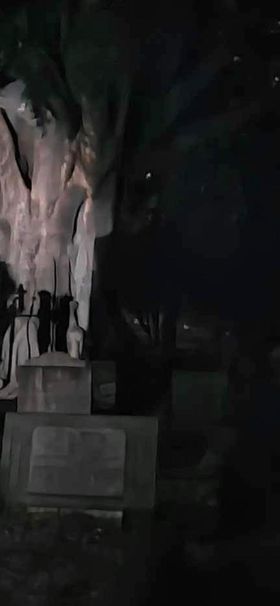
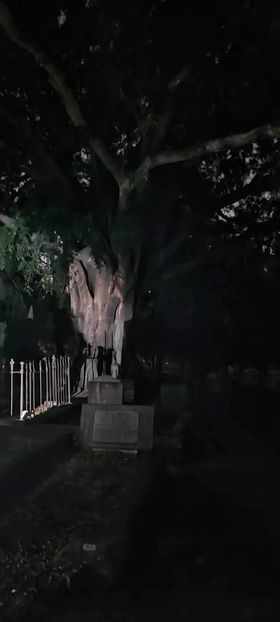
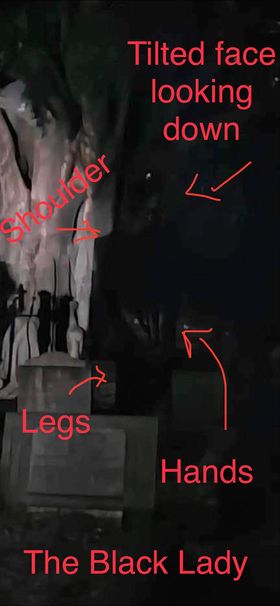
So, I was recently sent an image taken during a South Brisbane Cemetery night tour (the ‘Haunts of Brisbane‘ tour with Liam Baker) that the sender suggested might be the ‘Lady in Black’ ghost. Not too seriously, but she had noticed something odd in the photo, and then kindly labelled it, too. I straightaway assumed it must be a case of pareidolia, the kind I’ve seen dozens of times before on numerous ‘paranormal investigator’ websites. On closer examination, however, this was a particularly striking example. It was actually quite creepy, and one that I just had to investigate for myself.

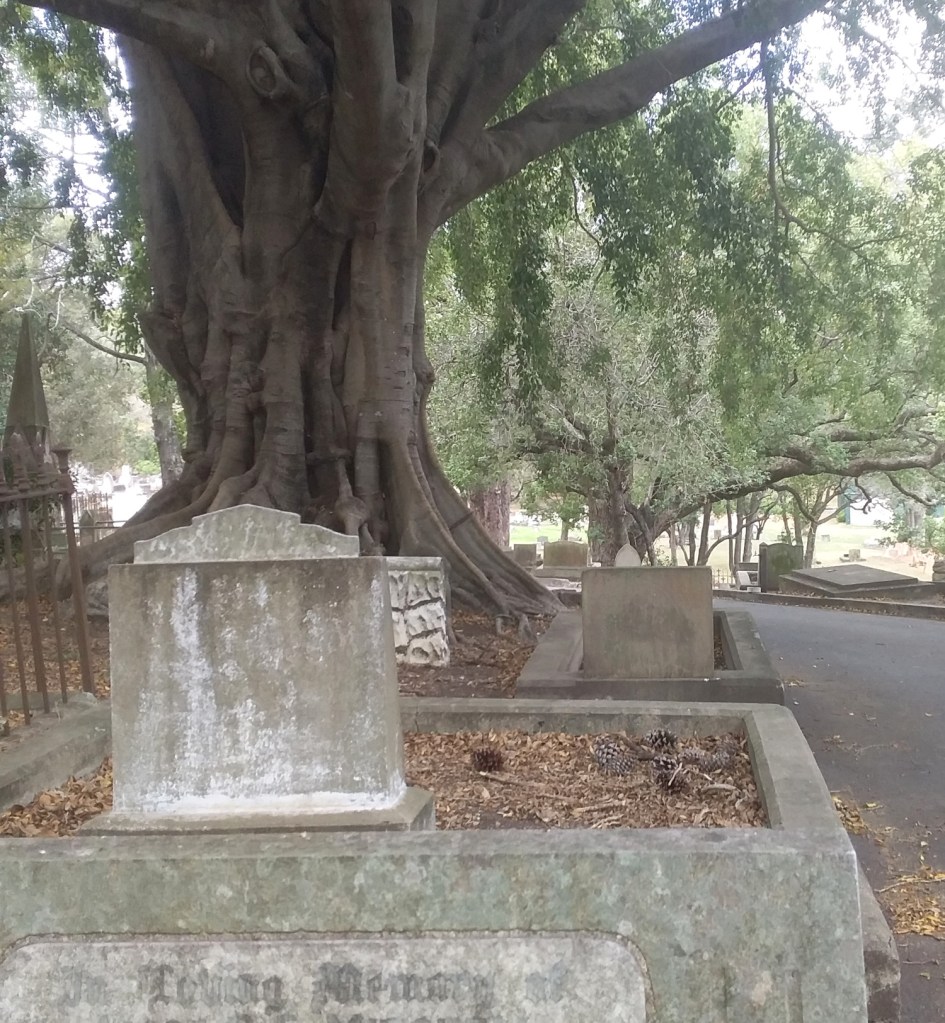
The ‘ghost’ can be seen in the following sequence of photos:

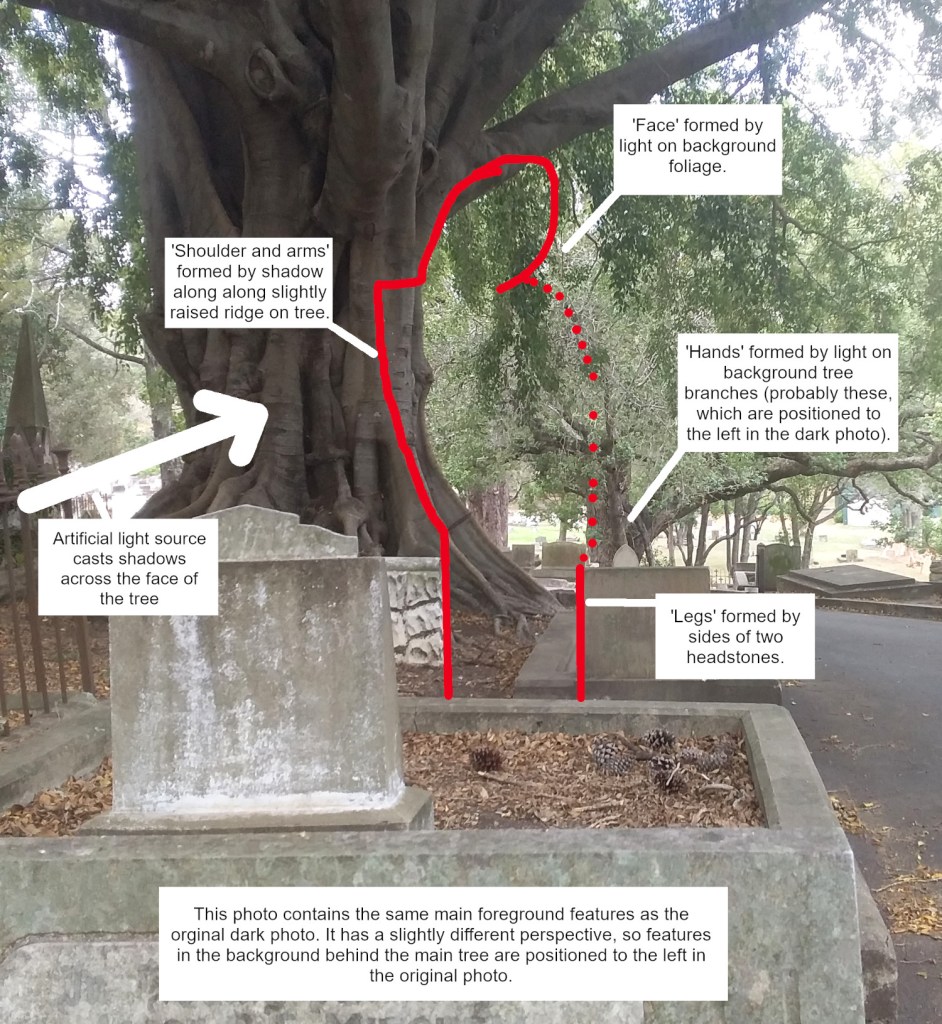
After working out where the original photo was taken, I took a few snaps of my own, trying to approximately reproduce the perspective of the first night picture, but now in daytime. Then I sat down and compared and contrasted the dark and light images, and the answer gradually emerged. This ‘human figure’ was formed via a combination of bright torchlight being cast across the surface of a large tree with a surface of ridges and hollows; shadows between headstones; and partly-lit background foliage and tree branches. The labelled photo below explains how it happened.

So, no Lady in Black this time, but it is nevertheless a very nice example of the phenomenon of pareidolia. I can guarantee you that if this image had been sent to almost any one of the ‘paranormal investigator’ pages online it would have been heralded as a ghost photo and splashed across the internet, and then the cemetery would have been swarming with people play-acting as ghost-hunters. I still half-expect the photo to be lifted from this page and re-presented without explanation anyway. It’s how these people operate, unfortunately. But this is basic stuff that any real researcher with integrity would be able to explain with several minutes of investigation.

Anyway, I thought this was a really interesting case of pareidolia to look into, it’s always fun trying to work these things out.

The 50th Guardian Angels Day

Guardian Angels, South Brisbane Cemetery, circa 2019. (FOSBC)

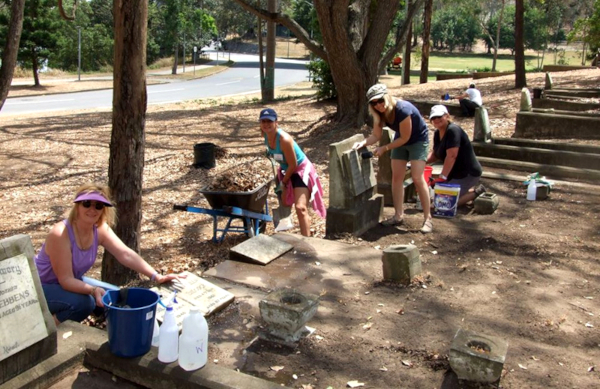
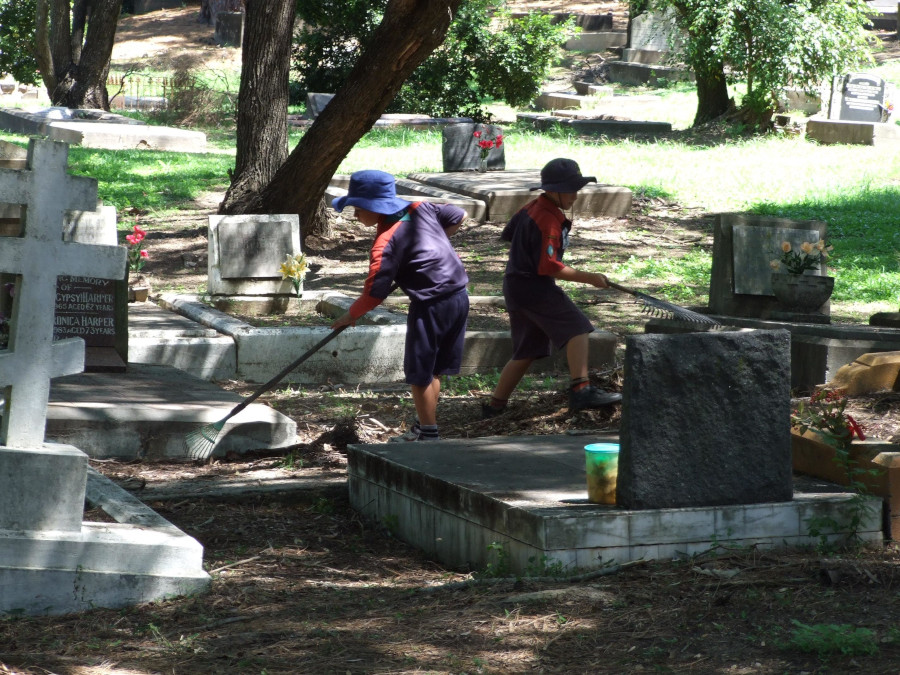
Something rather strange happens in the South Brisbane Cemetery several times each year. Volunteers arrive from all directions, some from just up the road and others from as far as Logan, the Sunshine Coast, the Gold Coast, Woodford, Beenleigh and Ipswich. They happily wash the grime off headstones, clear away leaves and soil from the surfaces of concrete-topped graves, rake and sweep pathways, pick up litter, remove weeds, and fill skips with tree debris.[i] This is the Friends of South Brisbane Cemetery’s ‘Guardian Angels’ community cleaning bee. These have been happening for five years and in September 2023 we will hold our 50th such event.

See a Guardian Angels gallery here.

There is a strong 21st-century tradition of community care of the cemetery. The three women of the original FOSBC did a hell of a lot of work here after 2005, and there have been Clean Up Australia Days since 2009, and also two big post-flood clean-ups in 2011.

The Guardian Angels programme commenced in 2018, shortly after the incorporation of the FOSBC. We did a ‘Clean Up Australia Day’ in the cemetery in March of that year and I thought, ‘why not do this more regularly than just once a year?’ It gets new people involved, keeps existing volunteers engaged, and does a lot of good for the place itself. So the notion of a monthly cleaning bee – branded as the ‘Guardian Angels’ after the statuary of the cemetery – was born. In terms of attracting new members, it has been crucial to the success of the FOSBC.

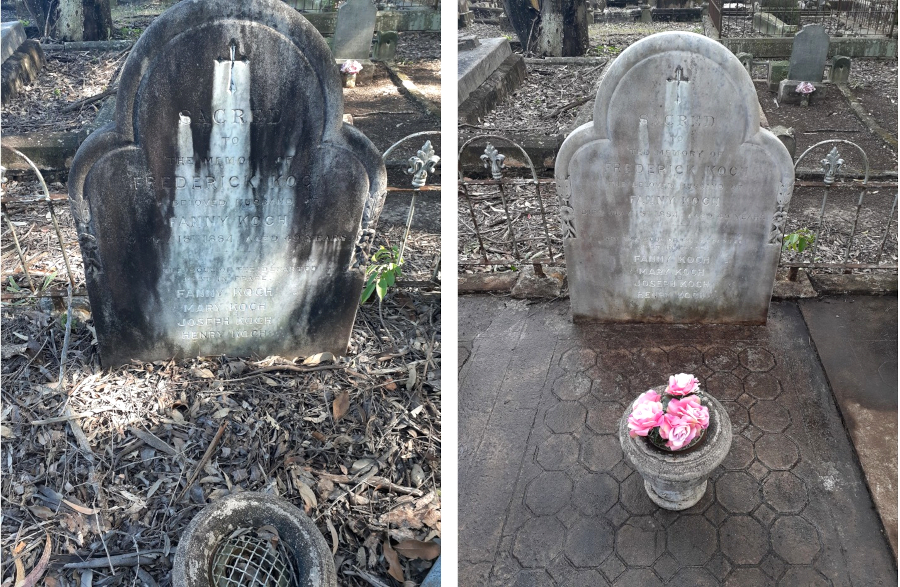
Reaching 50 cleaning bees is quite an achievement for what is, after all, unpaid physical labour. There are, however, several positive qualities that have made it work. The setting of the 153-year-old historical cemetery is beautiful and serene, surrounded as we are by heritage and nature. Attendance is low-pressure (come when you want, leave when you want), the mood is always light and friendly, and friendships among the volunteers have developed over time. Another secret ingredient is the pleasure gained from the work. The reaction I hear most frequently from volunteers is the real sense of satisfaction as they see grime fall away when the stone is rinsed with water after a careful scrubbing, or once-obscured inscriptions coming to light, or when a headstone hidden for years by layers of leaves and soil is unearthed. The enthusiastic taking of before-and-after photos show a job well done. Some people also like to research the story of the resident of the grave, thereby forming a little bond with them.

My reputation as a spreadsheet obsessive is occasionally useful, and I have recorded attendance for every Guardian Angels day. The earliest records are a bit vague as to some names, but I do know that the events have attracted over 1,350 attendees over the last five years, with quite a few volunteers coming over 20 or 30 times each. All in all, there would have been around 500 individual people coming along at least once.

Different people have their own cleaning preferences. Some (like me) tend to focus on cleaning the stones, while others like to do a more thorough job and also clean the graves surrounds, and maybe the adjacent pathway.[ii] Some volunteers will just concentrate on the paths. We have people who like to drive around and collect tree debris for the skip. Others like to do a spot of weeding or gardening, litter collection, or (safely) relocating fallen stones to a better position. Some like to post their results to social media. Then there is the job of setting up the kitchen area with drinks and nibbles. We can also, with a written request from the relevant grave owners, repaint the lettering on granite headstones to a professional standard. The combined results of all this work can be inspiring.

A typical ‘before and after’ result from one of the Guardian Angel days (FOSBC).

It is always a nice moment whenever a cemetery visitor lets us know how much better the place is looking now, and there have been numerous other highlights over the years:

  • We got the place looking spick and span for the 150th anniversary commemorations (thanks also to the Brisbane City Council),
  • Seeing young people, including school groups, enjoying the work and developing an interest in the cemetery,
  • Seeing regular attendees develop friendships,
  • Returning to work – with social distancing – after the Covid lockdowns,
  • Having regulars help with our comprehensive ‘State of the Cemetery’ Report earlier this year,
  • Having about 180 members of the Centenary Stake Youth, Church of Latter-Day Saints, turn up for what must be the biggest cemetery cleaning bee in Australian history (including the 20 other volunteers supervising that day), photo of this
  • Our successful lobbying for new benches and gardens in the cemetery,
  • A story about the Guardian Angels on the ABC news,
  • The involvement of the wonderful and very active people from the Brisbane geocaching community this year,
  • Sometimes, at the end of a long day when everything has been packed away, revisiting the section that has just been cleaned and just taking in how much better it looks thanks to the work of the volunteers.
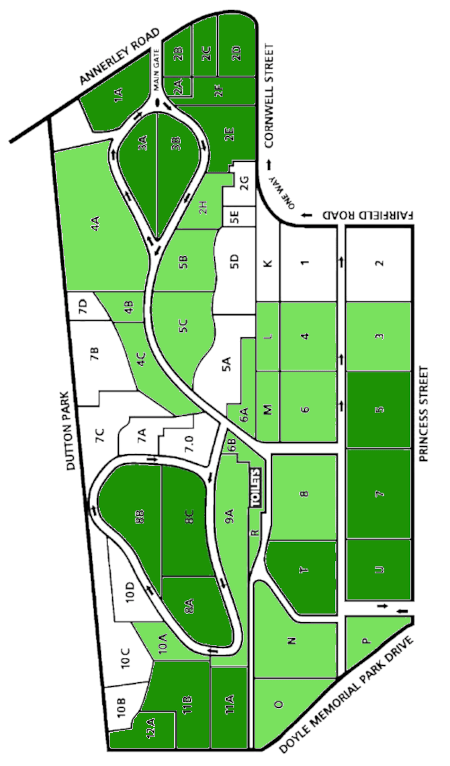
Map of how much of the cemetery that has been cleaned so far (approximately) on the FOSBC cleaning bees. Dark green: Completed. Light green: Partially completed.

There are, of course, costs associated with all this work, including equipment for cleaning, storage and catering, and sometimes advertising. Most of this is funded by our guided tours, volunteer donations of equipment, and the occasional grant. So if you have any old wheelbarrows, rakes, heavy shelving, bookcases, etc., we might be able to find a useful place for them at the cemetery. We should also thank the BCC for allowing us access to the shed and facilities in the cemetery, which makes it so much easier to run these events.

In writing this, I’d like to thank each and every person who has been a Guardian Angel over the years. It has been a lot of work and there is still much to be done in the parts of the cemetery we haven’t reached yet, but together we have made some good memories and a big, big difference.

(The 50th Guardian Angels takes place on Saturday 2 September, and all are welcome. The Facebook event page can be seen here.)


[i] The Brisbane City Council are responsible for infrastructure maintenance, and outsource tasks such as grass and weed management, but do not attend to paths or individual grave maintenance.

[ii] It should be noted that we do not aim to restore graves to their original shining splendour. We just wash away what surface grime we can but the stones still retain their ‘aged’ and historical appearance, as befits a cemetery of this age.

Colonial Columns: Woogaroo Lunatic Asylum (1869)

Above: Goodna Hospital for the Insane (formerly Woogaroo Asylum), 1919. (State Library of Qld)

This article about the ‘Woogaroo Lunatic Asylum’ was written back in 1869. The asylum was established at Goodna in 1865, which back then was an isolated site between Brisbane and Ipswich. Prior to this time, mentally-ill people in the region had been held in Brisbane Gaol.

The facility is now known as Wolston Park Hospital, and originally known as Woogaroo Asylum. You can read more about the history of the place here.

Brisbane Courier, 26 November 1869

‘THE WOOGAROO LUNATIC ASYLUM.

Perhaps the saddest and most painful scenes it is possible to witness anywhere are to be found within the walls of a madhouse, and the man or woman who could visit an institution of this kind without being affected by the sights to be seen, must possess an unenviable strength of nerve and indifference to human suffering.

Eastern travellers report that the Turks and Arabs treat the insane with marked consideration and respect under the belief that they are divinely inspired, and it is not difficult to conceive how such a belief originated amongst an ignorant, devout, and imaginative race with respect to such a mysterious, peculiar, and terrible visitation. To see a number of fellow creatures, most of whom seem to be in the possession of robust health and all their faculties with the exception of that crowning one – reason, – to listen to their strange weird talks and observe their conduct, arouses feelings of awe and dread, of pity and commiseration, of deep humility and self abasement, which are never experienced in the same force under any other circumstances. It is a painful task to witness such a scene, and very few persons ever think of undertaking it except from a sense of duty in some shape.

This, in all probability, is the chief reason why the Woogaroo Lunatic Asylum was allowed to become such an accumulation of unutterable horrors before any effectual steps were taken to reform the abuses which had crept in. The only visitors were officials of one kind or other, who, as a matter of routine duty went through the form of an inspection at stated times, and hurried away as soon as possible from the disagreeable scene. The public left the management to the Government and the officials appointed by them, and were content to accept the word of these people that everything was being done which could be done for the unfortunate inmates until at last the horrible truth leaked out that nothing, absolutely nothing was being done for them except locking them up in a foul den out of sight, and leaving them there to their own fearful devices, until the place became more like a pandemonium than a habítation of human beings.

Of course it was never the deliberate intention of any Colonial Secretary or other official person that the Asylum should become such a den of horrors. Nobody was, or pretended to be, more shocked than these same officials, when the truth was at last revealed by a searching enquiry, but that miserable parsimony which was eternally be grudging any outlay or expense in connection with the institution, while hundreds of thousands of pounds were being recklessly squandered in other directions the ignorant apathy of the public and the apparent want of sufficient firmness and decision of character on the part, of those entrusted with the management, produced the result just as certainly as though it had been a carefully devised scheme from the first.

With the present Acting Surgeon Superintendent in charge, and after the public exposure which has taken place it is hardly likely that the Asylum will be allowed to again fall into such a state as it was found to be at the commencement of the present year, but the only sure mode of preventing this is, for the public to keep a vigilant watch over the institution, and make sure that it is not being neglected. The most devoted and energetic of surgeon superintendents is apt to lose heart in time if he finds himself left single handed to battle with all kinds of obstacles, and the present Government seem just as much wedded to the “penny wise and pound foolish” policy as were any of their predecessors. An over active zeal for economy by saving the ‘pickings’ is, unless checked, almost certain to result in the striking off of necessaries, where it can be done with impunity, rather than superfluities, which are likely to be resisted. The present Government, like all previous ones we have had in this colony, are exceedingly pacific, not to say pusillanimous and their action is influenced in a great measure by the probabilities of meeting with active resistance from any quarter – not by any simple rule of right. If the Woogaroo Lunatic Asylum is made what it ought to be and can be made, – a clean, comfortable, and healthy retreat where the insane can be treated under the condition most favorable to their recovery – it will be because the Government are urged on to make it so by the pressure of public opinion not from any voluntary action on their part.

At present the asylum is very far from being what it ought to be and already there are symptoms of peddling make-shift expedients being advocated by the Government rather than a thorough and sweeping reform-such as is needed. We paid a visit to the asylum a few days ago for the purpose of seeing what had actually been done and what was proposed to be done for the purpose of rendering the place more endurable and a more fitting hospital for the treatment of the insane. We dropped in quite unexpectedly in the afternoon, and were received very cordially by the Acting Surgeon Superintendent, Dr Challinor, and shown over every part of the buildings and grounds. The Doctor seems to take a real pleasure in pointing out what has been done, what he intends doing, and what he hopes to be able to do in the way of improvements and reforms, and he is justified in feeling a little proud of his work so far. He, at all events appears to be the right man in the right place at Woogaroo. He has evidently entered upon his duties con amore and made the treatment and care of the insane an absorbing study, to which he brings that genuine kindness of heart singleness of aim, and persistent tenacity of purpose which rendered him such an intractable politician. He also seems to have a good first lieutenant in the present chief warder Mr Jessie, who in addition to his experience as a warder in the Melbourne Lunatic Asylum, evidently possesses the qualities of kindness decision of character, love of order, and administrative faculty, so requisite in an officer of this kind. The Doctor and Mr Jessie have already effected many and great improvements, as may be seen at once by anyone visiting the place – but having, as it were, to begin with chaos, the distance from thence to perfect order is very great, and the Government are beginning to dis cover that it is also very expensive to traverse.

They have not as yet gone the length of decidedly refusing to carry out the reforms to the desired consummation which hare been commenced, but they are not showing that alacrity which the necessities of the case require, and the public will demand. The male wards are fearfully overcrowded, and although the number of patients keeps increasing, we could not see or ascertain that any provision whatever was being made, or in contemplation for providing increased accommodation for them. The building itself was not originally intended for occupation by patients and therefore can never be made a very commodious and well arranged asylum.

Still a great deal could be done to improve the accommodation at present provided. In the first place, the over crowding could and ought to be provided against without a single day’s unnecessary delay. The building is a brick two story one, and the upper floor rooms are used as dormitories. These are in process of being made as comfort able as circumstances will permit. The ghastly white walls are being colored to a warm cheerful tint, and the patients are provided with clean sheets, pillow cases, and coverlets to their beds, in addition to the blankets, or fragments of blankets, which before time were their only bed clothing. But the beds themselves are so thickly placed, that it is difficult to walk between them. The occupant of one bed can, by merely stretching out his arm, reach over to the middle of the bed occupied by his neighbor on either side, and even in the daytime, when all the rooms were unoccupied, as they were at the time of our visit, those rooms in which the windows were closed to keep out the rain, had a close and sickly smell. When every bed is occupied, and the door closed, during a hot summer’s night, the atmosphere must be terribly oppressive and injurious to health, not to speak of comfort.

The dormitories, four on each side, if our memory serves us correctly, are divided by a narrow corridor. Each room is crowded with beds in the manner described, some containing as many as fifteen, and there is no means of separating the noisy from the quiet patients. A sane man of nervous and exciteable temperament, doomed to pass a week in such a place, would inevitably become as mad as the maddest of his fellow denizens.

The warders an no better provided for than the patients. The chief warder, his wife and family, seven in all, occupy, and are obliged to reside, in a couple of rooms at the end of a range of wooden buildings near and at right angles to the main entrance. The remainder of the building is used as doctor’s office, chief warder’s office, storeroom, &.c. By taking a portion of the storeroom, the chief Warder has been able to add a small sleeping room to his quarters, and, by close packing, he and his family can now manage to sleep in the place. But the door is close to the refractory yard on the one side, and the hospital on the other, every word uttered in these places – and the language is sometimes horrible, is heard by the chief warder’s wife and children, even when the door is closed, and there is no back yard accommodation whatever.

Another range of wooden buildings, running parallel to those already mentioned, forms the kitchen for the men, and a miserable little room at the end is made to accommodate four warders. The size of the beds and their closeness together reminds one of the ‘tween decks of an immigrant ship more than anything else, and the proximity to the kitchen, being only divided by a wooden partition, must render the room particularly lively at night with one kind of vermin or other. The rest of the warders are accommodated in the same luxurious style inside the main building. The ground floor of the main building consists of hospital day rooms for patients, warders’ day room, and dormitory for dirty patients. At present there are only eight patients required to be placed in this ward.

Under the old regime, patients were left to please themselves as to how they went to bed, and the result was that some from perversity, others from paucity of bedclothes or the like, went to bed without undressing. The majority of the patients did so, and some even carried the thing so far as to go to bed in their hats, as well as coats and boots. Now that clean sheets, pillows and pillow cases, blankets and coverlets have been provided for the beds, the doctor has had shelves put up on the corridor wall, at the entrance to each dormitory, and the patients are all obliged to undress and have their clothes placed on the shelf until morning. The poor unfortunates not only understand and duly appreciate the change, but already there is a marked alteration for the better in their habits. Cases of dirtiness are becoming less frequent, and men who would never rise to satisfy the call of nature have latterly been known, during an attack of diarrhoea, to get up four times in a single night. A few of Mr Tiffin’s self acting earth closets have been supplied to the institution on trial, and are found to answer admirably. The presence of these in the rooms no doubt has added to the gratifying result. The sooner a full supply of these for every ward is provided, the better it will be.

The old hospital, a miserable little shed quite unfitted for the purpose, has now been converted into a bath and lavatory, where a certain number of the patients are once a week provided with a very comfortable plunge bath, with ample supply of soap and water, and can get an extra swill from a shower bath to wash the soap off after. Indeed baths and lavatories have now been fitted up in every ward, and in addition to a force pump, which provides a supply of water from tho creek, a new under-ground tank has just been constructed, capable of containing 32,000 gallons, to store the rain-water from the roof of the buildings, so that an ample supply of water will be provided.

The present hospital consists of three adjoining rooms at the main entrance to the building on the left hand side, they have just been conveniently furnished with half tester iron bedsteads, which are to be provided with mosquito curtains (!) in addition to the sheets, coverlets, and other luxuries of modern date. The third room is darkened, and is appropriated to the use of the patients who are suffering from ophthalmia. The hospital might be rendered very comfortable by opening a door from the first room into the yard at the back, called No. 1 yard, which cannot be used now, and erecting a verandah over a recess in the building at the part near the door. It is doubtful whether this will be done without some pressure is brought to bear in the proper quarter, the objection being the expense. The extra space and greater comfort, however, that would be thereby provided, fully justifies the outlay, which, after all, would not be considerable.

The day rooms for the patients are at the opposite end of the building to the main entrance, and open into a yard called No 2 yard. Originally this was a small place enclosed with a tall hardwood fence, which completely shut out everything except a view of the sky above. The cross fence has been removed, and the yard extended nearly to the river, so that now the poor fellows can obtain a view of the river and a portion of the surrounding country, as well as having more space for exercise, and a much better supply of fresh air. The yard is not so complete as it might be made, as it is still only provided with the old fashioned privies, the wells of which are now full to overflowing. There are half a dozen new earth closets standing in the shed of No 1 yard, apparently for the purpose of supplying the place of these privies, but they have not been put up as yet, although they have been there some time.

To the right of the main entrance is the refractory ward and yard called No 3 yard. This yard, which used to be a mud hole in wet weather, has been gravelled and made comfortable, and on the further side a lavatory, bath, and shower-bath have been provided. The tank over the bath room is capable of containing 1400 gallons of water, and once a week the refractaries are stripped to the skin and thoroughly cleansed with soap and water in the plunge bath, and finished off in the shower bath. The latter is constructed to only discharge a very small body of water, and as the operation is performed in the afternoon the water in the tank above is generally tepid, and therefore not disagreeable. The only room in the building remaining to be mentioned is the warder’s day and dining room. A list is kept in this room of every patient in the hospital, and each warder has to enter a return on this list three times each day – morning, noon, and night, of every man under his charge.

All the rooms are kept scrupulously clean, the men are supplied with clean clothes, and the beds with clean sheets and pillow-cases once a week, and clean blankets, coverlets, and bed-ticks as frequently as occasion requires. How this is managed is a mystery that we shall not attempt to fathom, but we were assured that it was done, although the laundry is only supplied with two ten gallon coppers – the Government being such rigid economists. Mr. Hodgson, in the first burst of public indignation on the discovery of the state of the asylum, took it upon himself to order a recreation ground of about four acres in extent to be fenced in; this has been done, and an admirable improvement it is for the the men can and do make holiday here every Saturday, playing cricket, quoites and a number of games, to their evident gratification and permanent benefit. But there is no shady place for them to retire to except a temporary shelter contrived by the chief warder with some fragments of Osnaburg cloth-utterly inadequate for the purpose. And, what is worse, the laundry is within the fence, and the women employed are therefore subjected to some annoyance from the male patients when admitted to the recreation ground. The other available amusements for the patients are cards, draughts, dominoes, and bagatelle, most of which are impossible for want of sufficient room to play in without interruption. Mr Hodgson, before leaving, presented the Asylum with a very handsome and costly bagatelle board, his private property, but the Doctor is obliged to keep it packed up in his store, because there is no room in which it could be set up for play.

The kitchen for this division of the Asylum is large, and seems to possess ample accommodation for every requirement. The rations, too, are of excellent quality and ample in quantity, as the following dietary scale will show – Each patient receives daily, 1 lb fresh meat, 1 lb bread 1 lb vegetables, 1 oz rice, 1 oz salt, 1 gill milk, 1/2 oz tea, 2 ozs sugar, 2 ozs maize meal for hominy, 2 ozs mollasses, 1 oz soup, and 1 oz of butter to sick patients, or those who desire it. The weekly diet list is -Sunday, roast beef, plum pudding, soup, vegetables, and tea , Monday, corned meat, potatoes, pumpkins, or other vegetables, Tuesday, stew and roast beef, Wednesday, mutton, roast and boiled, soup and vegetables, Thursday, roast beef and vegetables and soup , Friday, mutton, roast and boiled, and vegetables , Saturday, roast beef and vegetables. All the men who work are supplied with tea each day, and half a pint of beer each daily.

The work for the men is road making, fencing, gardening, and other occupations of a similar character, and from a daily return of the chief warder, we found that out of 118 healthy patients the daily average number of workers is over 76, and of 54 women, 38 are employed in useful occupations of one kind or other. These facts speak volumes in favor of the new management. In fact, all that is now required to render the male portion of the Asylum very comfortable, and tolerably complete, are the addition of a cottage ward, capable of accommdating about forty patients, ten or eleven new cells for refractories, new quarters for the chief warder, better accommodation for the under warders , the removal of the laundry to a more convenient situation, and providing it with a bettor supply of utensils, and the erection in every ward and yard of the self acting earth closets. As yet, however, we could not learn that any of these improvements were likely to be carried out. Plans for the whole were prepared by the Colonial Architect, but when the estimates came to be sent in, some of the members of the Ministry shrank from the outlay, and thought it must be deferred until the public purse was better supplied with cash-an event which may happen in some succeeding generation, but is not at all likely to occur in this.

In the female portion of the Asylum a number of extensive improvements have been commenced, which, when completed, will leave little to be desired. Fortunately they were well begun before the Government were taken with their last fit of economy and retrenchment, so that they are in a fair way of being carried out. They will consist, in the first place, of a detached cottage ward, of wood, two stories in height, with eight feet wide verandahs round three sides and most part of the fourth. This building is being erected on an elevated site a short distance from the present female wards, and will command extensive views of the river, the village, and the surrounding country, including Mount Flinders in one direction – altogether a very pretty and pleasant site. The ground floor will consist of a day room and dormitory 24 feet by 40 feet, and the remainder of the available space, both below and above, is divided into lavatory and bath rooms, nurses’ room, sleeping rooms, and the like. Six of the sleeping rooms will be single ones, 8 feet by 9 foot 6 inches, for quiet and convalescent patients. The windows, in stead of being barred, will be made with narrow panes in frames of wrought iron, in shape and size like the ordinary wooden sashes, from which, when painted, they cannot be distinguished. this will get rid of the prison look of the place, which is now objectionable and depressing to the patients. There will be no balcony to the upper rooms, but the windows will be fitted with Venetian shutters. The whole ward is to be fenced in with a substantial fence, so as to enclose a large recreation ground of about four acres.

Another improvement which is also in a satisfactory stage of progress consists of a large and well appointed kitchen and offices. The ground floor is about equally divided. One part of the main building consisting of a kitchen 20 feet by 20 feet, to be fitted up with a Russell stove capable of cooking for eighty persons , two large boilers and other kitchen requisites. The other part, consisting of a large room also twenty feet by twenty feet, is to be a warders or nurses dining and day room. It was originally designed to have the kitchen chimney so constructed as to admit of a fireplace for this room, but, by an unwise alteration, as we think, the fireplace in the dining room is to be dispensed with. Even in Queensland, and especially by the river side, in winter, a fire in a room is absolutely necessary to render it all comfortable, and there is no reason why the nurses should not be made as comfortable as circumstances will permit.

In addition to the rooms already mentioned there will be nurses bed rooms, store room, pantry, etc. At the front of the kitchen will be a verandah eight feet wide, floored, and at the back a ten foot wide verandah, not floored. Among the minor improvements in this portion of the institution are the enlargement of the yards and the construction of covered airing courts in the refractory yard. The main yard has been opened out nearly to the river, giving a splendid view from the upper part of it, and the refractory yard has been largely extended in the opposite direction. The covered airing courts before referred to is an excellent scheme of the Doctor’s for dealing with refractories. They consist of a series of courts 7 ft 6 in wide, and about 20 ft long, covered at the top, the sides being constructed of narrow hardwood boards fixed upright, allowing small spaces between – something like an ordinary sawn wood paling fence only much higher. The boards are all nailed on from the inside, so that escape is impossible, and the inmates cannot injure either themselves or the building.

However refractory and troublesome a patient may be, all that is necessary is to put her into a strait waistcoat and lock her up in one of these courts for a few hours She is there secluded from the other patients, and at the same time has the benefit of the fresh air and such exercise as she likes to take, without the necessity of being attended by a nurse. One poor creature we saw there could never be taken out into the fresh air without two nurses to attend her until these courts were constructed. Adjoining the courts are the refractory cells, or rather they are in process of removal from their old site to the bottom end of the new refractory yard. The female ward although at present too crowded, is much better adapted for the purpose of a lunatic asylum than those occupied by the men. One half of the ground floor forms a day room or covered court, and along the sides are the sleeping rooms, capable of holding three beds comfortably, but now containing four beds each. The chief nurse’s cottage is also as crowded as the male warder’s rooms, but when the new kitchen and cottage ward are completed this objection will be removed.

Objection has been taken to the site of the asylum, but we cannot agree with the objectors in this particular. There are all the natural features requisite to render the site both healthy and pleasant, and by a re-arrangement of the fences, an extension of the yards, and other improvements of the kind, a good deal has actually been done in this direction already. The doctor appears to have been indefatigable in his efforts to effect improvements in this way, and has been eminently successful. Indeed the amount of good useful work which has been accomplished by the patients alone in the way of fencing, road making, clearing, and beautifying the grounds, during the last six or seven months, is really surprising. A great deal more is in contemplation, and will, we hope, be carried out, as it involves very little expense and finds beneficial occupation for the inmates. One of these is the construction of a wharf and approaches, partly done already, for the landing of Government stores and other requisites for the asylum from the river. Another is the laying out of a large garden, so that the inmates may grow their own vegetables. A third is beautify the grounds, and for this purpose Mr Walter Hill has not only promised to furnish designs, but also the requisite number of trees and ornamental shrubs.

A very popular innovation has been introduced in the shape of bi-weekly balls on Tuesday and Friday evenings, to which a few of the well conducted villagers are admitted, and all the patients who can attend. One of the patients, a warder, and two villagers, supply the music, the dancing is engaged in as heartily, and the enjoyment is as real and great as at the most fashionable ball in the grandest room in the colony. What is better still, it is found to have a permanently beneficial effect upon the health and spirits of the patients. Sometimes visitors drop in from Ipswich, although it is ten miles distant. Brisbane is almost out of the question, being fifteen miles away, and to attend one of the balls would necessitate staying in the village all night, and returning to town next day.

The general impression left on our mind by this visit to the Asylum is, that Dr Challinor is well qualified for the duty he has undertaken, is really and heartily desirous of conscientiously performing that duty both to the letter and spirit, and that he is well seconded by his present chief warder and chief nurse. That a wonderful change for the better has been effected in almost every direction, but that still more requires to be done in order to render the Asylum decently comfortable, and that the only way of securing this end is to keep public attention constantly directed to it.’

A Boggo Road Great: John Banks, 1939-2014

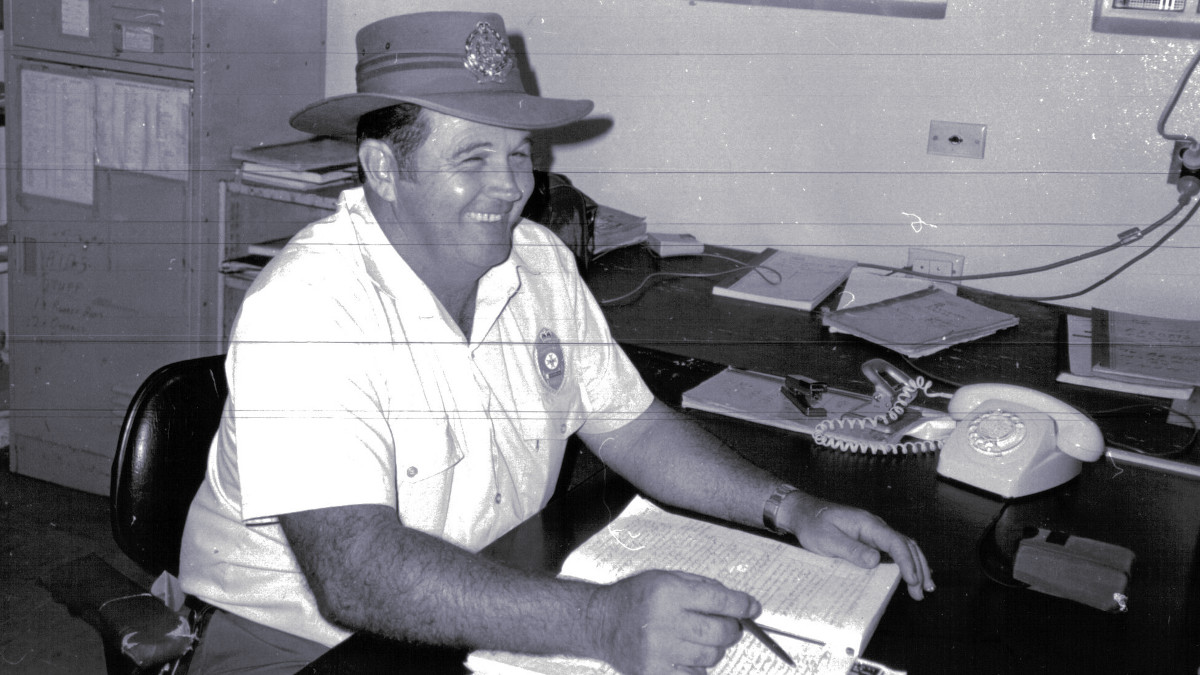
Above: John Banks at work, 1980s. (BRGHS)

In 2014 we said goodbye to the late John Banks, the founding president of the Boggo Road Gaol Historical Society. He was a man described by his former workmates as one of the true ‘Boggo Road Greats’, not only because he was one of those screws who was respected by officers and prisoners, but he was also a champion of the Boggo Road historical site. John could come across as very much old school ‘hard-but-fair’ and easily annoyed into gruffness by fuss and nonsense, but his true nature was that of a giver and humanitarian. I’d like to take the time to put something of his life, as I knew it, on the record.

John was born in Brisbane on 3 October 1939 – a birthday he shared with the No.2 Division of Boggo Road. His schooling took him all around south Queensland until he gained a scholarship in 1954. His working career in Australia and overseas included long-distance truck and coach driving (and working as a doorman alongside the infamous John Andrew Stuart) before he became a prison officer at Boggo Road in 1972. By that time he had a wife (Gwen) and two children (Michelle and Michael).

John also worked at other prisons such as Wacol before his retirement in the 1990s, and then he started guided tours at Boggo Road with three other men. Within a few years the others had retired to leave John and a tiny handful of volunteers running the not-for-profit museum, and that’s where I met him in 2001.

As manager of the Boggo Road museum he very regularly volunteered his way through 60-hour weeks without making a cent in return. As a tour guide he took thousands of schoolchildren through the place, sometimes doing six tours a day, and the schools came back year after year, just for John. Teachers have recently been in touch with us expressing their disappointment that he wasn’t there to take tours anymore. At times John carried the gaol on his back to keep it open and – by virtue of it being open and in regular use – safe from demolition.

An image that always stuck in my mind was when I called into the museum about 6am one September morning to get some work out of the way (I had my own keys). As I walked up the driveway through cold dawn drizzle, there was John slowly making his way around the prison, unlocking the dozens of doors as he did every morning, a cat following close behind. He’d usually be there for another 12 hours, 18 if there was a function that night. And this was how he lived his life at the museum.

John, 2005. (BRGHS)
John, 2005. (BRGHS)

The simple fact is that nobody has ever worked as hard for Boggo Road, and nobody ever will again. The fact that Boggo Road is still standing is part of his legacy.

I would talk here about his ‘tireless efforts’ at the museum, but that would not be right because he was greatly tired by his efforts. It was not uncommon for him to take five or six tours through the prison in one day, in later years limping through them and taking short breaks when he could to rest his arthritic knees. He was a man in genuine pain (which was thankfully relieved in later years by knee operations). And this was his life, week in, week out, and he did it for free – the true mark of a labour of love. This was all despite John being one of the ‘faction’ who remembered the fly-by-night heritage demolitions of previous years and insisted the government was going to end up bulldozing Boggo Road anyway.

His effort was all the more remarkable because he also had to endure what was described as a ‘personal vendetta’. The museum was not-for-profit, with the surplus for each year being donated to charities such as ‘Drug Arm’, and every cent was meticulously accounted for in the records. Despite this, a businessman who leased an office at Boggo Road and had free access for tours developed some kind of a personal issue with John and lodged an endless series of petty and often hysterical complaints behind his back. John generally brushed these off, but it offended the rest of the volunteers, especially when John got a call from Centrelink because someone had told them he was making money at the museum (and therefore basically committing pension fraud). A completely false accusation, as was soon discerned.

To see a fundamentally honest pensioner freely volunteer his time to take so many tours through the prison and then be treated like this was beyond belief. What is the mentality of a person who would do that? It was, as another former officer said in prison parlance, ‘a maggot act’. In Christmas 2008, after John had moved to the Sunshine Coast hinterland for a well-deserved retirement, the Boggo businessman sent him absurd legal threats and made exorbitant demands for compensation. It is a measure of the man that John was able to shrug off these attacks over the years, but he was a honest and compassionate person who gave his time freely for the common good and he deserved better.

I might just be a friend praising his work here, but then it was also highly praised in speeches in the Australian Federal Senate. Not many of us can say that.

Of course, sheer hard work alone doesn’t make you a good person. What made John stand out was the fact that he was, much like his good friend and museum colleague Don Walters, a humanitarian – despite the often gruff exterior. For example, he was once asked in a radio interview about prison officer brutality and he replied that, ‘some officers seemed to think prisoners were there for punishment. They weren’t. They were there as punishment’. This was a theme he brought to his prison tours. ‘Every prisoner who walked in the door’, he would say, ‘will one day walk out of it. And they could move next door to you. What kind of a person do you want them to be after prison? Do you want them to be better people or be brutalised?’ He had no time for former officers badmouthing prisoners on tours and if it happened he let them know it.

John was saddened by the prospects of some of the young inmates in his keep. Many had the kind of childhoods and lack of education that make prison almost inevitable, and without further help they were condemned to spend a life in and out of prison. John was the kind of officer who tried to provide that help. He took the time outside his regular duties to teach inmates to read. He taught them horticulture, using rose cuttings obtained from New Farm park keepers. He also taught the craft of leatherwork, and used the proceeds from sales of their work on Christmas presents for the particularly disadvantaged inmates with intellectual problems who probably deserved to be in a different kind of institution. Christmas Day for John and Gwen was sometimes spent inside institutions handing out these presents.

As I said, all this was done outside his regular workload. He didn’t need to do it, but he did it because he wanted to. Most of the prisoners and the officers respected him for it.

Unlike some prison officers, John made no effort to conceal his address and phone number, despite having young children at home. His philosophy was that if he did his job properly and fairly inside the prison, he would have nothing to fear outside of it. Sometimes former inmates would rock up to the museum just to say hello to ‘Mr Banks’. It is no surprise that one of his favourite movies was ‘The Green Mile’, and Tom Hanks’ characterisation of a sympathetic prison officer in that movie probably struck a chord with John. As he told me during an interview last year;

‘Being a prison officer, you are not supposed to talk to prisoners, you are not to have any dealings with prisoners, but how can you work within a system and not having something to say to somebody? Now, I had no trouble with any prisoner, they were quite amiable to me, they were polite, and the feeling between me… they were prisoners, I was a prison officer, when I went home I had to forget about what they went in there for, but when I came back to work I had to remember what they were in there for and I had to make certain they didn’t escape. But if you want to be gruffy and bad-tempered and do all the stupid things… you’d have a pretty rough time in there because all you do is just keep looking at your back all the time.’

He was also a giver outside of prison, whether he was coaching baseball to kids or being the RSPCA ‘Santa Paws’ for several years (you haven’t really seen John until you’ve seen him dressed as Father Christmas greeting a long line of pets – “have you been a good budgie this year?”). No doubt there’s a lot of other generous things he did that I don’t know about, because you had to rely on other people to tell you about this stuff. For instance, one thing I only heard about from Gwen was when John took a small group of at-risk youth through Boggo Road for a tour once. The biggest boy in the group had a bit of an attitude and seemed proud that he would probably be going to prison one day. John took the time to explain to the boy that while he might be a big fish in his little youth group, he would be passed around the big fellas in prison like a sex toy. And people like John wouldn’t always be there to protect him. John knew because he had seen this happen.
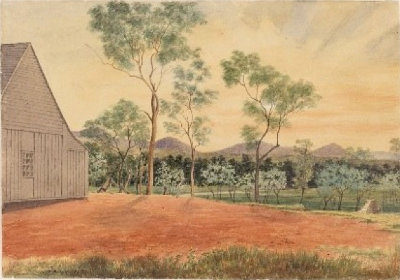
Well, about six months later the youth group coordinator rang up to say ‘thank you’. That little talk had made such an impact that the boy’s attitude had completely changed and he had since started an apprenticeship. Prison was no longer an option. As I said to Gwen when she later told me this, if John had done nothing else with his life, that one thing alone would make it a life worth living.

He also had a great touch with animals (outside of pig shooting and fishing), and a wild cat that lived around Boggo Road adopted him, following him everywhere and jumping on his lap whenever the chance arose. When the museum closed in 2005, John adopted PC (Prison Cat) and PC continues to live a happy life today. John also became a bit of a Birdman of Boggo Road and loved breeding canaries and budgies. The Banks household was often a foster refuge for wounded wildlife.

John and Gwen receive honorary lifetime memberships of the BRGHS from Senator Claire Moore after his retirement in 2007.
John and Gwen receive honorary lifetime memberships of the BRGHS from Senator Claire Moore after his retirement in 2007. (BRGHS)

So what is John’s legacy? In terms of History, it is not only the survival of Boggo Road prison and the tens of thousands of children who learned about it from him, it is also the fact that the Boggo Road Gaol Historical Society exists and that hundreds of its members continue his work. John always said that seeing the museum come to life when it could just as easily have been demolished was a ‘dream come true’, and he took great satisfaction in knowing that the good work was being carried on by others, and that the prospects of Boggo Road becoming a not-for-profit site again were looking very promising. How many of us can aspire to having others remember and carry on our labour of love when we have passed away?

The BRGHS will, in time, formalise his legacy at Boggo Road.

Even more important than all that, however, is the legacy of his personal life, in having a family that love him, and people grateful for the innumerable acts of kindness that made their lives easier or better.

After a short illness, John died peacefully in his sleep in June with loving family by his side. In typical John fashion, he asked for a no-fuss private family funeral (although his first preference was to be put in a cardboard box and dumped in the garden).

His family has lost a deeply-loved husband, father and grandfather; his colleagues have lost a respected friend; and Boggo Road has lost its champion. However, the dead only die when they are forgotten, and the work and actions of John Banks counted for a lot and will clearly not be forgotten.

The following poem is often attributed (probably wrongly) to Ralph Waldo Emerson. There is a lot in it that can be said of John Banks and remind us that even after all the slings and arrows, he did succeed…

‘Success’
To laugh often and much;
To win the respect of intelligent people
and the affection of children;
To earn the appreciation of honest critics
and endure the betrayal of false friends;
To appreciate beauty, to find the best in others;
To leave the world a bit better, whether by a healthy child,
a garden patch or a redeemed social condition;
To know even one life has breathed easier because you have lived.
This is to have succeeded.

Rest in Peace, John. You earned it.