Constance Clyde of Dutton Park: Author and Suffragette

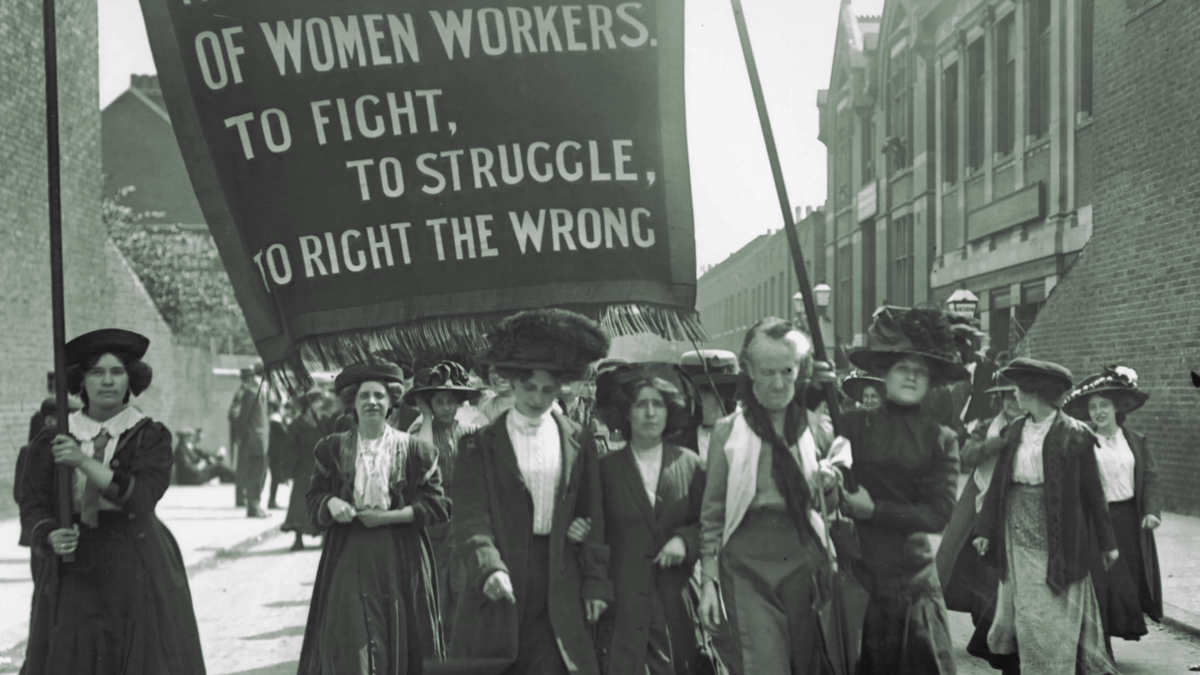
Above: Suffragette march.

In August 1951 a 79-year-old Brisbane woman died and was buried in the Hemmant Cemetery. No headstone marks her grave, no newspaper obituary marked her passing, and her life in Brisbane had been generally unremarkable. Yet Constance Jane McAdam had done much to be remembered for.
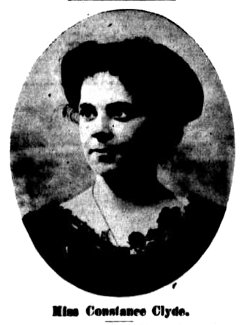
Constance Clyde, 1903.

I first came across Constance while researching the Brisbane Women’s Prison of the 1930s. She had spent three weeks in Boggo Road in 1935 after being convicted of ‘pretending to tell fortunes for payment’, and subsequently wrote a newspaper article about her experiences there. From that article, the breadcrumb trail of online information revealed a formidably independent woman who had been a writer in New Zealand, Sydney and London, producing a novel and numerous short stories for newspapers and magazines. In London 1907 she spent time in Holloway Prison for her part in a Suffragette protest at the Houses of Parliament. She even managed to get herself ejected from the New Zealand parliament after a one-person protest there. Clearly this was someone who lived a life worth recalling.

That life began in Glasgow, Scotland, in 1872 when she was born as the 11th child of William and Mary Couper. The family emigrated to Dunedin, New Zealand, in 1879. She began her literary career as a young woman writing poetry for the Otago Witness newspaper, and her first paid piece was a short story in the Dunedin Star. She moved to Sydney in 1898, where a major part of her journalistic career was spent writing for the Sydney Bulletin, particularly on the subjects of ‘social, feminist and literary questions’.[1] She wrote under the pen name ‘Constance Clyde’, no doubt a sentimental reference to the river than ran through the city of her birth. She also joined the ‘Yorick Club’, a somewhat bohemian collection of people with ‘a professional interest in literature, visual arts or science’.

Constance moved to London in 1903 to further her career. Her only novel, A Pagan’s Love, was published there in 1905. Lawrence Jones provides this analysis of the book:

‘Clyde is explicitly contemptuous of Puritanism, which she dismisses as ‘this coarse, church-belled heathenism’. She sees it as a narrow, barren, blinkered creed suitable for the respectable conformists who live in the Presbyterian Otago community of Waihoa. The attractive alternative offering deliverance from this stultifying religion is paganism. For Clyde, this is a blend of atheism, sexual equality and a new morality. The novel charts the progression of the heroine, Dorothea Wylding, away from Puritanism towards paganism. Growing up in Waihoa, Dorothea is imbued with a strict sense of morality and a belief in respectability. This begins to be undermined when she travels to Sydney, the ‘laughing pagan city’. Here she meets the feminist Ascot Wingfield, an independent career woman and solo mother, who teaches Dorothea of the need for women to have both an intellectual and an emotional life. Dorothea is also reunited with childhood friend Edward Rallingshaw, the pagan of the title. A married man, he tries to persuade Dorothea to live with him in a free love union. Just as he wears the last of her resistance down he dies in a fire. While this at first appears to reinforce the Puritan theological code of transgression and punishment, it eventually results in the defeat of orthodoxy. Returning to Waihoa, Dorothea marries the Rev John Archieson. When she leaves him to return to Sydney he in turn discovers that the Puritan code is limiting. In a final sermon he questions whether ‘there is such a thing as sin’ and declares that ‘it is not the higher but the broader life that we want; we need our minds enlarged rather than our souls purified’. John’s heterodoxy reunites him with Dorothea. The ex-Puritan hero and heroine resolve to work together to free others from the religious and moral bondage they have experienced and to promote ‘a new morality and religion of love rather than law, of fulfillment rather than denial.’[2]

The novel did not find a large audience and I don’t know if Constance ever tried to write another one. Certainly after this time her output was largely confined to short stories for various newspapers, with the occasional piece of journalism, although in 1933 she co-authored a travel/history book titled New Zealand, Country and People.

Her political beliefs saw her make the news in 1907. Constance was naturally drawn to the cause of the Suffragettes and their long struggle for full voting rights for women. This led to her arrest and imprisonment in March 1907 for taking part of the first Suffragette protest outside the British parliament – which followed the defeat of another suffrage Bill – in which there was reported to be prolonged fighting between the protesters and the 500 police who were defending the House of Commons. 75 women were arrested that day. Constance wrote vivid newspaper accounts of these experiences, which I will reproduce in the next article on this website. I am unsure as to the direct and ongoing extent of her involvement in the Suffragette movement, and it is clear from her articles that she set out to get arrested just so she could report from inside the ‘belly of the beast’, but her writings show that she was clearly a very strong supporter of the struggle. Her actions also show that she was not afraid to see the inside of a prison cell, and like many Suffragettes she wore imprisonment as a badge of honour.
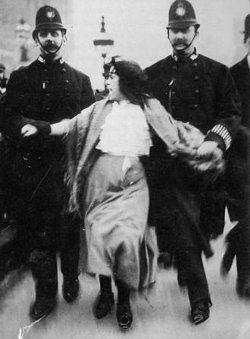
A young Suffragette is arrested at the March 1907 protest.

Her life in Edwardian London seemed to become much quieter after this time, and in 1912 it was reported that she ‘was recently received into the Church by the Jesuit Fathers at Farm street, London.’ On the face of it, this appeared to be a surprising move for a person who had railed against the establishment and conformity for so long, but Constance lost none of her political combativeness.

Her short stories continued to appear various publications in the following years, but any dreams of literary stardom in London must have faded away. She returned to New Zealand – probably during the 1920s – and continued her love/hate relationship with that country. She was admonished in the pages of the Coffs Harbor Advocate in 1925 – with the suggestion that her ankles should be caned – for her article in the Empire Review criticising the people of New Zealand for their general submissiveness. Then, in 1931, Constance was making news again with another parliamentary protest. This time her concern was child abuse, while the New Zealand parliament was considering a Child Welfare Bill.

‘When the Speaker of the House of Representatives was reading prayers this afternoon a woman in the visitors’ gallery suddenly and loudly protested against the Child Welfare Act. An attendant persuaded her to remain silent, but when prayers had concluded she recommenced her protest. She tore up a copy of the Act, throwing it to the floor of the House, She was ejected by the police. 

The woman stated subsequently that her name was Constance McAdam, and her pen name Constance Clyde. She said she was a member of the Women’s International League of Peace and Freedom, and had not been aware that the House opened with prayer. “At all events, I am the first woman to speak in the New Zealand Parliament,” she added.’ (Sydney Morning Herald, 19 March 1931).

Another short insight into her political and social activities was provided by a Brisbane newspaper in 1932:

‘Prominent among New Zealand writers is Constance McAdam Clyde. Articles written by her have appeared in the best English magazines, including the Contemporary and Empire Reviews. Her last publication is a history of New Zealand, in which she collaborated with Alan Mulgan, and which was brought out by Whitcombe and Tombs. Some of her most valuable work has been achieved, however, in assisting to place new writers before the public. Miss Clyde is an ardent advocate of physical culture for both the youthful and middle-aged. She is also, prominent in anti-vivisection matters.’ (Telegraph [Brisbane], 25 June 1932).

It was around this time that she moved to Brisbane and settled in the suburb of Dutton Park. This was the time of the Great Depression, and Constance was by now advertising her services in assisting with the preparation and publication of manuscripts, and she also sought a writing partner. However, in June 1933 she was living at ‘Lavinia’, on Dutton Street, Dutton Park, and subtly advertising her services as a fortune teller.

Constance also became a writer of regular letters-to-the-editor, usually under her birth name and espousing her views on various subjects. In 1933 she wrote about child protectionprison reform, her opposition to the forced sterilisation of ‘mental deficients’ (which she also wrote about in 1934). She also suggested that people should wear ‘a small piece of pale green ribbon’ on Sundays to show their support for ‘a better state of things financial’.

She continued telling fortunes under the name ‘Madame Lavinia’, and in 1935 (while living on Merton Road) she was arrested and charged with ‘having pretended to tell fortunes for a fee’. Constance faced the police and the court with characteristic defiance:

‘She told me that she only did it as a sideline,’ said Constable Davissen, of the Traffic Office. She said that she was a journalist, writing for ‘Women’s Weekly, ‘Women’s Budget,’ ‘The Women’s Mirror’ and several other papers. And before I left she said, ‘You can tell the magistrate from me that I will not pay any fine, even if it’s only sixpence.’ (The Truth, 7 April 1935)

She told the court that ‘I thought that I could do some good in this depression by sympathy, kindness and advice, and especially by telling people that there is nothing wrong with this world except the monetary system.’ For Constance, even reading tea leaves could become a political platform.

True to her word, she refused to pay the fine and so was confined inside the nearby Boggo Road prison for three weeks. She didn’t miss the opportunity to write about this experience, and I have already covered that work in this article.
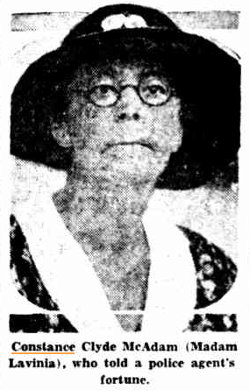
Constance McAdam, 1935.

This proved to be Constance’s last brush with the law. Her newspaper letters now became infrequent and her concerns trivial. In a letter to the Women’s Weekly in 1935 she complained of children getting Christmas presents too early. In 1938 she was unhappy with the etiquette of people listening to household radios, and in 1939 she complained of an accident hotspot on Ipswich Road. In 1940, now aged 68 years, she suggested that the government could save money on pensions by asking rich families to help provide for their elderly relatives. In 1944 a rather insipid poem on the tragedies of love appeared in the Queensland Times. And then, nothing. This must have all felt like a long way from the dreams of the ambitious young writer who travelled by ship from Sydney to London in 1903 with an unpublished novel under her arm.

In the 1949 Queensland Electoral Roll she was listed as a journalist and living at 15 Deighton Road, South Brisbane.

Constance died in Brisbane on 30 August 1951, and was buried in the Hemmant Cemetery. The event passed without mention in the local newspapers. There was no obituary, no funeral notice. It was a quiet end to a life that had petered out in the mundane concerns of suburbia after such an ambitious foray into the bohemian literary circles of turn-of-the-century Sydney and London. Hopefully this article will help make more people aware of the achievements of Constance Jane ‘Clyde’ McAdam.

Note:
I set out here to put together the most complete online account of Constance McAdam’s life. While that general aim has been achieved, my research has been limited and holes remain. I would appreciate any further biographical information that can be added above.

List of the published writings of Constance McAdam (work in progress).

  • ‘Consolation – Song Words’, poetry (The Bulletin, 12 December 1896) 
  • ‘Hypnotised’, short story (The Bulletin, 9 January 1897) 
  • ‘Dead’, poetry (The Bulletin, 31 July 1897; 11 January 1933) 
  • ‘To Save His Soul’, short story (The Bulletin, 26 June 1897) 
  • ‘A Woman’s Promise’, short story (The Queenslander, 11 December 1897) 
  • ‘Mrs Murgan’s Snake Bite Cure’, short story (The Sydney Mail, 17 December 1898) 
  • ‘Letters from the Grave’, short story (The Queenslander, 17 December 1898) 
  • ‘Dreams and Shadows’, poetry (The Bulletin, 24 December 1898) 
  • ‘A Woman’s Love’, short story (The Bulletin, 7 January 1899) 
  • ‘Virgins, Wise and Foolish’, poetry (The Bulletin, 28 January 1899) 
  • ‘The Widow’, poetry (The Bulletin, 11 February 1899) 
  • ‘Night’s Day’, poetry (The Bulletin, 11 February 1899) 
  • ‘A Glass of Beer’, poetry humour (The Bulletin, 1 July 1899) 
  • ‘A Boarding-House Idyl’, short story humour (The Bulletin, 29 July 1899) 
  • ‘The Test of Love’, poetry (The Bulletin, 2 September 1899) 
  • ‘Conversely!’, short story (The Bulletin, 4 November 1899) 
  • ‘The Saddest Song’, poetry (The Bulletin, 9 December 1899) 
  • ‘The Soul of David King’, short story (The Bulletin, 9 December 1899) 
  • ‘The Dream Child’, poetry (The Bulletin, 23 December 1899) 
  • ‘The Elopement of Lydia’, poetry humour (The Bulletin, 6 January 1900) 
  • ‘In the Night’, poetry humour (The Bulletin, 20 January 1900) 
  • ‘Love’s Climax’, poetry (The Bulletin, 24 February 1900) 
  • ‘Why They Killed Mrs Saville’, short story (The Australasian, 10 March 1900) 
  • ‘For Ever’, poetry (The Bulletin, 28 April 1900) 
  • ‘Mrs Flynn’s Sofy’, short story humour (The Bulletin, 5 May 1900) 
  • ‘Jones, the Genius Hunter’, poetry humour (The Bulletin, 26 May 1900) 
  • ‘The Cleverness of Douglas Fitzgerald’, short story (The Australasian, 2 June 1900) 
  • ‘Angela, the Good’, short story (The Bulletin, 23 June 1900) 
  • ‘Millar’s Water’, short story (The Australasian, 7 July 1900) 
  • ‘The Broken Dove’, poetry (The Bulletin, 28 July 1900) 
  • ‘Stepmother Bessie’, short story (The Australasian, 11 August 1900) 
  • ‘The Man that Came Back’, short story humour (The Bulletin, 25 August 1900) 
  • ‘A Faithful Woman’, poetry humour (The Bulletin, 8 September 1900) 
  • ‘The Ballad of John Bigley’, poetry (The Bulletin, 20 October 1900) 
  • ‘Parson King’s Happy Day’, short story humour (The Bulletin, 3 November 1900) 
  • ‘Sympathetic Miss Swanston’, short story (The Australasian, 29 December 1900) 
  • ‘Pirates’, short story (The Bulletin, 29 December 1900) 
  • ‘My Best Friend’, short story (The Australasian, 29 June 1901) 
  • ‘Her Good Father’, short story (The Newsletter, 28 December 1901) 
  • ‘Pan of the Seashore’, poetry (The Australasian, 6 April 1901) 
  • ‘Mr. Shannon’s Choice’, short story (The Australasian, 19 October 1901) 
  • ‘The Chief Mourner’, short story (The Australasian, 16 November 1901) 
  • ‘The Forgiveness of Florence’, short story (The Australasian, 14 June 1902) 
  • ‘The Game Eileen Played’, short story (The Australasian, 5 July 1902). 
  • ‘An Appeal’, poetry (The Bulletin, 19 July 1902) 
  • ‘Mabel’s Love Letter’, short story (The Australasian, 20 September 1902) 
  • ‘Lizzie’s Lie’, short story (The Australasian, 15 November 1902) 
  • ‘The Ballad of John Ibbetson’, poetry (The Bulletin, 21 February 1903) 
  • ‘A Men’s Refuge’, short story (The Bulletin, 21 March 1903) 
  • ‘The Diplomacy of Caroline’, short story (The Bulletin, 16 May 1903) 
  • ‘The Question of Beer’, poetry (The Bulletin, 23 May 1903) 
  • ‘The Enfranchised Woman’, prose (The Bulletin, 20 June 1903) 
  • ‘The Difference’, poetry (The Bulletin, 27 June 1903) 
  • ‘An Exemplary Mother’, short story (The Australasian, 22 August 1903) 
  • ‘The Marrying of Mr. Maxwell’, short story (The Australasian, 24 October 1903) 
  • ‘The Commonplace Men’, poetry (The Australian Town and Country Journal, 9 December 1903) 
  • ‘A Pilgrim of Love’, short story (Colac Herald, 16 September 1904) 
  • ‘His Strange Little Lady’, short story (The Australasian, 26 March 1904) 
  • ‘The Tragedy of the Spun’-Silk Shawl, short story (The Australasian, 28 May 1904) 
  • ‘Held Cheap’, short story (The Australasian, 9 July 1904) 
  • ‘The Ordeal of Mrs Holmes’, short story (The Australasian, 26 November 1904) 
  • A Pagan’s Love, novel (London: T. Fisher Unwin, 1905) 
  • ‘The Career of Jessica’, short story (The Australian Town and Country Journal, 26 February 1908) 
  • ‘The Plan of Elise Blanc’, short story (The Australasian, 13 March 1915) 
  • ‘The Pardoning of Jessie’, short story (The Australasian, 11 March 1916) 
  • ‘Soldier’s Wives’, short story (The Australasian, 23 March 1918) 
  • ‘The Flippancy of Felicia’, short story (The Australasian, 3 September 1921) 
  • ‘It’s a Young Country Yet’, short story (The Australasian, 28 January 1922) 
  • ‘When the Dumb Spoke’, short story (The Australasian, 11 February 1922) 
  • ‘The Eyes of John Denne’, short story (The Bulletin, 27 January 1927) 
  • ‘The Motor-Car Wife’, short story (The Australian Woman’s Mirror, 27 September 1927) 
  • ‘Elimination’, short story (The Australian Woman’s Mirror, 3 January 1928) 
  • ‘With Shop Attached’, short story (The Australian Woman’s Mirror, 14 February 1928) 
  • ‘The Magic Dress’, short story (The Australian Woman’s Mirror, 12 August 1930) 
  • ‘Change of Heart’, short story (The Queenslander, 21 March 1935) 
  • ‘Contrasts’, poetry (Queensland Times, 3 March 1944)

[1] Kirstine Moffat, ‘The Puritan paradox: an annotated bibliography of Puritan and anti-Puritan New Zealand fiction, 1860-1940. Part 2: reactions against Puritanism’, Kotare: New Zealand Notes and Queries, Vol.3, No.2, 2000.
[2] Lawrence Jones, ‘Puritanism’, The Oxford Companion to New Zealand Literature, ed. Roger Robinson and Nelson Wattie, Melbourne, Auckland: Oxford University Press, 1998, p.130.
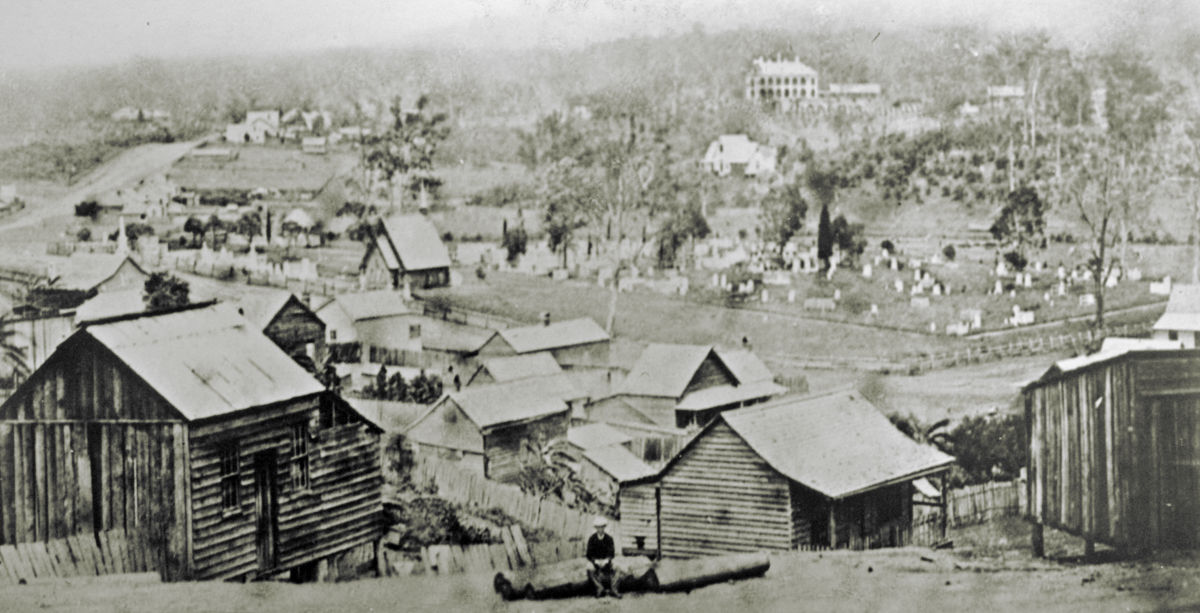
Colonial Columns: Consecration of the Church of England Burial Ground (Brisbane, 1862)

Above: Looking across the former Paddington Cemetery, c. 1870. (Qld State Archives)

The following article about the consecration of the old North Brisbane Burial Ground – at what is now Lang Park – appeared in the The Courier, Brisbane, on Saturday 24 May 1862. Such rituals were one-offs and only possible in religiously ‘segregated’ cemeteries, where separate portions of land were set aside for the use of different denominations.

In non-segregated ‘mixed’ cemeteries, such as the ones at South Brisbane and Balmoral, consecration was considered to happen at individual grave sites when religious burial services were performed beside them.

These rituals were not often covered in the newspapers of the time in this level of detail:

“THE consecration of the ground set apart and granted for burial purposes to the Church of England took place on Thursday, as announced, at eleven o’clock. This land, which is very prettily situated in a valley behind the Green Hills, has been for a long while since dedicated to purposes of burial, but had not been consecrated. The piece of ground is now almost fenced-in, and a small chapel has been erected on it.

At eleven’ o’clock the Bishop commenced the service, assisted by the Chancellor of the Diocese, J. Bramston, Esq., B.C.L., of All Souls’ College, Oxford, and by the Rev. T. Bliss, Rev. J. Moseley, Rev. J. Tomlinson, Rev. J. R. Moffatt, Rev. Mr. Bailey, Rev. B. E. Shaw, Rev. E.G. Moberley, and the Rev. V. F. Ransome. There were comparatively few persons present at the commencement of the ceremony, but the number subsequently increased, so that the little chapel could scarcely afford sufficient accommodation for those present.

The boundaries of the ground having been traversed by the Right Rev. Prelate, his reverend assistants, and the other persons present, joining in the appointed service, the chapel was entered, and the Chancellor, Mr. Bramston, read the document under the hand and seal of the Bishop defining the ground, and setting forth the purposes for which it had been consecrated, and to which alone, for all time to come, it was to be applied. Prayers were then offered up, and a portion of the Communion Service performed, after which the Bishop, Dr. Tufnell, delivered a brief appropriate, and earnest sermon, taking as his text John xi., 25th verse – “I am the resurrection and the life; he that believeth in me, though he were dead, yet shall he live.” The right rev. gentleman dwelt upon the beauty and appropriateness of the opening passages of the service for the burial of the dead, appointed by the Church of England, the verse, “I know that my Redeemer liveth, &c,” which seemed, as we heard it at the church door when following the corpse, to embody the expression of hope on the part of the dead body, whilst the following verse – “We brought nothing into this world, &c,” contained, as it were, a consolation for the living and an expression of implicit resignation to the Divine will.

The reverend speaker then drew attention to the fact that, whilst heathen nations had different ways of disposing of their dead, the Christian nations invariably respected the remains of their people and buried them. The first instance we found in the Bible of the care observed with regard to burying places, was that of Abraham, who purchased a burying-place from Ephron, and who would not accept one of the sepulchres of the children of Heth for his dead. The right rev. gentleman then enlarged at length upon the points that, both on account of the dead, and’ also for the instruction of the living, it was the duty of Christian communities to have burial places consecrated and set apart. He pointed out as one reason why the remains of the dead should be respected, and preserved from indignity, that the members of the Church expressed in the creed their belief in “the resurrection of the body,” not the resurrection of the soul, for the soul, although withdrawn, was eternal, and could not die; but the resurrection of the body as it was on earth. This resurrection was, perhaps, he said, a more wonderful instance of the Divine power than even the original creation of the body. The rev. gentleman then pointed out how the setting apart of burial places, consecrated and respected, was of instruction and benefit to the living, as it served to remind them of the transitory nature of their own existence. It was also a pleasant feeling to know that we could visit the last resting-place of those we loved, and that their remains would not be rudely disturbed or suffer indignity. The right rev. prelate concluded his Sermon by alluding to the chapel in which they were assembled, which he hoped would be of some service. Humble as the building was, if it were the means of saving but one soul, it would not have been erected in vain.

At the conclusion of the sermon, a collection was made, after which the Communion was administered to such as remained to partake.”

Colonial Columns: The Lost Graveyard of Terranora Creek

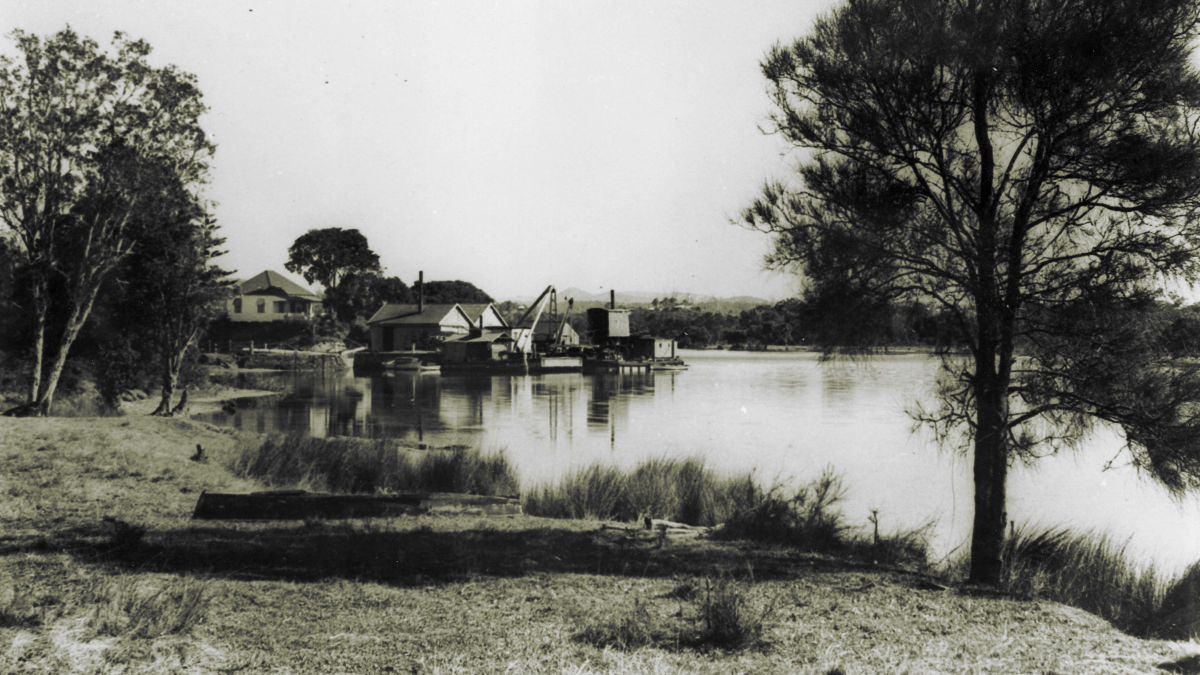
Above: The dry dock (constructed 1898) on the Tweed, 1937. This was located
near the old graveyard. (John Oxley Library)

There are of course many little old graveyards dotted around the Queensland landscape today, some in better shape than others, but there are lots more that never made it this far and have been lost to history. Here I will look at a burial ground that once lay on the banks of Terranora Creek, off the Tweed River just inside the New South Wales border, and is today gone but not quite forgotten.*

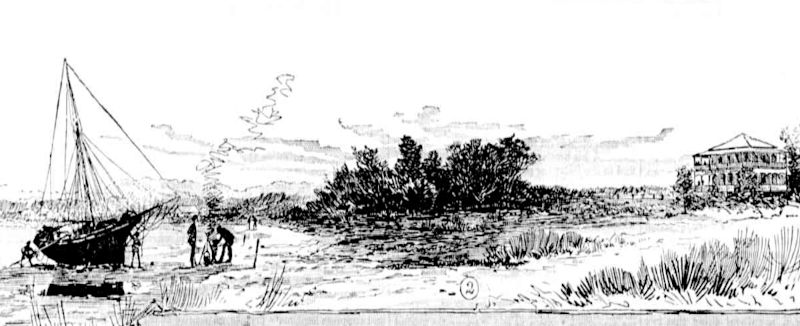
Tweed Heads. (Australian Town and Country Journal, August 1886)

This small burial ground was laid out close to the Terranora Creek sometime in the 1840s/50s as part of what was originally known as Tarranora (‘little river’), the first non-Indigenous settlement in the area, established from 1844. The cemetery lay in the vicinity of what is now Philp Parade/Dry Dock Road.

Tarranora was built by southern cedar-getters. The logs they cut down in the region were transported south on schooners, some of which were wrecked on the shallow river bar. This was a shipping hazard until retaining walls were built in the 1890s, and among the dead buried in the cemetery were those who died in the nearby wreck of the schooner ‘Ebenezer’ in July 1859.

‘LOSS OF THE EBENEZER. The Fortune, which arrived last night from the Tweed River, brings intelligence of the total wreck of the above named schooner. She sailed from this port for the Tweed, and on the 30th ultimo, on taking the bar, with a heavy sea rolling in, the wind fell light, and she got on the rocks. Every endeavour was made to get her off by running out a kedge, but she broke up suddenly, and we are sorry to add that two ladies, named Mrs. J. and E. Boyd, with their two children, were unfortunately drowned: the rest of the passengers and crew were saved.’ (Sydney Morning Herald, 6 August 1859)

Unfortunately their graveyard was a bit too close to the waters, and over time graves were lost as persistent flooding eroded the bank. By the 1920s only three headstones remained, and only one of those was still standing. The oldest stone was said to date back to 1856, but some of the inscriptions were by then indecipherable. A visitor at the time wrote a very useful account of the state of the place. and his words were published in the Border Star newspaper in September 1932:

‘At Tarranora is the Tweed’s first cemetery and to this sacred spot where “the rude forefathers of the hamlet sleep”, a pilgrimage was made last Sunday by Brisbane tourists, to inspect the neglected graves of the victims of the ‘Ebenezer’ and ‘Mary Jane’ disasters. Gnarled old age has its home in this cemetery situated on Government reserved land on the right bank of the stream facing the East with lovely Eucalypts all around where the numerous dead are lying. Rank weeds and bracken surround the crumbling gravestones, which speak of the disappearance or forgetfulness of those whom the dead have left behind, of the slender memories of the present generation for their grand-sires who went through storm and stress when the Tweed was young and Australia battling for its very existence. There is an unmistakable air of melancholy where the dead are lying. But the butcher bird whistles its song in the neighbouring thicket, the subdued sound of the sea can be heard moaning a requiem and except where the shadows are dense the bright sun covers all with a benediction – Requiescat in pace. 

There are only three graves visible and marked by tombstones, in one of which no less than six persons are interred, Old hands state there were ten or twelve well-defined graves there at one time though many more persons were buried there in what was for many years the only cemetery on the river, and two more monuments have disappeared by the erosion of the riverbank.

The lettering on the monuments is weather-worn and some of the dates in the records of a whole chapter of tragic events are now almost undecipherable. Here they are.

‘Sacred to the memory of Hannah, the beloved wife of John Boyd, aged 26 years. Also Thomas, son of the above named John Boyd, aged 2 years and 3 months. Also to the memory of Mary Ann, the beloved wife of Edward Boyd, aged 24 years, all of whom perished in the wreck of the ill-fated schooner Ebenezer at the entrance of the Tweed River on 30th July 1859. Also Edward, the only son of the above named Mary Ann and Edward Boyd who also perished in the above named vessel, aged 2 years; Also Richard second son of Thomas and Mary Boyd who died 30th December 1859, aged one year; Also Edward Boyd who died February 5th 1863, from the effects of a gunshot wound inflicted by the hand of an assassin at the Tweed River, aged 34 years.’

(His ‘assassination’, it is said, was due to an aboriginal. This Mr. Boyd was one of the survivors of the ‘Ebenezer’ wreck.) 

A few feet to the left of this remarkable record stands a second headstone bearing the inscription:- ‘Sacred to the memory of Bridget Gillett who departed this life August 1st, 1856, aged 38 years. May the Lord have mercy on her soul.’ 

A third stone was lying flat at the water’s edge, having been undermined by the erosion of the bank in many years’ lapping of the tide. cluster of oysters has taken possession of the scroll on top. It reads:- ‘Sacred to the memory of Margaret Wootten who departed this life August 3rd, 1856, aged 37 years; Also Charles Wootten who was drowned going from the Tweed River to Sydney on board of the ill-fated ”Mary Jane” on 26th July 1861, aged 45 years. Gone out with the tide. May the Lord have mercy on their souls.’ Erected by his beloved wife, Delia Wootten. 

In 1926 the Australian Workers’ Union held their convention at Coolangatta. During a river excursion the delegates were landed at this old cemetery. Realising the significance of the tombstones they set to work with rope and pole to raise them into safety on the high bank. Then with bared heads they stood around while Senator Barnes, like a true patriot, gave a brief speech in memory… ‘Peace to their souls, for surely in their careers it is shown these departed pioneers fulfilled some Divine decree in the regulating of a great destiny.’ For which things the thanks of Australia are due to the A.W.U. and Senator Barnes. 

Dry Dock was not only the first town on the Tweed but several schooners were built there in the early days. Mr. Philp who has lived nearby for nearly 40 years, states that many years ago an old lady inspected the cemetery. She said her father Mr. Henry Gillett built a schooner just beside the cemetery and she was a native of the Tarranora hamlet…

Anyone who looks at the one picture of the lonely cemetery at Tarranora which tells of the last gallant struggles of those who, in their day without clarion-like advertisement in an unostentatious way helped to build the glory of our Empire will understand something of what the famous soldier felt when he uttered his memorable words. In this little spot marked by a few crumbling freestone monuments with the inscriptions of nine persons lie how many hopes and loves and ambitions, brought by the paths of glory to untimely graves?… 

Somewhere within this quiet place Jack Warwick, a former British naval seaman and cedar-getter’s cook was drowned there, and an American sailor also sleep their last sleep… 

Of the ill-fated ‘Mary Jane’ I have never been able to gain any documentary evidence. The records of the Navigation Department go back only to 1870. Old hands say she was one of the many cranky coracles that went out from our port with a human freight and was never again heard of – mysteries that must remain unsolved until that day when the sea shall give up her dead. The late Mr. Tom Lillie who was living at the Dry Dock in the Fifties said the hotelkeeper was lost in this manner whilst going to Sydney. 

Bridget Gillett was the second wife of the late Henry Gillett, shipwright, who died at the Coldstream, Clarence River, 17 3 81 aged 80 years. With his wife and two children, he embarked as a ship’s carpenter on the emigrant ship ‘Hiberna’ which carried 550 souls for Australia. When 60 days out the ship took fire and all efforts to subdue it were ineffectual. The boats were few and unseaworthy and hopelessly inadequate to the demands upon them. Over 500 lives were lost, including his wife and children! The survivors returned to Rio de Janeiro. Eventually he reached Sydney in 1826, where he built the ‘Susan’. He was in that vessel when she was the first boat to enter the Clarence in 1830. On that river he built the ‘Martha’ and ‘Elizabeth’ and the ‘Atlanta’. Then he went to the Bellinger and built the ‘Matha Ann’. Moving to the Tweed in the early Fifties, Mr. Gillett built ‘The Twin’, the first vessel launched on the river in 1854, that being the year in which twins were born to Mr. and Mrs. Gillett, the vessel being named ‘The Twins’ in consequence. The lady who visited the graves many years ago was one of the twins. After the death of his second wife he returned to the Clarence in 1858.

The object of this article is to plead that love of antiquity alone should urge the preservation of a particular memorial as these old gravestones are, before it is too late. Even now some words in the epitaphs are for ever obliterated. Quaintly worded as they are they are nevertheless a loss to posterity in the eyes of those who love the few surviving records of the old pioneers. The Tweed affords an extraordinary variety of interest and beauty. Part of its attraction is the historical interest – romantic if one will – which age always brings to the scenes and monuments of man’s early struggles with primeval nature. It is of course true that we in Australia are just a little shy of admitting this interest and many indeed are still quite indifferent to the past. But to say the least, the indulgence, of such a taste will not hurt us and a proper concern for origins and for the memorials of past history has always characterised self-respecting peoples once they have reached a stage of leisure and self-consciousness. It would be difficult to find a more touching scene of human pathos than these forlorn and neglected tombstones present to us, or one which more strikingly illustrates the typical chances of life and death which belonged to the pioneer story of Australia. If we knew no more than these inscriptions tell us, they are enough to make the preservation of these monuments a matter not merely of piety but of common and national interest. But, set in the framework of the pioneer story of the Tweed country they acquire added pathos and historical value.’

These three stones were later recovered and one went on display at the Tweed Heads Maritime Museum (later renamed the Tweed Heads Historical Society and linked with the Tweed Regional Museum). The Terranora headstone is still in the custody of the THHS. In the 1960s the ‘Taranora Cemetery and Memorial Stone’ was erected on the riverbank off Philp Parade, in the locality of the original burial ground. This monument is still standing. In 2007 a new monument was erected on the north side of the Tweed River, off a car park on Coral Street. While this is some way from the original location of the burial ground, it is nevertheless good to see an effort has been made to acknowledge local history.

The Philp Road monument, 2003.
(Tweed Heads Historical Society)
The Philp Road monument, 2003. (Tweed Heads Historical Society)
The new location off Coral Street.

Chronology of historic Tweed Heads cemeteries

The Terranora cemetery was part of the foundation settlement in the Tweed estuary.

A cemetery was in use at North Tumbulgum from 1873 until 1947. It was later restored and can still be visited.

The Chinderah cemetery was in use by the Lower Tweed during the last few decades of the 19th century. The council still maintain this place but it is closed to burials.

The cemetery at Florence Street (now Charles Street Cemetery), Tweed Heads, opened in the late 19th century. It is still maintained by the local council but is no longer an operational cemetery.

There is also a graveyard at Fingal which was been used by First Nations peoples during 1864-1964.

The Strangest Case Ever Made Against Capital Punishment

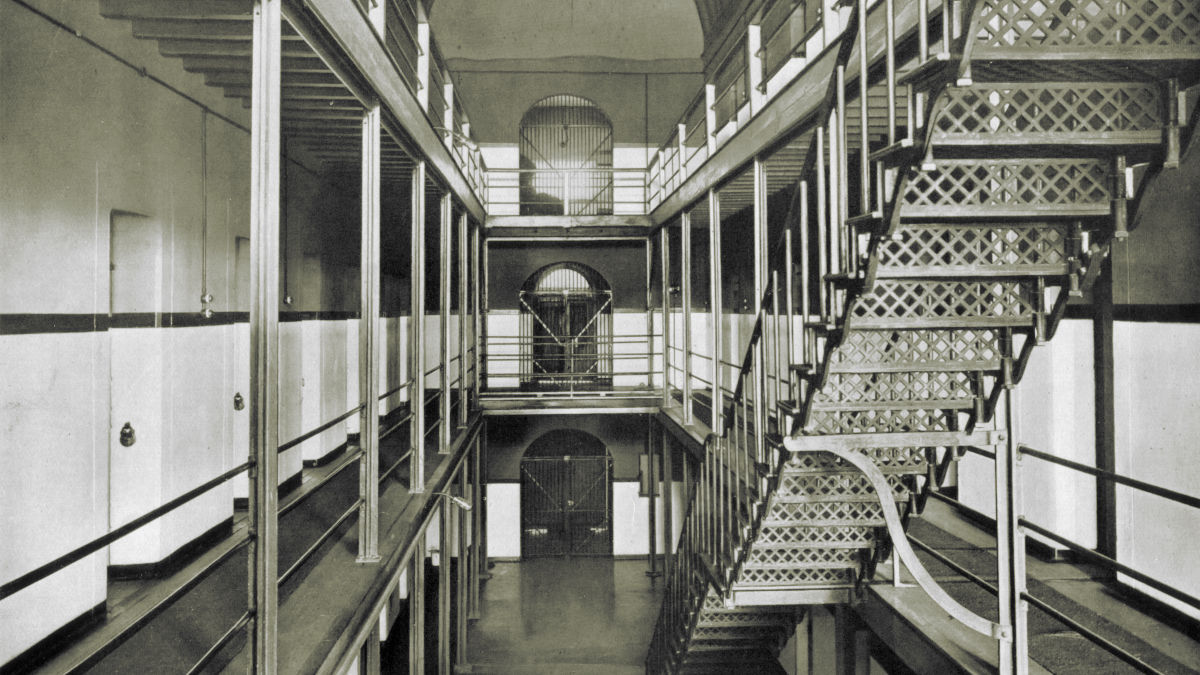
Above: A-Wing, Boggo Road, circa 1914. (Comptroller-General’s Report)

Queensland was the first part of the old British Empire to abolish capital punishment. This remarkable milestone happened in 1922, with the simple addition of one sentence to the Criminal Code: ‘The sentence of punishment by death shall no longer be pronounced or recorded, and the punishment of death shall no longer be inflicted’.

The road to abolition was not so simple, however, and this was the second time that a Queensland Labor government (we also had the world’s first Labor government) had tried to pass the bill. The first attempt came in 1916, and parliamentary debate featured a range of arguments in favour of and against the idea, including what has to be one of the most left-field cases ever made against capital punishment.

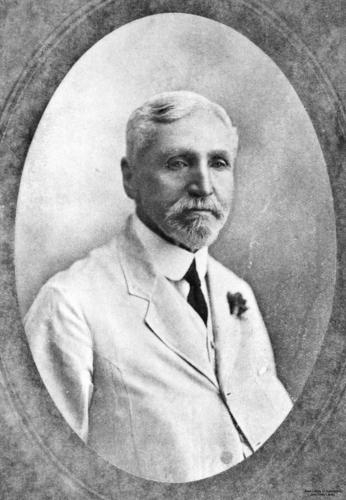
Dr William Frederick Taylor.
Dr William Frederick Taylor. (John Oxley Library)

Speaking against abolition, the Opposition Queensland Liberal Party contended that the issue was unimportant as there were more pressing concerns at hand, such as World War I. Their main line of argument was that capital punishment was a deterrent to crime, and that the absence of the death penalty would result in the rise of ‘lynch law’. The Old Testament sentiment of ‘an eye for an eye’ was raised on numerous occasions.

The arguments in favour of the bill included the religious (a prisoner would be deprived of the full opportunity for repentance); medical (murderers sometimes had ‘mental disease’); practical (hanging failed to act as a deterrent); judicial (even though mistakes had been made in the past, the sentence was irrevocable); and moral (the punishment does not fit the case nor effect the reformation of the offender). It was left to Dr William Taylor to bring an entirely new perspective to the debate.

As the official parliamentary records show, Taylor argued from a spiritualist viewpoint, asserting the existence of telepathy and astral planes, and that the death of a criminal only serves to release his consciousness into the astral plane, which would cause more harm than good:

By killing the body you free the mind of the individual, and his consciousness is much more capable of influencing others than it was before. That is the great argument against the death penalty… by killing the body, you liberate the criminal, who will do more mischief than he could possibly do if you keep him in his body, it is a mistake to kill him… 

If you kill the body with its five senses, the vehicle for the ego, or consciousness, to manifest through on the physical plane, you do a very stupid action, for the evil-disposed man can from the astral plane influence more easily the minds of dwellers on the physical plane than he could do while in his physical body.

Having introduced an angle that nobody saw coming, Taylor then flipped his argument around, saying that although he preferred imprisonment for murder, even inside a prison cell the prisoner may still be able use telepathic powers to influence others into committing crime:

We all know that such a thing as telepathy exists, and if you can concentrate your thought sufficiently you can transmit that thought to some other individual who will receive that thought and act on it… If you shut him up in a cell he is powerless to do any evil, unless he has a sufficient mental power to concentrate very strongly, and even then there is not much possibility of his doing any evil.

To be fair, Taylor was in many ways a great man, having a brilliant medical career and being an early advocate of such causes as female suffrage. Like many others at the time, he turned to Spiritualism during the carnage of World War 1 (in which he lost a son). However, this was probably one of the strangest arguments ever presented on the floor of the Queensland parliament.

After a short debate the bill was defeated, but the Labor government made a second and successful attempt to pass the abolition bill in 1922. William Taylor entered the astral plane in 1927.

Australia’s Next Top Bizarre Death-Contraption

‘That some better method of inflicting death than hanging should be adopted we readily admit. It is at best a disgusting method of execution, and is liable either to degenerate into something like torture, or else to lead to a shocking mischance such as happened yesterday. There are many well-known methods of producing painless extinction, and one or other should be adopted.’ (Brisbane Courier, 14 June 1887)

Above: Fannie Bay Gallows. (K. Hodge, Flickr)

So wrote one reporter after the execution of Ellen Thomson at Boggo Road in 1887, during which the rope cut into her neck and blood gushed over the floor. And he was right. Hanging is one of the most unpredictable methods of execution and often did not go according to plan (which in the late 19th century was to break the prisoner’s neck quickly and cleanly). Some prisoners in Brisbane were strangled to death as a result of the ‘drop’ not delivering enough force to the neck, while on other occasions the head would be almost removed due to too much force being applied. In fact, on one memorable occasion in 1879, the prisoner’s head was completely pulled off when he reached the end of the ‘drop’.

There was much debate around that time as to the best method to use. The French still used the more predictable guillotine, and the electric chair was being developed in the USA. The unpredictability of hanging drew occasional comment in Queensland newspapers on the subject of alternative execution methods. Some of these correspondents had obviously given a lot of thought to the subject.

When convicted murderer Patrick Collins was hanged at Petrie Terrace prison in 1872 he was given an unusually high drop and the shock of the fall resulted in in his head almost being severed from his body. It was reported that the sight was apparently ‘sickening to behold, and many turned away from it in horror’, and this prompted John Kelly of Fortitude Valley to write to the Brisbane Courier to complain that hanging was ‘barbarous and unscientific’. He helpfully suggested that garrotting be used instead, in order to make the ‘the operation as physically painless as possible to the victim, and as little revolting as possible to the beholden’:

The “garotta” is an instrument which fulfils these conditions. An armchair, in which the victim is seated, his legs and arms secured to those of the chair, an iron collar, having inside the back, in a recess, a sharp chisel-shaped cutter, which can be shot forward by some mechanical contrivance, is adjusted around his neck; a touch from the executioner, and the cutter, entering the neck, severs the spinal cord, and, without a groan or a sigh, earthly life ceases to exist. No red torrent gushes forth, no nervous struggles shock the onlookers. Is not this a more scientific and more humane way of severing the spinal cord, than our rude way of wrenching asunder the cervical column? In many parts of these colonies, people kill their cattle in an analogous manner, but by simpler means. (Brisbane Courier, 15 June 1872)

Queensland Times correspondent of 1874 suggested that it was ‘by no means certain that in hanging and beheading that death is instantaneous’, and so suffocation by carbolic acid gas should be used instead. The writer recommended that, after the prisons of the colony had been ‘furnished with air-tight cells and other proper apparatus’, execution could be carried out in what amounted to a gas chamber. ‘D.H.F.’, another advocate of carbolic acid gas, went to greater lengths in 1892 and described the required apparatus, which he felt was ‘far preferable to hanging, decapitation, garroting, or this new-fangled “electrocution”’.

‘Construct an air-tight perpendicular shaft, say 3ft. square by 10ft. in height, open at the top, and provided with a close-fitting door. The floor would consist of perforated metal, which would form the top of a small chamber airtight at the bottom and sides. Inside the shaft would be a seat on to which the criminal would be strapped, after which the door would be closed. A strong iron vessel containing lime and sulphuric acid and provided with a stop-cock would be placed in the airtight chamber below the floor. When all was ready this vessel would be opened and the gas would pass up through the perforated floor carrying the ordinary air above it. If a sufficient supply of carbonic acid gas is generated death must ensue very rapidly. Anyone wishing to experiment on a small scale with this method of causing death may easily do so with a glass tube about 1ft. long and 3in. or so in diameter. It would be very easy to fasten a floor of wire gauze about 3in. from one end. An ordinary bottle will take the place of the iron vessel, and the carbonic acid gas can be produced with the ordinary tartaric acid and soda of commerce. By some such apparatus the effect of the gas could be watched on a mouse or some other small animal.’ (Brisbane Courier, 27 April 1892)

Just before the first Boggo Road hanging took place in 1883, ‘Verdugo’, a correspondent to the Brisbane Courier, described hanging as ‘a troublesome, difficult, and illiterate’, and advocated poisoning condemned prisoners in their sleep and then hanging them afterwards for the statutory hour.

In 1893, ‘Humanity’ wrote that he had ‘often thought that drowning would be an excellent method of execution, and one free from many of the disagreeables associated with execution by hanging, beheading, and electricity.’ He had, in fact, given the subject enough thought to devise the following:

‘Requirements: An iron tank, 10ft. by 4ft. in diameter, open at the top, and filled with water, placed in position so that the top would be level with the floor on which the officials and the victim would stand. The victim, having had his hands tied behind him, and a weight of 100lb. or so fastened to his feet, would be lowered foot first into the water, and after remaining submerged half-an-hour, would be lifted out, and the customary ceremony of pronouncing life extinct performed.’ (Brisbane Courier, 18 July 1893)

Despite all this unsolicited ‘expert’ advice, no garrotting chairs, gas chambers, midnight poisoners or drowning tanks were ever required at Boggo Road, and the Queensland government persisted with hanging until the last execution took place in 1913. They must have been reassured, however, that upstanding citizens were out there devising new-fangled murder contraptions and sharing their plans in the newspapers.

Colonial Columns: The Chinese in Camooweal (1892)

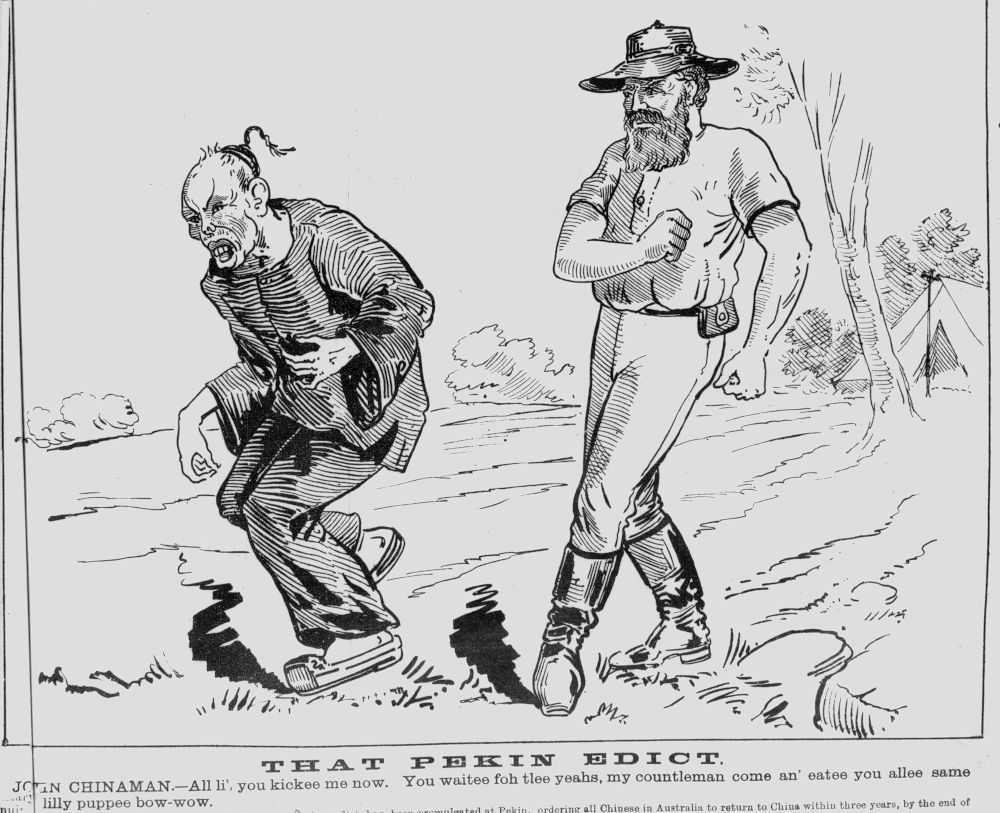
Above: Anti-Chinese cartoon in the Queensland Figaro and Punch, 14 July 1888.

Camooweal is a small town (population just 187 during 2011) on the far north-western border of Queensland/Northern Territory. It was established during 1884/85 and – because of its position – soon found itself the scene of attention.

Years of anti-Chinese racism in colonial Queensland had resulted in Chinese immigrants – once welcomed as a source of cheap labour – being subjected to various pieces of discriminatory legislation in the areas of health, immigration, quarantine, mining and customs duties. Entry into Queensland was strictly restricted, but the road through Camooweal from the Northern Territory (which at the time was part of the colony of South Australia) soon became a back-door entry point for ‘unauthorised arrivals’. This prompted extra policing measures in the local area, including the opening of a police gaol at various times during 1897-1902.

The issue subsided after the introduction of the Commonwealth’s Immigration Restriction Act in 1901, which curtailed Chinese immigration across Australia.

The article below features a lot of opinion and finger-pointing at the government over in South Australia, and features language and a tone that are sadly all too familiar to 21st-century Australians.

Maryborough Chronicle, 23 June 1892

‘The first reports from Camooweal. a small settlement near the border line between Queensland and the Northern Territory of South Australia, of an influx of Chinese in large numbers into this colony created some apprehension and a desire that every effort should be made to keep them out: but the latest reports, assuming them to he reliable, of the terribly destitute and pitiable condition of these Asiatic outcasts and the apparent certainty of starvation and death if forced back into the inhospitable colony which tempted them to leave their native land, excites our sympathy for their wretched state and indignation that this colony should be menaced with, and have to suffer from the cruel and culpable neglect, of the South Australian Government.

There is of course the possibility that the reports recently to hand of the deplorable condition of the Chinese have been grossly exaggerated for a purpose. The influx of such an abundance of cheap and docile labor is probably not at all an undesirable circumstance in the eyes of the large squatters of the far West and the Gulf country, and if a tale of woe poured into the ears of the Government could induce them to reduce the precautions for stalling off the influx, the tendency to resort to such a pathetic subterfuge would be strong with them.

On the other hand, however, if the telegrams received from the border convey the facts, not unduly embellished with touches of romance, the position becomes a very serious and difficult one for the Government of this colony to deal with. There arises a conflict between our humanity and our laws. The thought of driving back fellow creatures even though they be Chinamen into a barren wilderness out of which they had just struggled hungry and exhausted, is a painful one to contemplate, and its actual occurrence must offend and distress the average conscience.

The circumstance is the logical outcome of our own laws for the exclusion of Chinese from Queensland, and the contiguity of a colony in one portion of which such laws are not in operation or have been specially suspended. The imaginary line that divides us is far removed from the practical control of either colony, running through a tract of country that is hardly yet explored, much less civilized, and this fact adds to the difficulty of the matter. Our exclusive laws dealing with the great Chinese question as affecting Queensland seem in the case under notice to be operating with pitiless rigor and with such results as to arouse public sympathy for the homeless and despairing wretches, who implored the police to shoot them rather than drive them back to the more awful lingering death of starvation in the desolate wastes of Northern Territory, and declared their intention of returning again and again over the Queensland border, courting imprisonment where they might at least be sure of food.

But the trouble arises not from any default on the part of Queensland. It is due to the utterly callous neglect and selfishness of the South Australian Government. Our treatment of the Chinese is quite rational and justifiable. Human prejudices, when they are strong and widely diffused, need to be legislated for as well as human rights. The well being and peace of a community could not be assured unless this were done. Our laws imposing a heavy and exclusive poll tax upon the admission of Chinese for the colony were founded almost wholly upon a strong European prejudice against the ‘Heathen Chinee’ and all his ways, and so long as that prejudice remains a strong public sentiment our laws are justifiable. Granted this prejudice, Queensland acts fairly in all other respects to the Chinaman. Those who are already in the country enjoy ample freedom and are equally protected with Europeans by the arm of the law, and those outside are warned of the stringent and only conditions under which they will be allowed to set font upon this country, so that they are not deceived and imposed upon.

The same cannot be said of South Australia, for whose faults in this respect Queensland is evidently doomed to suffer. The Government of that stupidly apportioned colony seems to have wilfully neglected its duties and utterly disregarded the consequences upon this colony. In South Australia proper the prejudice against the Chinese is probably just as strongly manifested, or would be if an influx were threatened, as in Queensland, but unfortunately the South Australian Government has under its administration a large tract of northern country, effectually cut off by the great unknown Australian interior from the thickly and white peopled southern portion of that colony, and as almost the whole of the electors reside in the south there is a natural indifference as to the social conditions which may lie permitted to prevail in Northern Territory. As a result, this tropical slice of Australia has been developed under practically no government at all. and has been the happy hunting ground of grasping syndicates and the hell upon earth of hordes of slavish Asiatics – chiefly Chinese. This state of affairs, bad as it may be, would be no business of ours, were it not that it so seriously menaces us.

The practice that has evidently been in vogue of introducing into Northern Territory large numbers of Chinese to perform certain definite works, with no intention of sending them back to their native country, and on the completion of those works letting them go adrift, to swarm over into this colony, is not to be tolerated, and should be rigorously and effectually protested against. The condition of the majority of the Chinese in Northern Territory is deplorable, and the deceptions that have been practised upon them are monstrous. We are loath to allow the poor wretches to die along our border line, but indignant that the evil consequences of maladministration should be visited upon us and not upon the people who permitted them to arise, and whose secure distance from the scene of these troubles saves them any apprehension. Moral suasion in inducing the South Australian authorities to have a little more respect for themselves and consideration for their neighbours, and expensive defensive action on our own part are our only present remedies, pending the adoption of a scheme of federation, under which the various colonies for their own good will be more amenable to each other.’

Slim Halliday: Man or Spiderman?

Above: Slim Halliday runs down an internal track in Boggo Road. (BRGHS)

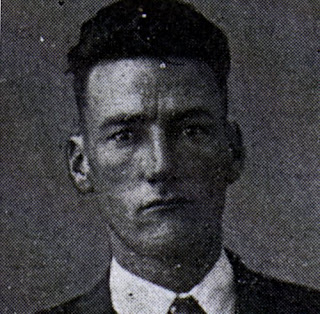
Arthur Ernest ‘Slim’ Halliday, convicted murderer and infamous Boggo Road escapologist of the 1930s-1960s, is the subject of some incredible tales, some tall, some true. Like the time he bent a solid metal cell door back with a winch made from bits of wood and bed sheet. Or the time he burned a hole in roof of the mattress workshop in a bid to escape. Or when he made a replica gun from bits of leather. These are some of the true tales.

Photo of Arthur 'Slim' Halliday, 1937
Arthur ‘Slim’ Halliday, 1937. (BRGHS)

There is, however, one particular story that is as tall as it gets. During one of my first visits to Boggo Road in the late 1990s I took a tour with a former prison officer who told our group all about ‘Halliday’s Leap’, the place where Slim Halliday jumped off the roof of E Wing cellblock in 1940 and landed on the top of the perimeter wall before making good his escape. At the time I totally believed it – such is the authoritative power of the tour guide – but after I later worked at the museum and spent more time in the area, I realised that the story and the numbers just didn’t add up.

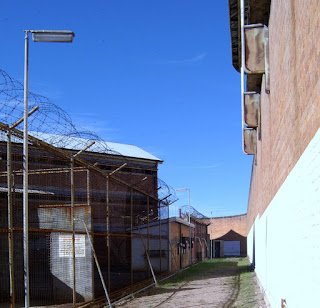
The legendary leap would have involved jumping from the roof of a three-storey cellblock onto the top of the red-bricked outer prison wall, a near-impossible feat involving a drop of eight metres over a space four metres wide. The curved top of the wall itself is no more than 30cm wide and is over seven metres high – not the safest landing spot for someone jumping from a great height. Imagine jumping off the roof of a two-storey house, aiming to land perfectly on a 30cm-wide ledge, without breaking your legs or spine or falling over when you do land, because that ledge is seven metres off the ground – and someone with a rifle on the neighbour’s roof will shoot you if they see you. It is, basically, a feat requiring all the abilities of Spiderman, and Slim may have been a lot of things but he was no superhero.

Photo of Track, outer wall, and cellblock at No.2 Division, Boggo Road.
Track, outer wall, and cellblock at No.2 Division, Boggo Road. (BRGHS)

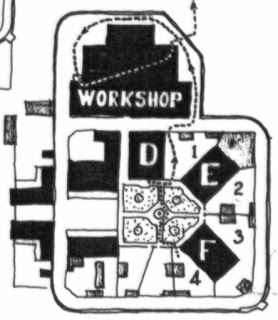
I delved into the official records at Queensland State Archives and a very different story emerged, but one that was no less impressive. To run through it briefly; Halliday had planned this escape for months, secretly making and hiding escape ropes, grappling hooks and wire cutters in the prison workshops. One day he slipped unnoticed from a line of prisoners and scaled the 10-foot high fence of the exercise yard to gain access to the Track that ran around the inside of the perimeter walls. He climbed onto the workshop roof and dropped down through a skylight that gave him access to the inside of the workshop, where he cut through wire mesh walls with the hidden wire cutters to get to his escape ropes. He climbed up onto the roof again and hooked the longest rope over the outer wall, at a place he had worked out to be a blind-spot from the towers. He dropped the shorter rope down the side of the workshop and climbed down onto the Track, then climbed up over the prison wall using the first rope before changing his clothes and making his escape.

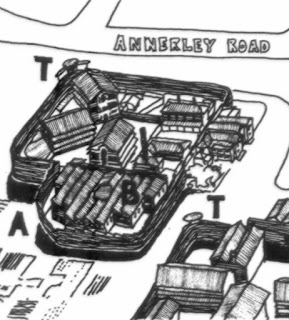
Sketch of No.2 Division, Boggo Road, in the 1940s.
A – Location of ‘Halliday’s Leap’
B – Workshops
T – Towers
No.2 Division, Boggo Road, in the 1940s. (BRGHS)
Sketch of Halliday's escape route 1940.
Halliday’s escape route 1940. (BRGHS)

There is no room in this article for the tale of the massive manhunt, shoot-outs and high-speed car chases that led to Halliday’s recapture, which is all covered in detail in the book The Houdini of Boggo Road. Of more relevance here is how the myth of ‘Halliday’s Leap’ grew. One clue comes from discussions with local residents who were children when the escape happened. When news of the breakout got out, local parents ordered their children to stay home, but the kids had other ideas and formed themselves into ‘posses’, excitedly roaming the local streets in nervous pursuit of the escaped prisoner. They circulated a story that Halliday had jumped from a roof during his escape, and in the process of ‘pass it on’ this became a cellblock roof. This story took hold, and 50 years later it had become accepted even within modern prison officer circles.

Halliday escaped over the blind spot at this section of the wall again in 1946, and it gained the name of ‘Halliday’s Leap’ quite early on. Following yet another escape attempt by Slim, this time in 1953, a newspaper ran an article with the headline ‘HALLIDAY’S LEAP HEADACHE FOR BOGGO ROAD STAFF: WEAK SPOT IN THE PRISON WALLS’. However, the blindspot had in fact been fixed in 1947 with the erection of a new stand-alone guard tower (called E tower) in the prison grounds to the southeast of the workshops. The workshops and Halliday’s Leap were later demolished as part of the prison modernisation of the early 1970s. The myth of Halliday’s Leap has only been demolished in more recent years.

The Tale of the Logan Crocodile

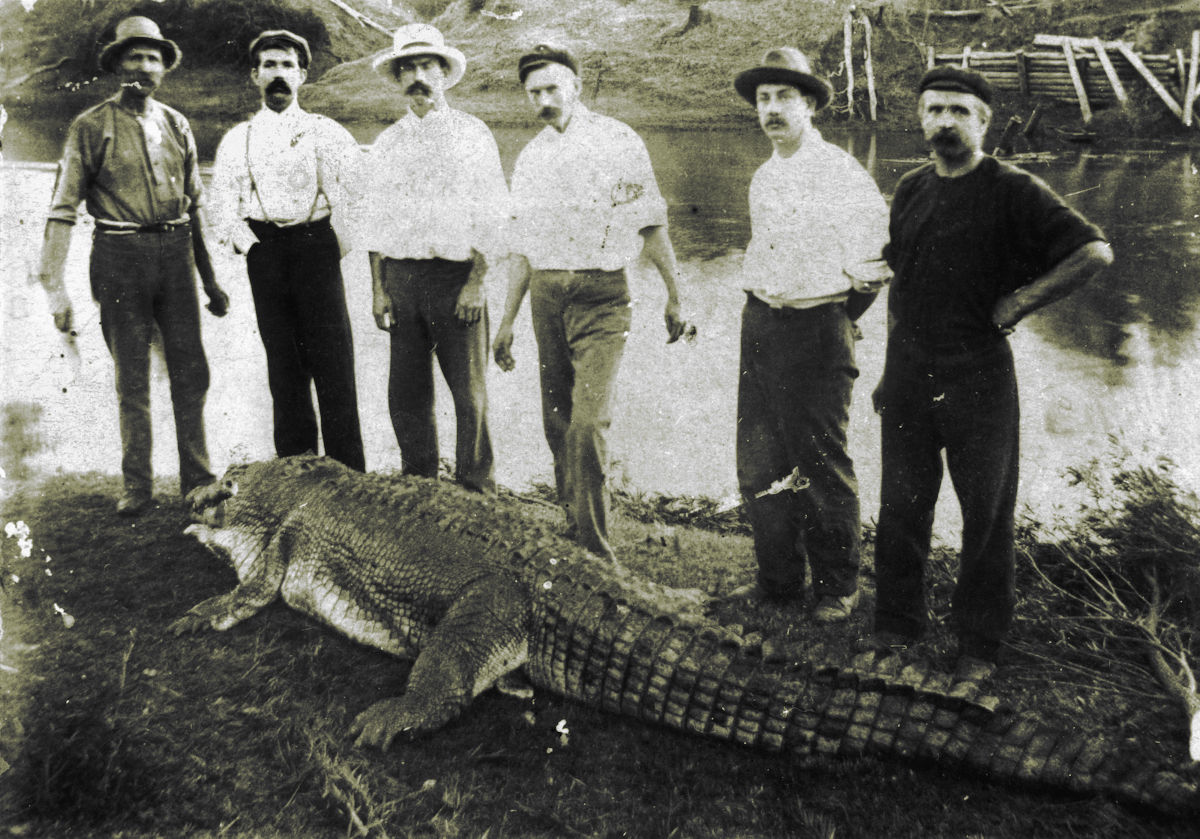
Above: The Logan crocodile, 1905. The men are John Storey (farmer), Jack and Alf Hinds (storekeeper), Mr Cook (school master), Mr Rump (publican) and Fred Manitzky (blacksmith). (State Library of Qld)

‘We are informed by a correspondent that on Thursday last Mr. William Hammel… of Beenleigh, observed a large alligator on the bank of the river near Loganholm ferry. Mr. Hammel procured a rifle and succeeded in wounding the saurian, which took to the water, and disappeared. From time to time of late the existence of an alligator in the Logan River has been alleged, but no credence has been given to these reports, as no authentic record exists of the occurrence of the alligator in Queensland rivers south of the Mary.’ (Brisbane Courier, 1 March 1905)

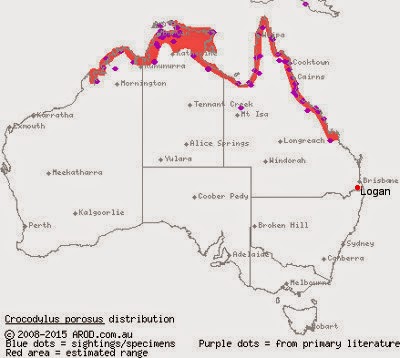
In the early 1900s a series of alleged sightings of crocodiles (or ‘alligators’, as they were often incorrectly termed at the time) in the Moreton Bay area were met with some scepticism, as this was thought to be too far south of the animal’s natural habitat. Despite this, the witnesses were usually quite adamant, like the man who was swimming near a sandy cove at Lota, on Moreton Bay, in December 1900 when he saw what he described as a ‘big log’ rise out of the water. He very quickly got back to shore but his friend supposed he must have seen a dolphin. However, one morning in 1902 he was in the same area looking across to Green Island and saw a ‘big animal of some sort’ running along a sand bank. He told a friend, who was sceptical and joked about it being his ‘sea serpent’, but a few days later she saw it herself through binoculars and claimed it to be a crocodile.

Saltwater crocodile distribution. (Australian Reptile Online Database)

There are also stories from around this time that a crocodile in the Albert River nearly overturned a ferry boat full of schoolchildren. Another story had a man swimming in the Logan and then being grabbed and pulled under before escaping. Witnesses to this event stated it was a crocodile. However, I have as yet found no corroborating evidence for these stories.

Another sighting took place on Fisherman’s Island, at the mouth of the Brisbane River, where a man claimed to have seen a crocodile with a ‘bunged-up’ eye. David Drennan, the lighthouse keeper at Fisherman Island, also reported seeing a crocodile near there in 1898. He estimated it to be about seven feet long. It was lying on the mud, and upon being disturbed it disappeared in the river. Drennan inspected its tracks and recognised them to be those of a crocodile.

A few newspaper stories in March 1892 referred to the supposed presence of a crocodile in the Brisbane River. A man fishing from a punt near New Farm claimed that an ‘alligator’ charged at his boat and he rammed one of his oars down the creature’s throat before heading for the bank. The croc gave chase but was apparently distracted by a barking dog on the shore, allowing the man to scramble ashore at Breakfast Creek.

There was some scepticism over this tale, but over the following weeks many more people claimed to have also seen it. There was talk of a hunting party being assembled to hunt the animal, but it seemed to have long gone and was never mentioned again.

Speculation reached fever pitch after Hammel shot and injured the crocodile in the Logan in February 1905. AJ Boyd recalled that back in 1870 he owned the Pimpama-Ormeau sugar plantation about 50km south of Brisbane. The plantation was next to a large swamp, and one day the manager told him that he had been sitting near the swamp when he heard a crackling noise in the nearby rushes, and a ‘long iguana-like animal came into view on the edge of the water’. It was, he said, ‘either the bunyip or an alligator’. Sometime later, during a drought, they burnt off the reeds by the water’s edge and noticed strange tracks there. In later years, Boyd saw crocodile tracks near the Herbert River and realised they were the same type as the ones he had seen at Pimpama. He was then convinced that there had been a crocodile on his plantation, and he even suggested that it could be the same one that Hammel had shot at.

A plausible explanation soon emerged for the presence of the animal so far south. It was said that about nine years earlier two ‘well-known’ Brisbanites had received the crocodile as a Christmas gift from some northern friends. During the night it escaped from the case it was contained in and vanished without a trace. About a week later some fisherman reported seeing a ‘strange monster resembling an alligator’ off Fisherman Island.

A few weeks after the Hammel shooting, fishermen spotted the crocodile on mud banks at Garden (Tindappah) Island, not far from the mouth of the Logan. It was next seen in June 1905 when it was shot at by Charlie Goetsch in the river opposite his property near Waterford West. The wounded animal then floated upstream to a ferry landing near the Logan village, where it was found dead a few days later by local storekeeper Alf Hinds. A few other men arrived and they pulled it up onto the bank.

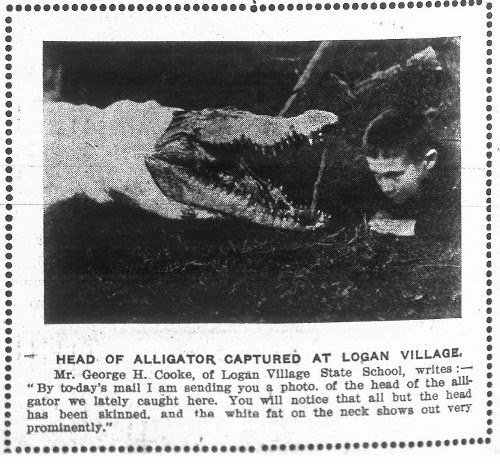
According to the Brisbane Courier, the crocodile measured a substantial 12 feet 7 inches long (3.83 metres), and its stomach contained corn, several ducks and small turtles. Excited locals gathered to inspect the new curiosity and pose beside it. It was originally intended to stuff the animal and keep it in Logan, but later reports suggest that its skin was displayed on a Logan Village school wall for many years afterwards. The photo below shows a child posing next to the freshly-skinned crocodile.

Child posing with crocodile. Brisbane Courier, 19 August 1905.
Brisbane Courier, 19 August 1905.

No crocodiles have since been sighted this far south, although one did turn up in the Mary River, near Maryborough, in 2012.

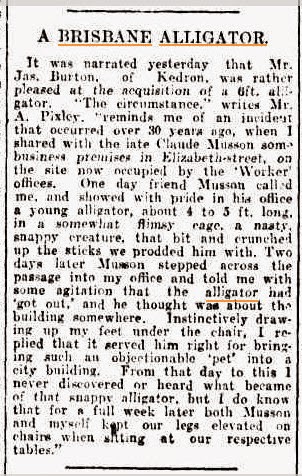
Postscript
The following story appeared in the Brisbane Courier in 1926:

Colonial Columns: ‘Cleveland Point’, by John Dunmore Lang (1854)

Above: Cleveland, 1885. (BCC, Brisbane Images)

Cleveland was proclaimed as a township in 1850. While it is a quiet suburb today, during the 1850s there was discussion of making this area the capital of the future colony of Queensland. There was shipping access there, but of course Cleveland eventually lost out to Brisbane. The following letter highlighting some of the logistical problems facing Cleveland at that time was written by prominent Queensland development advocate John Dunmore Lang in 1854.

Moreton Bay Courier, Saturday 26 August 1854

‘AUDI ALTERAM PARTEM (‘listen to the other side’)
CLEVELAND POINT

To the Editor of the Moreton Bay Courier.

Sir, – Having been one of a small party of the democracy, or, as our fallen friends delight to call us, the rabble and the mob, who made an excursion to the township of Cleveland during the present week, I beg to trouble you… with a few observations on that locality, first, as the site of a town, and secondly, as a rival shipping port to Brisbane and Ipswich.

I have no hesitation, therefore, in acknowledging that the impression produced upon my mind by the view of Cleveland Point and its vicinity was decidedly favourable. The locality is not only well chosen as the site of a town, but is highly interesting and romantic; its principal feature being a point of land, considerably above the water level, projecting into the Bay, and shooting out into its waters a long narrow spit of land, like the bony projection from the head of the fish called the Snapper. This spit of land has evidently been a reef of rocks on which the soil has accumulated on both sides in the course of ages from the washings up of the sea in northerly and southerly gales, the direction of the spit being east and west; and it is equally evident that, at no distant period, it has been one of the numerous islands in the Bay, the narrow neck that joins it to the mainland being scarcely elevated above high water mark. From the point already mentioned, as well as from the narrow spit, the view is singularly beautiful; the numerous islands, and lightly wooded shelving shores of the Bay, with Moreton Island and the Glasshouses in the distance to the northward, forming a picture on which the eye delights to rest.

To the south-ward, the channel between Stradbroke island and the mainland reminded me of Long Island Sound in the Bay of New York, although it is consider-ably wider than that narrow Sound. And one can scarcely gaze on such a scene without anticipating the time when a numerous agricultural population will be settled all along the shores of the Bay, and numerous steam-boats will be paddling along the now silent waters of this in-land sea, and maintaining a perpetual intercourse between the small towns and villages on its shores and the capital of the province.

There is much good land along the shores of the Bay, and as the principal object of my visit was to ascertain the general capabilities of this part of the country for the settlement of an agricultural population, with a view particularly to the cultivation of cotton, I was gratified to find that my anticipations on the subject were much more than realized. Besides the land at present available for agriculture around the Bay, there is a vast extent of land in all parts of it in process of formation, from the gradual deposits of sand and mud from the waters of the Bay in the numerous mangrove swamps that line the coast in all directions ; and there is also much land originally of the same character, now permanently abandoned by the sea, but still so strongly impregnated with saline matter as to be utterly useless at present either for man or beast.

Now it is precisely this description of soil – land on the sea-coast and strongly saturated with salt – that the cotton plant chiefly affects, and that produces the finest description of cotton. And I have no doubt whatever that when this species of cultivation becomes general and extensive, as it is sure to do in a few years hence at farthest, in this district, the salt marshes along the shores of the Bay will be in great requisition, and a numerous agricultural population, cultivating the cotton plant, and exporting the produce in as large quantities as the present export of wool, will be settled all along the Bay. For such a population – in the southern portion of the Bay – a town on Cleveland Point will be indispensably necessary, and such a town will accordingly grow up with the surrounding population as a matter of course. The proprietors of allotments in this township may there-fore rest assured that they will come into use and prove valuable at no distant day.

But to force up a town into premature existence, like a hot-house plant, in any locality whatever, when there is no country population within a moderate distance either to require or to support it, is the grandest absurdity imaginable. But this is precisely what has been attempted at Cleveland, and it only shews with how little wisdom the squatting world, including although it does the veritable aristocracy of the country, is governed.

The first indication of civilization and refinement, in approaching the township of Cleveland, is a brickfield, belonging to a practical brickmaker, who it seems has hitherto supplied all the material of that kind required for the construction of the city of Cleveland; and it is worth mentioning, for the comfort of all who are in any way interested in the stability and permanence of the future city, that the bricks made in that locality are of a very superior quality, and are worth at least a pound a thousand more than those made in certain other localities. At some distance from Mr Maskell’s brickfield, (the intervening line of bush-road leading through a beautifully wooded and richly grassed country that might almost be mistaken for the vicinity of a Ducal palace in the old country,) appears the first house in the town of Cleveland. It is an eight-roomed, substantial, commodious, brick-built, verandah cottage, with all the requisite appurtenances of a kitchen, and other outbuildings for the Democracy, on a much lower level towards the Bay ; the cottage itself being situated on the elevated point of land already mentioned, and commanding a beautiful view of the Bay with its fine scenery all round.

But every leaf was at rest, and I heard not a sound from the uninhabited mansion. It looked like one of those haunted houses that one sometimes sees in England, and that nobody will occupy for fear of “the ghost”; and when we reflected that it would probably cost from £1,500 to £2,000 to erect such a cottage, with all its appendages, in Sydney, and that it would rent, if there, at £200 a year, our party named it “Bigge’s Folly,” and rode on. At short distances towards the Point, we passed two other substantial brick cottages, each intended for two or more families of the Democracy, but both uninhabited like number one. We then crossed the low neck that joins the narrow spit to the mainland and rode onward to the jetty, where we found a whole suite of buildings for the future town, including a well built, substantial, capacious store, to which, as it was quite empty, our party gave the name of “Bigge’s Vacuum.’ Before the era of the Italian Torricelli, European philosophers used to tell us that “Nature abhorred a vacuum”; but here was a proof of the contrary, the capacious store at Cleveland Point being ” a perfect vacuum,” and no mistake. It was not very kind, however, in our friend Mr.- when contemplating this uninhabited town, (which really reminded one of the enchanted city in the Arabian Nights’ Entertainments), to say that “a fool and his money were soon parted.” An Englishman has a right to do what he will with his own ; and if any Englishman who has made his money at the public expense in the easy way the Squatters make theirs, chooses to build an uninhabited town in any part of this territory, what is that to Mr. -? Every Squatter, without exception, has “a preemptive right” to indulge in all such follies without let or hindrance.

Cleveland will never compete as a watering place for Brisbane and Ipswich, or for the inhabitants of the interior generally, with Sandgate, to which the access from Brisbane is so much more easy. Around Cleveland Point the shores of the Bay are generally muddy and the water very shallow ; the tide ebbing a long way out, and leaving a great extent of dry land, from which unpleasant exhalations arise, at low water. I was told indeed at Charleston, in South Carolina, in America, that the exhalations arising from land left dry by the efflux of the tide, did not constitute malaria, and were not prejudicial to health. But it would be quite as well for people visiting the coast either for health or for pleasure, not to make the experiment. At Sandgate, which I happened to visit in 1851, the shore is shelving and perfectly free from mud, the beach being composed in some places of sand, and in others of shingle. It is beyond all comparison a more suitable locality for a watering-place, such as will be indispensably necessary in this warm climate by and by ; and the building ground being situated much higher above the sea level and fronting the widest part of the Bay, it will be still more favourably situated for the sea-breeze. A good road from Brisbane to Sandgate, and the erection of a hotel, for families and invalids from the southern colonies, in that locality, are desiderata at present in this part of the territory.

As to Cleveland being ever a rival shipping port, competing for preeminence with Brisbane and Ipswich, the idea is absurd. Beautiful as the situation confessedly is for a subsidiary town, it affords no protection for shipping, and no facilities of any kind for the loading or unloading of vessels. The Bay, it must be recollected, is not less than sixty miles long, and twenty broad to the northward; and vessels lying off the Point are exposed to the full force both of the northerly and southerly winds that are frequent in the Bay, the only protection being from easterly or westerly winds. Besides, the water is very shallow, and the navigation, from rocks, and sand or mud banks, very intricate. Although I do not pretend to be an authority in such matters, I am confident, from what I saw at Cleveland Point, compared with what I have myself seen effected for the navigation of the river Clyde in Scotland, that it would take at least four times the amount to form anything like a proper harbour for shipping at Cleveland Point that it would take to remove every obstruction at present in the way of the navigation of the Brisbane River, and to render that river navigable for the largest vessels. Besides, there are whole miles of natural wharves already formed along both banks of the Brisbane River, whereas it would take an enormous outlay to construct anything of the kind at Cleveland Point. The Jetty at that Point, if carried out for about a hundred yards farther, towards the deep water, as is proposed, would form a very good landing place, both for passengers and goods, for small coasting steam-boats trading between the Bay and the Capital, although even for such vessels it would scarcely be available in bad weather; for I have been told that in such weather, the sea makes a complete breach over the present Jetty, and if carried out farther, it would only be the more exposed. No doubt if a few millions sterling were to be expended in the construction of a harbour at Cleveland Point, and if a Tram-road were formed between Cleveland and Ipswich, “the Squatters’ Mistake,” (for that I think ought to be the proper name for Cleveland), might compete with Brisbane as a shipping port. But these ifs are very awkward conjunctions; and the Squatters, who are interested in upholding the character of Cleveland should recollect the sage advice of the authoress of the famous Work on Cookery, “first catch your fish.”

These remarks, which I trust will not prove altogether valueless in certain quarters, will doubt-less be received the more willingly by the intelligent and candid reader, when I add that I was myself strongly prepossessed, on my first visit to this district, nearly nine years ago, with the idea that a shipping port and commercial capital for the Moreton Bay country should be looked for either in the northern or in the southern part of the Bay – either at Toorbul Point, opposite Point Skirmish on Bribie’s Island, where Flinders found a land-locked harbour, or at Cleveland Point. I am satisfied now, however, that Brisbane is destined to be the future Capital of this district, both commercially and politically; and the sooner the question is set completely at rest, the better will it be for all parties concerned. The blundering and delays of our incapable Governments – for the evil is of old standing, and by no means peculiar to the present regime – in the laying out of the sites for towns, and in the adoption of the requisite measures for carrying out proper plans, in this important particular, when once resolved on, have occasioned incalculable inconvenience and loss to the inhabitants of these colonies, from Geelong, in Port Phillip, to Moreton Bay; and the procedure of the authorities in this respect will remain a monument of folly to future generations. At Maitland there are three towns where there ought only to have been one. So are there also at Geelong, and so are there here. In all the three localities, it would have been perfectly easy for the Government to have formed one noble town in the proper place, and to have prevented the erection of a single house any where else in the neighbour-hood till that town had been fairly formed.

About a hundred and twenty years ago, old General Oglethorpe, a philanthropist of his day, formed a colony in Georgia in America ; and the cities which he formed – one of them a hundred miles up the Savannah River, – are built upon his original plans to the present day; having broad streets with lines of trees along the pathways, and noble squares at proper intervals throughout. What a wretched contrast most of our Colonial cities and towns present to this noble idea, and how indignant our posterity will feel at their forefathers entailing upon them inconvenience and disease from the faulty construction of our cities and towns ! For as the democracy will then have obtained a good government of their own, our posterity will scarcely know how to put the saddle on the right horse in these matters.

I am, Sir,
Yours, &c.,

JOHN DUNMORE LANG.

Brisbane, 17th August, 1854.’

Citation Needed: Evil-Clown Fakelore in Brisbane

The release of the ‘evil clown’ movie ‘It’ in 2017 was accompanied by the amendment of a Wikipedia article on ‘evil clowns’ to include several paragraphs about an alleged evil clown in Brisbane. While the anonymous author had obviously put a lot of effort into making this seem like a real story, it contained many obvious falsehoods from the first sentence to the last.

What I will do here is run through the story and debunk each bit of misinformation in turn to show how this story was ‘fakelore’ – that is, fabricated folklore.

‘There is a popular urban legend in Brisbane, Queensland, Australia in which the fiendish entity at the centre of the tale appears to be an early representation of the odd crimes and violent behaviour of a mentally disturbed vagrant in the city parks of Brisbane Australia in the late 1930s.’

To begin with, there is no such ‘popular urban legend’ in Brisbane. There is no record of this story even existing before the Wikipedia entry appeared in July 2017. However, the use of the phrase ‘urban legend’ is interesting because the author then starts making claims of official records to back the story up, even though none of these alleged records are ever cited. Almost every paragraph they added ends with the standard Wikipedia warning of ‘citation needed’.

‘Queensland Police records details of a handful of petty assaults in which various women and children were set upon by a fiend who resembles the modern idea of the evil clown. The victims were pushed around and subjected to a tirade of taunts and bawdy humour by a man dressed as a clown. The assaults which lasted only a few minutes saw the victims pinched, pushed and barraged with taunts by a painted joker. The man behind the makeup was dock worker Franklin Smith.[citation needed] 

Smith, a notorious drunk and thief, was well known to the local constabulary. The case turns strange when arrest records show that Smith refused to take off the clown outfit he was wearing. Smith stated that it was gifted to him by a dying gypsy woman and had been reported to be the very same outfit worn by a jester clown who had murdered a Romanian King due his amorous intentions for the victims Queen. Whenever constables tried to remove the garments Smith became violent and animalistic. Refusing to be quiet at his trial and mocking the presiding magistrate with foul humour and ridiculous gestures Smith was sent to what was then known as the Goodna Insane Asylum. 

The events which led to the institutionalization of Franklin Smith were further compounded by the hospital records of another inmate whose detailed sessions bear witness to Franklin reportedly talking to the clown suit at night.[citation needed]’

No evidence is provided to support these claims, and no records of any incident like this seem to exist. The absence of dates is telling, as is the fact that the author starts the next bit of the story with ‘legend says’ before again referring to detailed records. Which is it – urban legend or historical fact?

‘Legend says that even the staff of the asylum could not force or convince Smith to remove the jester garments. However, fellow inmates swear that he would often take the suit off in the dead of night. Hanging the outfit on his cell wall he would converse with it like a second party. One inmate claims that he had heard the suit answer back. The myth became even more mysterious in light of the actions that led to Franklin’s death. Smith was feared and despised by all the other inmates despite him never having spoken or interacted with any of them. The hospital medical examiner records in great detail that Smith was attacked by a vast number of inmates when undertaking his routine bath. A senior guard at the hospital diarised the event and made note of a second group of inmates banding together to ensure the cell holding the clown suit remained locked while the mob lynched Smith in the bath house.[citation needed]’

That is quite a sensational event. Fortunately, it never happened. No proof is provided in the story, even though such events would have been reported upon very prominently at the time, as were four suicides at the asylum during 1937-38 and an accidental death there in 1941. Any murder there would have also prompted a criminal investigation.

‘According to hospital records the clown suit was fitted within a state issued body bag of the times and transferred to the Dutton Park mortuary for internment in the lower section of the Dutton Park Cemetery. Mortuary documents reveal a complaint to the State government health board over the apparent gluing of a clown outfit onto the cadaver of Franklin Smith.[citation needed]’

Once again, no evidence or reference is provided for these claims, and – even more telling – there never was a mortuary at the cemetery.

‘State government investigations further detail a war of letters between the hospital and the funerary staff with hospital staff oblivious to how the clown suit had even been transferred along with the body let alone glued to the corpse. Enraged by the complaints, hospital official Dr Basil Stafford sent his head of staff Dr Peter Novel to view the body. Correspondence between the two doctors reveals a perturbed account from Dr Nobel who confessed that not only was it the suit that Franklin had worn but it was in fact glued or somehow tarred to the body of the murdered thief come jester.[citation needed] 

Dr Nobel further added that attempts to remove the costume were only successful in tearing away large chunks from the corpse and the decision was made to bury the infernal thing with the body. Franklin Smith was buried in an unmarked grave in Dutton Park Cemetery in 1941. The cemetery was made famous by the 1974 Brisbane floods in which a large section of the graveyard was washed away with some coffins still unaccountable. Further scandal over the council allegedly tampering plot records and using headstones for landfill have also brought the cemeteries name to the news headlines.[citation needed]’

Lots more allusions to the existence of records here, but still no citations of evidence. The cemetery paragraph is particularly misleading. There is no record of a Franklin Smith ever being buried in any Brisbane municipal cemetery, and there is not even a Frank Smith buried around that time. Also, ‘a large section of the cemetery’ was NOT washed away in 1974 (or ever), and so there are no ‘unaccountable’ coffins. There was also no ‘scandal’ with ‘tampering plot records’ (mistakes were sometimes made in record-keeping, but there was no ulterior motive). I suspect this was only raised here to provide cover for the fact that the burial records contradict the story.

‘It is however the growing number of sightings and accounts of people being pushed or prodded by an invisible assailant and various sightings of a creepy phantom clown at the cemeteries river edge that are sparking news interest and growing the legend. If local historians are accurate the site of this spate of phantom clown activity falls right at the area in which Franklin Smith was interred 12 feet down at the request of the then commissioner Johnathan Lairborne.[citation needed]’

Again we go back to the story being a ‘legend’, even as the author continues to allude to official (and conveniently unreferenced) records of these events. We also have claims of a ‘growing number’ of sightings of a ‘creepy phantom clown’, although once again there is no record of any such sightings prior to this article appearing in July 2017. And as for ‘news interest’ – the story has never been mentioned in any news outlet. Also, which ‘local historians’ have researched this? The answer appears to be ‘none’.

A perusal of the history of edits of the article (all detailed on the Wikipedia ‘view history’ facility for that page) reveals little. The story first appeared on 16 July 2017 and underwent several editing changes over the next few weeks. At a couple of early points the editor provided citations before quickly removing them. One of those citations went up on the 16 July and linked to a now-removed page on the Brisbane Ghost Tours website. Another citation was added on 20 July, this one linked to a ‘hauntedbrisbane.com’ address that redirected to the same Ghost Tours site. Another short-lived link went to the clearly irrelevant National Trust of Queensland homepage. Although the editor promised on 22 July that ‘state archive documents to support article will be published August 15th 2017’, nothing was ever produced.

This of course raises the question of who wrote the story, although it appears that the author was making a determined effort to remain anonymous. Their style is amateurishly affected and often cringe-worthy, while the plot is ridiculous. All the mentions of unnamed official records indicate a desire to present themselves to be a historian, but the author and their alleged sources were never identified.

No part of the history in this story holds up, and no citations of evidence are provided. Somebody was trying to invent a non-existent ‘urban legend’, but we can safely dismiss this as a piece of fakelore, planted on Wikipedia for whatever motive.

A problem with this sort of fake history is that it creates a genuine threat to the historical integrity of the cemetery. It distracts people from the real stories of real people interred there, and undermines the spiritual values of the place.

I edited the Wikipedia page to remove the fake story from the ‘evil clown’ page. It might reappear again sometime, but I suspect the author will continue to hide their identity and their alleged ‘sources’. Sadly, when it comes to people producing fake history, ‘citation needed’ seems to be a mandatory modus operandi.