Boab Prison Trees – Fact or Fiction?

‘A ‘BOOB’ IN A BAOB TREE.
Away up in Western Australia’s wild and woolly nor-west some distance out of Wyndham there’s a boob in a baob tree which is surely the queerest gaol in the world! It was used in the early days for imprisoning natives overnight while on their way to the township for trial and it is known officially as the Hillgrove Lockup.’ (Sydney Morning Herald, 31 August 1940)
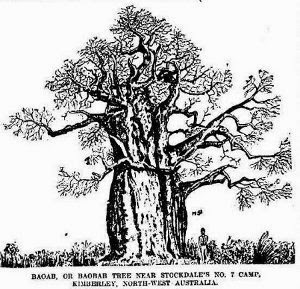
Boab tree
Boab tree. (The World’s News, 27 December 1902)

‘A Boob in a Baob Tree’, indeed. Well played, headline writer. ‘Boob’ is slang for ‘prison’ and, yes, he was writing about keeping prisoners inside a tree, specifically the rather peculiar boabs (Adansonia gregorii, also known as baobabs among many other names) found in the Kimberley region of north-western Australia.

There are two such ‘prison trees’ in the Kimberley region, one near Wyndham and another near Derby, some 900km away. Plenty has been written about these trees over the last century, thousands of intrepid tourists have photographed them (they have been tourism drawcards for decades), and the trees are even listed in the State Heritage Register of Western Australia. As boabs are some of the longest-living lifeforms in Australia (some are estimated to be 1,500 years old) their future as historical icons seems assured.

However… as a historian I would say that extraordinary claims demand hard evidence. There are plenty of retrospective tales about these trees being used as lockups, but is there any decent evidence? I tried to find some…
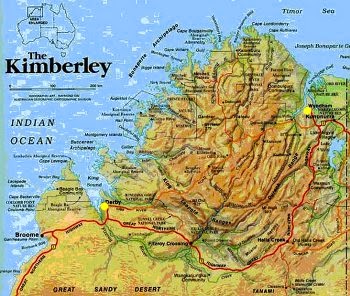
Map of the Kimberley.
Map of the Kimberley. Wyndham is the yellow dot to the east, Derby the yellow dot to the west.

The Story
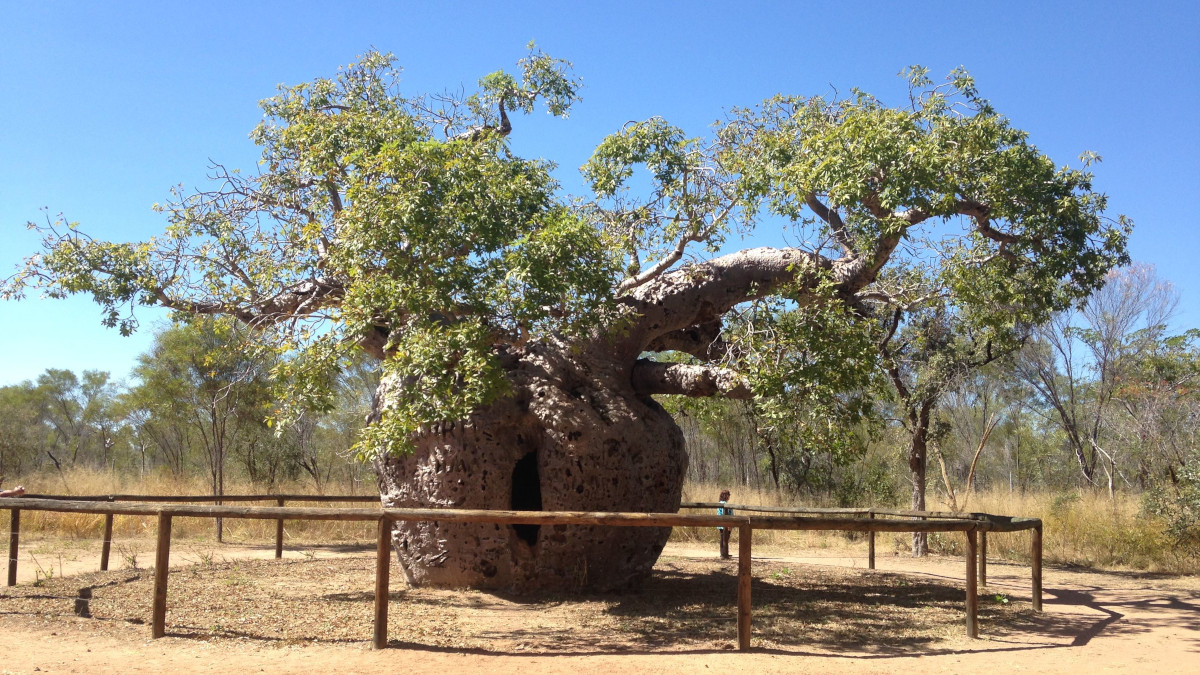
On the King River and Kurunjie Gibb River roads just south of the small town of Wyndham stands a large hollow boab tree at least 15 meters in circumference. This is the ‘Boab Prison Tree’, widely thought to have once been used as a makeshift lockup around the turn of the 20th century. Back then it was reportedly known as the ‘Hillgrove Lockup’. It was often necessary to march prisoners in chains over hundreds of kilometres from their places of arrest, and safe overnight camping places were required where the prisoners could be secured (according to a 1905 government report, about 90% of First Nations arrests in the region were for cattle-killing).

A similar tree just south of Derby is also said to have been used to confine First Nations prisoners being transported to Derby in the 1890s. The hollow had a ‘ceiling’ about 6 metres high with two natural holes for ventilation.
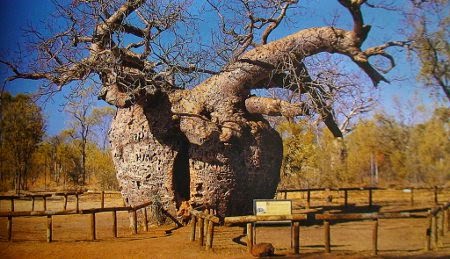
'Prison Boab Tree', Derby.
‘Prison Boab Tree’, Derby.

Newspaper articles about these trees began to appear in the 1910s and were already referring to their use as lockups in the past tense. The earliest mention I’ve found of it so far is in a Perth newspaper of 1919, which simply featured a photo with the caption, ‘A Boab Tree at the King River Pool, Kimberley. It is known as tile “Hill Grove Lockup.” Twenty-six native prisoners have been held in this tree at one time.’ 

Occasional newspaper articles over the following decades repeated the claim and generally provided very similarly worded information. The story goes that patrolling policemen in the 1890s or 1900s discovered that the Wyndham tree was hollow and they cut a person-sized opening so they could use it as a lockup for First Nations prisoners they were transferring to Wyndham. This was no mean feat as the walls of the tree are about 60cm thick. The entrance was said to have been fitted with an iron grille.

The internal capacity was around 9 square metres, reasonably roomy for inside a tree but probably not enough to accommodate 26 men, as claimed in this 1923 article, or 30 prisoners as suggested in this 1931 Queenslander article. This claim of 30 was also made by Ernestine Hill in her 1940 book The Great Australian Loneliness. A 1940 article makes the more realistic claim that some prisoners were chained to the outside of the tree when the hollow was full:

‘Some years ago a trooper was bringing into Wyndham a party in chains when at dusk they arrived at the baob-tree. As there wasn’t room inside for everybody the trooper chained two of the prisoners to the tree. One of the pair was a magnificent specimen of a man well over six feet high with well shaped arms and legs and a blacksmith’s chest. At daybreak that native was missing and so was the chain. But an iron bolt to which the chain had been padlocked was left bent back in the form of a hairpin.’ (Sydney Morning Herald, 31 August 1940)

It was also claimed in the Mirror (Perth) in 1936 that ‘the Queerest Gaol in All Australia’ had a huge bolt fastened into it for chaining prisoners to.

The boab has soft bark which allows people to carve graffiti into the tree, and a photo taken circa 1917-23 shows the words ‘Hillgrove Police Station’ cut deeply into the Wyndham tree (it can be seen here). Of course, a bit of graffiti does not prove anything – I could carve the same words into any old tree – but it does show the lockup story had currency at the time. Hundreds of other names and initials have been cut into the tree since then and the Hillgrove graffiti has all but disappeared.

Drawing of boab tree.

Not as much was written in the newspapers about the Derby boab, and a 1966 article on boabs in that esteemed academic journal Woman’s Weekly even suggested that the Derby tree was probably never used as a lockup, although they did add the rider ‘unlike the other well-known hollow baobab at Wyndham’.

Despite this, the two trees were heritage-listed in the 1990s. It is claimed in the State Heritage Register entry (under ‘Prison Boab Tree’) that the Wyndham tree was used as a lockup, and there is also emphasis on the Indigenous significance of the tree, although all uses are part of ‘a long oral tradition history of use’.

The entry in the same register for the ‘Prison Boab Tree’ of Derby makes the more ambiguous claim that the tree was ‘believed’ to have been used as a lockup. Despite this, it is noted that the tree is significant as ‘a symbol for the town of Derby as for the history associated with it. It represents the harsh treatment prisoners often received in the north of Australia in the late nineteenth and early twentieth century’. It is also noted that the tree is a ‘well established tourist landmark’, but then boabs in general have attracted sightseers since the 19th century. Indeed, the popularity of the prison trees and the resulting stream of people climbing into them and carving names in the bark has resulted in the trees being fenced off.
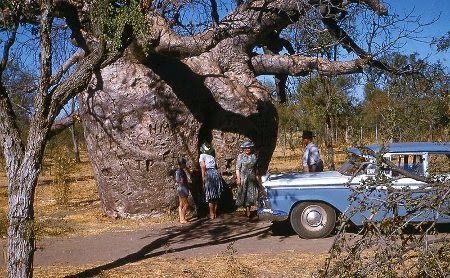
'Prison Boab Tree', Wyndham, 1960.
‘Prison Boab Tree’, Wyndham, 1960. (Wikimedia Commons)

This popularity shows no sign of diminishing. Numerous images of the trees, many taken by tourists, can now be found on the Internet, and dozens of websites feature the ‘prison tree’ claims. Some of these websites are travel blogs, others are dime-a-dozen travel advisory sites, and others (including local and state government websites) use the trees to promote local tourism. Worst of all are the ‘Amazing Top Ten’ sites that infest the Internet with unoriginal information. Look up some of the website types named above and you will instantly notice the unfortunately common practice of cutting-and-pasting entire blocks of text from one website to another. And so the legend spreads…

Behind the Stories
The fame of the Boab Prison Trees is well established in national folklore and it is easy to see why. A string of occasional newspaper articles – especially from the 1930s onwards – pretty much repeat similar stories of First Nations prisoners being confined within the boabs. Various authors mentioned the Derby boab tree elsewhere. JK Ewers wrote about the boab tree that was used ‘for a gaol’ for a 1949 edition of Walkabout magazine. In his 1961 book The Land That Sleeps, Gerald Glaskin mentioned the ‘famous’ tree having been ‘hollowed out and used as the township’s jail’. Mary Wilcocks similarly wrote of the ‘famous prison bottle tree’ in a 1966 article for Walkabout.

This repetition has been amplified a hundredfold on the Internet, but all these sources seem to contain a lot of hearsay and no direct evidence. It is telling that the earliest written references to the prison trees only appeared in the 1910s, especially as the use of trees as chaining-posts is well established and recorded elsewhere in Australia. Early police stations in the Bush usually had no built structures outside of a canvas shelter, and it was common to chain prisoners to strong trees or heavy logs. This practice is known from official records and numerous newspaper accounts of the 19th century.

It does seem possible that the Wyndham and Derby boab trees were used as chaining-posts, and news articles of the 1930s and ‘40s mention this happening (although a huge chain would be needed to surround the tree). It is also quite possible that chains were affixed to a bolt in the tree. There is, however, no contemporary mention made of the inside of the tree being used, although the reminiscences of the Reverend Andrew Lennox – who lived in the region 1897-1907 – mention that the Wyndham boab had ‘a door… cut out of it, with a lock and key on it, the decayed pith cleaned out was used as a temporary locker by the police, ventilated by slightly porous ceiling’. This memoir was completed in 1958.

On the other hand, this 1894 article about the treatment of First Nations prisoners being marched to Derby makes no mention of the boab, and neither does this 1894 story about prisoners escaping from Wyndham lock-up. Even fairly descriptive articles about Derby and Wyndham in the 1900s make no mention of the prison trees (such as this one from 1905) and, more tellingly, neither does this very long 1907 article.

The boab is particularly conspicuous by its absence from a 1905 state government report on the appalling treatment of First Nations prisoners in the area, despite the report giving a very detailed and damning account of the gaols and the transportation of prisoners to Wyndham and other local towns. A stockman who appeared before this inquiry was questioned:

‘Have you seen natives being brought under escort by the police?’
‘Yes.’
‘Have you noticed whether the chains are attached to the constable’s saddle, or held in his hand?’
‘No. The chains were fastened round the blacks’ necks, and they marched along in front of the policeman’s horse’.
‘Are the women put in chains?’
‘Yes. This is done as a safeguard because they are witnesses against the male prisoners.’ (Western Mail, 25 February 1905)

A police constable also described transporting female witnesses:

‘How do you detain. them, with neck-chains?’
‘They are chained by the ankles.’
‘Do you mean that their two legs are chained together?’
‘No. I fasten the gin to a tree, with a handcuff and then fix the chain to one ankle with another handcuff – one handcuff, for each prisoner.’
‘Is it only at night that they are chained like this?’
‘It is necessary to detain them sometimes in the day when going through scrub or. rocky country, where they might get away; It is very rare that they have to be secured in the day time.’
(Western Mail, 25 February 1905)

Prisoners in chains outside the Roebourne Gaol, Western Australia, 1896.

While the non-mention of any boab in these reports doesn’t prove that the trees were not used as lockups, it does show that if they had, then the newspapers of the day would certainly have reported such things.

There is much doubt about the Derby tree in particular. The subject is explored in Gerald Wickens’ book The Baobabs* with the conclusion that there is zero official evidence for any use as a lockup, and that the tree is close enough to Derby (16km) that the police would have continued on to the town anyway (a gaol had been established there in 1887). Moreover, overland marches with prisoners tended to be long enough to cover several days and nights and as prisoners were chained together (by the neck) there was little need for makeshift lockups elsewhere, so why have one so close to Derby?

First Nations Perspectives
It is important to note that there are no Indigenous accounts of such a use. Researchers in Wyndham found that:

‘… the indigenous interviewees revealed alternate perspectives regarding the accepted historical wisdom of prison trees in the Kimberley. The tale commonly told is that Aboriginal prisoners were imprisoned within the hollow in the tree overnight on multi-day trips to take them to the nearest Kimberley gaol. Aboriginal perspectives of the prison trees revealed the belief that prisoners were actually chained to the outside of the tree while their police custodians slept in the dry hollow (away from monsoonal rains and mosquitos).’

Boabs feature extensively in First Nations social, material and spiritual culture. As a Department of Environment and Heritage report on the Kimberleys noted:

‘Some trees are believed to harbour extremely severe and potent powers, like Jilapur, a boab on the outskirts of Derby, more commonly known as the Derby Prison Tree. This tree is believed to be about 1,500 years old, and it has an opening into its hollow trunk large enough for a man to enter. There is speculation that prisoners were locked inside, and other accounts recall prisoners being chained around the outside of the tree. This tree is also a camping place for the Nyikina Creation Being Woonynoomboo.’

It was a practice in many First Nations cultures to place the bodies of their deceased on tree platforms and later put the bones inside trees or other concealed places. Confining living people inside trees that had been used in this way would have been unspeakably horrific from an Indigenous viewpoint. An account written in the 1910s noted the presence of human bones in the Derby tree:

‘It has even been suggested that the Derby tree was used by Aborigines as a resting place for the dead. The natives have long been in the habit of making use of this lusus naturae as a habitation; it is indeed a dry and comfortable hut. Some bleached human bones were lying upon the floor, which suggested that the tribe had also made use of the tree for disposing of the dead. A frontal bone of a skull clearly bore evidence that the individual had fallen a victim to the bullet of a rifle.’#

Such a use was also mentioned by author Ernestine Hill in 1934:

‘At Mayall’s Well, outside Derby, there is a tree-vault 25 feet in diameter, a native burying-ground from which they have taken the skeletons of a whole dynasty.’
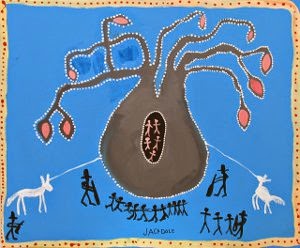
'Boab Prison Tree Derby'
‘Boab Prison Tree Derby’ by Jack Dale, 2012.

Who ‘they’ were and why they took the skeletons is not elaborated on. Mayall’s Well is very close to the prison boab. Also writing in 1934, author Ion Idriess claimed that the tree hollow was ‘littered with aboriginal bones’ and that a ‘fragmentary skeleton’ was still there but word was that ‘sightseers from the irregular steamers had souvenired others’.

In 1999 the ‘Boab Prison Tree also known as Kunamudj’ was registered under the Aboriginal Heritage Act 1972. It is recognized as a ceremonial and mythological site associated with Kunamudj, the shark. The tree was also fenced off and a sign placed there reads thus:

‘Site of Significance
The significance of the Prison Boab Tree derives from its reputed use as a rest point for police and escorted Aboriginal prisoners en-route to Derby, and principally, its prior but less publicly known connection with Aboriginal traditional religious beliefs.
The Prison Boab Tree attracts many visitors. The fence was erected out of respect for the religious significance of the Prison Boab Tree and to prevent pedestrian traffic from compacting the soil around its roots.
The site is protected under the Aboriginal Heritage Act 1972. Please be advised that unauthorized entry beyond the perimeter fence is prohibited.
Note that snakes are known to inhabit the tree.’

The Verdict?
Widespread repetition of sensational stories without recourse to historical research is a key factor in urban myth-making. Newspapers and websites have certainly spread it far and wide over the last century, but these situations are always made worse when businesses have a vested interest in propagating myths. The tourist industry has to exploit whatever local resources/attractions it can to promote itself, and in this case the local industry around Derby and Wyndham certainly feature the prison trees prominently in their marketing.

From the dozens of ‘prison tree’ references on the Internet it would be very easy for a non-skeptical person to assume they must be true. Despite this, there seems to be little evidential basis for the lockup stories. There is none for the Derby tree, and only the writings of Rev. Andrew Lennox provide any eyewitness reference to the Wyndham tree as a lockup. It is quite likely that the trees could have been used for chaining people to, but not actually being confined inside. The stories have all the appearance of an urban (or in this case, rural) myth. What is more, this would be a myth that overshadows a much more interesting Indigenous perspective on the trees. Still, as the heritage-listings point out, their reputation as ‘prison trees’ does act as a useful reminder of the historical treatment of First Nations prisoners.

All that being said, if any reader out there knows of any direct evidence that these boabs actually were used as prison trees, I’d love to hear it.

Full title: ‘The Baobabs: Pachycauls of Africa, Madagascar and Australia:’
# Herbert Basedow, ‘Narrative of an expedition of exploration in North-Western Australia’, Transactions of the Royal Geographical Society of Australasia, South Australia Branch, vol. XVIII, session 1916–1917, pp. 105–295.

Death Rides a Penny-Farthing

Above: Studio photograph of two men on penny-farthing bicycles, Queensland, ca. 1885. (John Oxley Library)

A Toowong Cemetery headstone features one of the more unusual symbols I’ve found on a marker. Dating from the mid-1880s, it is on the grave of Alfred Joseph Duggan of Spring Hill, a 19-year-old chemist’s shop assistant, a member of the Brisbane Amateur Cycling Club, and the proud owner of a penny-farthing.

Duggan family grave, Toowong Cemetery, 2020.
Penny-farthing image on the Duggan family grave, Toowong Cemetery, 2020. (C. Dawson)

The penny-farthing was popular in the 1870s and 1880s, when it was simply called a ‘bicycle’, the first machine to be known by that name. The ‘penny-farthing’ moniker actually came later, a reference to the disparity in the wheel sizes being like two British coins – the large penny and the tiny farthing.

On Thursday 13 November 1884, Alfred was riding his penny-farthing along the North Quay near central Brisbane when he fell off and managed to dislocate the second joint of the ring finger of his right hand. He went to a doctor and had the finger set, and at first his injury did not appear to be too serious. However, a couple of days later tetanus set in and he was sent to the hospital on Wednesday 18 November. Tetanus is an infection caused by bacteria entering the body through a break in the skin such as a wound caused by a contaminated object. This produces toxins that interfere with normal muscle contractions and result in severe muscle spasms, each usually lasting a few minutes and sometimes severe enough to fracture bones. In the most common type, the spasms begin in the jaw a few days after infection (which is why tetanus is also sometimes referred to as ‘lockjaw’) and then progress to the rest of the body, with about 10% of cases proving fatal.

After monitoring his condition, the doctors decided to amputate the affected finger, but it was too late and Alfred never rallied, and he died, reportedly on ‘great agony’ during the night of Friday 20 November.

It was an interesting decision by his mother to incorporate a lead-rendered image of a penny-farthing on his headstone, seeing as his fall from one led to his eventual death, but it would also reflect his love of the contraption.* The wording on the stone also reads that he died ‘in the 20th year of his age, by a fall from a bicycle’. Most contemporary records indicate that Duggan’s given names were Alfred Joseph, although it is marked on his headstone as Joseph Alfred. A stonemason’s error, perhaps? It did happen from time to time.

The penny-farthing became obsolete from the late 1880s, when modern bicycles with evenly-matched wheel sizes became popular. These were marketed as ‘safety bicycles’ because they were much lower than penny-farthings, which reduced the danger of falling from them. A danger that was sadly demonstrated by the tragic demise of Alfred Duggan, and recognised on his headstone.

Similarly, another marker in the cemetery for the victim of a motorcycle crash features a motorcycle symbol.

The Gallows of the Old Windmill Tower

Above: Depiction of the 1841 hanging in Brisbane. (Telegraph, 10 March 1970)

The ‘Old Windmill Tower’ on Wickham Terrace is the oldest surviving European structure in Queensland and one of the heritage gems of Brisbane. It has been used for a variety of purposes since its construction by convicts in 1828, being at different times a windmill (originally driven by sails, and then by treadmill) a telegraph signal station, fire brigade observation point, radio research and television broadcasting station, and now a heritage-listed historical site.

All this history was quite interesting in its own way, but there was one incident that was heads-and-shoulders more dramatic than anything else that happened there (including the time a convict slipped to his death on the treadmill). In the winter of 1841, during the dying months of the convict settlement, two First Nations men – Mullan and Ningavil – were hanged at the windmill tower for being accessory to the murder of William Tuck (a convict assistant to surveyor Granville Stapylton – who was also murdered at the same time – near Mt Lindesay).

It was a fascinating case for various reasons: a graphic local example of early First Nations-European conflict over law and land; the horrifically grisly murder scene; the unusual decision to return the prisoners to Brisbane after their Sydney trial; and the fact that it appears the wrong men were convicted. All those details are covered in the book The Hanging at the Brisbane Windmill, but this article will focus specifically on the type of gallows used that day, because it is still not clear if the unfortunate men were hanged from the tower, or just near it. The commonly-believed story is that they were hanged from the windmill, but even then there are differing accounts of exactly what the gallows looked like. Was the rope attached to the windmill sails, or a pole sticking out of a window, or did the whole thing take place on a nearby separate gallows constructed from the dismantled sails themselves? Different records tell different stories and there is still uncertainty on this matter.

The windmill had been constructed on a high ridge next to the convict settlement with the intention of using it to grind corn, which was the main ingredient of the convict diet. The sandstone-and-brick tower was 16 metres high and encircled by a small exterior balcony about a third of the way up the side, allowing access for the maintenance of the large wooden sails. The windmill turned out to be mechanically unreliable as it was not well positioned to catch the wind, and it also required a lot of maintenance. A convict-operated treadmill built adjacent to the mill compensated for this problem.

Despite these technical issues, the windmill was reported to still be working in 1841, having been maintained by convict mechanics. Tom Dowse, who arrived in Brisbane in July 1842, recalled that, ‘We Journey’d up the hill to inspect that relict of old times – its well appointed Machenery, its revolving arms dressed with a complete suit of Sails, all in proper working order’. Dowse also reported in a March 1845 letter to the Sydney Morning Herald that the mill was still working and being used by private individuals for grinding corn and wheat.

The contemporary observations of Dowse were contradicted by the journalist J.J. Knight, who wrote in 1898 that the windmill had been ‘partially dismantled’ by the time of the hanging. The question of the working status of the windmill in the early 1840s is important when assessing Knight’s further claim that the ‘disused arms made convenient timber for a staging which for the purposes of the execution projected from the balcony’. He also wrote that ‘a pole was run out from a window above, and to this was fastened the fatal rope’. This is one of the clearest written descriptions of the actual gallows used for the hanging of Mullan and Ningavil, but Knight was writing over half-a-century after the event and using oral history sources, which can sometimes be quite unreliable.

A nine-year-old Tom Petrie was a witness of the hanging, which was described in his reminiscences (published in 1904) as taking place ‘at the windmill, which was fixed up for the occasion’. This phrasing suggests that the windmill itself was adapted for the purposes of the execution. Whatever the gallows looked like, we do know that they were constructed by Tom’s father Andrew Petrie, who was the Foreman of Works in the settlement. Knight wrote that Alexander Green, the executioner, brought up from Sydney for the occasion, was impressed with the gallows and assured Petrie that they were ‘quite equal to the affair in Sydney’.

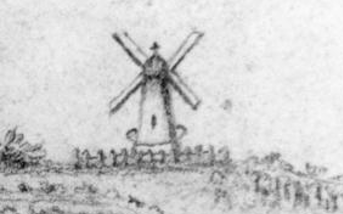
The balcony of the windmill, possibly used as the gallows stage, can be seen below in this detail from a sketch of the settlement, circa 1835 (attributed to Henry Boucher Bowerman, John Oxley Library).

Unfortunately, contemporary newspaper reports of the execution provide no description of the gallows, only telling us that the hanging took place ‘at’ Windmill Hill. The official records are also quiet on the subject.

This was only the second hanging to have taken place at Moreton Bay, the first being in 1830 when two runaway convicts were returned after trial in Sydney and executed in the yard of the convict barracks, reportedly on a scaffold made for the occasion. It is not known what happened to those gallows, but in later decades it was common practice for gallows to be dismantled and stored away after use, then reconstructed when required again. Is it possible that the components of the convict gallows were carried up Windmill Hill in 1841 to be reassembled and reused there? There is no evidence to suggest this actually did happen, but it does remain a possibility.

The next Brisbane hanging came in 1850, when two murderers were hanged on Queen Street. On that occasion, second-hand gallows were transported up from Maitland Gaol, which had recently acquired a new set.

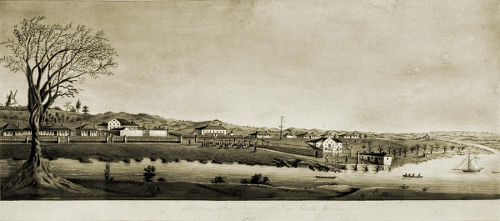
A panoramic landscape by Henry W. Boucher Bowerman, depicting Brisbane circa 1835.
A panoramic landscape by Henry W. Boucher Bowerman, depicting Brisbane circa 1835. The windmill can be seen on the far left. (John Oxley Library)

So while the most descriptive evidence suggests that the windmill tower was adapted for use as gallows, either with the construction of a new attached scaffold or simply using the existing balcony, that evidence was provided decades later and there are no contemporary accounts to back it up.

One thing we can be sure of is that Mullan and Ningavil were hanged – one at a time – using the ‘short drop’ method, in which the body on the end of the rope fell less than one metre. In later years the government switched to the ‘long drop’, carefully calculated to give a ‘quick death’ by delivering enough force at the end of the fall through the scaffold to break the prisoner’s neck. However, the short drop was still in use in the 1840s and the results were almost always a slow death by strangulation. Young Tom Petrie was taken to look at one of the bodies after the hanging, and his description of the face he saw clearly indicates strangulation:

‘After it was over a prisoner, taking young ‘Tom’ by the hand, drew him along to have a look in the coffin. Stooping, he pulled the white cap from the face of the dead blackfellow, exposing the features. The eyes were staring, and the open mouth had the tongue protruding from it. The horror of the ghastly sight so frightened the child that it set him crying, and he could not get over it nor forget it for long afterwards.’ (Constance Campbell Petrie, Reminiscences of Early Queensland, 1904)

So ended the hanging of Mullan and Ningavil. They had been returned from Sydney to Brisbane so that their deaths would serve as a lesson to those who witnessed it, which turned out to be about 100-300 First Nations people as well the majority of the European population of the settlement. After the event, the instrument of the prisoner’s death was immediately removed. The windmill itself was sold and dismantled for parts in 1849, and converted into a telegraph signal station in 1861. By that time Brisbane had a new prison (at Petrie Terrace) and executions were conducted inside the prison yards, away from the prying eyes of the public. Coincidentally, the first person to be hanged at that new prison was Thomas Woods, who – as one of the few remaining convicts in the Moreton Bay Penal Settlement in July 1841 – had been mustered to watch Mullan and Ningavil hang at the windmill. Clearly, the intended lesson of their execution had not been learned by some.

The Seven Devils of George Street

Above: Printer’s Devil over main entrance, old Printing Office, George Street, Brisbane. (Public Works)

‘Now when Jesus was risen early the first day of the week, he appeared first to Mary Magdalene, out of whom he had cast seven devils.’ (Mark 16:9)

Anyone familiar with Brisbane’s George Street will probably have noticed the bizarre carved relief of a devil’s head over the main entrance of the old Government Printing Office. If you are not familiar with it, stop and take a look the next time you are around there.

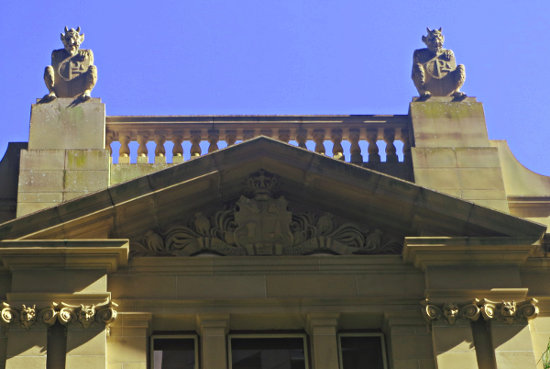
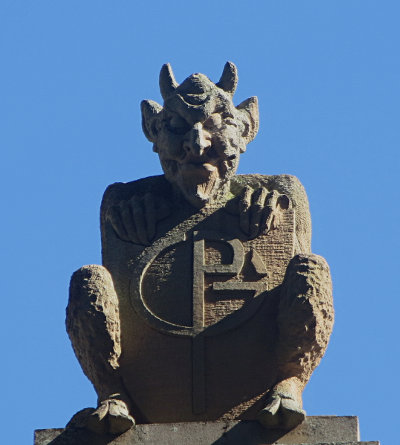
Then, if you step back a bit, look up to the top of the building and you will see two hooven gargoyles with the same face, perched on the parapet looking out over the street. The trees make viewing a bit tricky, but you might also be able to see four other carved devil faces on the pilasters on the wall below the gargoyles (see photo below).

This means that back in 1911-12, the Queensland Government erected a government building with seven sandstone devils on the front. Why would they have done this? The answer is not as sinister as some might think. Simply enough, the devil is a historical symbol of the printing industry.

As far as I know, these are the only ‘printer’s devils’ on a public building in Australia, although I would be happy to be corrected on this matter.

The gargoyles on the parapet watch over George Street.
The gargoyles on the parapet watch over George Street. Four small devil faces can also be seen near the bottom of this photo. (Brismania)
The gargoyles hold shields inscribed with 'GP' (Government Printery).
The gargoyles hold shields inscribed with ‘GP’ (Government Printery). (Brismania)

Why the ‘Printers Devil’?
There are several different theories, some more plausible than others, as to where this concept came from.

A ‘printer’s devil’ was a nickname given to printer’s apprentices, who performed such tasks as mixing ink and fetching type. These apprentices invariably stained themselves with black ink and – as black was associated with the ‘black arts’ – the nickname ‘devil’ took hold.

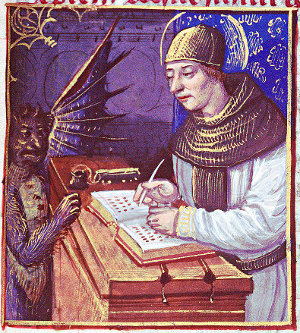
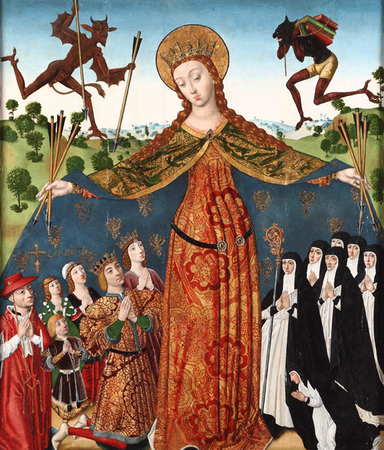
There was also said to be a ‘fanciful’ belief among printers that print shops were haunted by a special devil who got up to such mischief as inverting type, removing entire lines of completed type, or misspelling words. Historically this figure was Titivillus, a mythical demon that worked on behalf of Satan to introduce errors into the works of scribes. References to Titivillus date back 800 years. It has been suggested that the apprentice became a substitute scapegoat for printery mishaps, leading to the ‘devil’ nickname.

Another rather implausible account of the origins of the name has John Fust – a business partner of Johannes Gutenberg – selling several of Gutenberg’s bibles to King Louis XI of France, claiming that the bibles were hand-copied manuscripts. As the individual letters were identical in appearance, Fust was soon accused of witchcraft and imprisoned. Although he was later freed, many still believed Fust was in league with Satan.

Diego de la Cruz: Virgin of Mercy (c. 1485), Burgos, Abbey of Santa María la Real de Las Huelgas.
Diego de la Cruz: Virgin of Mercy (c. 1485), Burgos, Abbey of Santa María la Real de Las Huelgas. Titivillus appears to the right of the image.

A further association with the devil in printing is the name of the hellbox, which was a box that worn and broken lead type was thrown into, and which the printer’s devil (apprentice) then took to the furnace for melting and recasting.

Yet another link was ‘Deville’, the assistant of the the first English printer and book publisher, William Caxton. This was said to have evolved to ‘devil’ over time and used to describe other printers’ apprentices.

All in all there are a number of possible explanations for the concept of the printer’s devil, but the link between the ancient Titvullus stories and the ink-stained apprentices seems the most plausible.

There is, however, one other story I came across during research for this article. It comes from an uncomplimentary review of a Brisbane ‘Ghost Tour’ that stops outside the Printing Office, where the customers are told this story of the devils:

‘They are thought to ward off evil spirits, however these ones invite them… Printing presses, much to the displeasure of the church, used to print copies of the Bible. This made the book more accessible to commoners and limited the church’s ability to manipulate its contents. The church therefore condemned printers, citing them in league with the devil. However instead of backing down, the printers took on Lucifer as their patron saint.’

Those are the words of the reviewer, of course. If the content of this review is correct, then the tour guide has got it wrong and a correction is required. The advent of the printing press did present challenges (and opportunities) for organised religion, but Satan is not the patron saint of printers (see instead John Bosco, and Augustine of Hippo). I’d assume that Satan is not the patron saint of anything. Satan isn’t even a saint. (The review also relates another tour story about the Printing Office that also seems to be untrue, and that is covered here).

The Printing Office: A very brief history
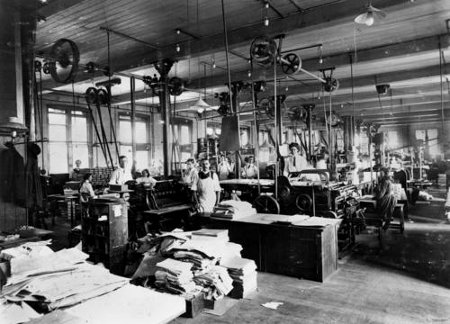
The new Colonial Government (created by the separation of Queensland from New South Wales in 1859) needed a printing office to print official materials such as Hansard, postage stamps, Government Gazettes, Acts of Parliament, departmental reports, survey maps, electoral rolls, and banknotes.

Government Printing Office, Brisbane, 1912.
Government Printing Office, Brisbane, 1912. (John Oxley Library)

A three-storey brick building facing William Street was constructed during 1872-74 (and is still there today as the Public Service Club), and extended with a three-storey brick building erected along Stephens Lane (1884-87). The complex was further extended in 1910-12 with the erection of the three-storey brick building on George Street. The importance of the printing office to a functioning democracy was reflected by its proximity to Parliament, and the high quality of the buildings themselves. It is inconceivable that modern state governments would build such quality structures, never mind adorning them with finely-sculpted statues and reliefs.

The gargoyles were lifted into position in October 1911:

‘The Printers’ Devils.’
Two huge stone figures with sardonic grins on their hard faces were swung into position on the top of the third story of the additions to the Government Printing Office yesterday. From their giddy height they look down on to the traffic below. On the shields which they clasp in their hands is inscribed: ‘G.P.’ – Government Printer. These symbolise that mythical individual supposed to form part of a printing establishment – the printer’s devil. The Government Printer is to have a double supply – hence two figures have been carved out and placed in position. Yesterday they were the subject of much curiosity, and speculation. The only thing wanting to complete the symbol is a plentiful supply of printers’ ink to the faces, and a couple of aprons of the colour of coal! (Brisbane Courier, 25 October 1911)

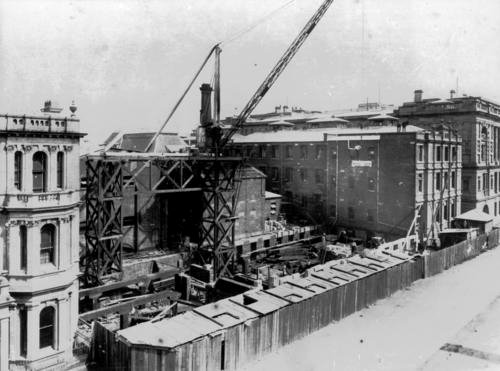
Printing Office under construction, 1910.
Printing Office under construction, 1910. (John Oxley Library)

The Printing Office staff started holding annual balls in 1940, and the decorations for the first event had a ‘printer’s devil’ theme.

The George Street Printing Office closed in 1983 and after some demolitions and modifications to parts of the wider site it was heritage listed in 1992.

The Eighth Devil

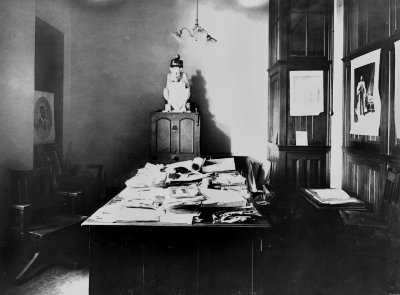
In addition to the seven outside the printery, there was at least one more devil inside the building, as shown in this photo of one of the offices in 1921:

Devil statue on desk.
‘A large desk, overflowing with papers, stands in the middle of  the room. A safe is positioned against a wall to the side of the desk. On top of the safe is a stonework devil, identical in style to the two gargoyle statues that are perched over the entrance to the building.’ (John Oxley Library)
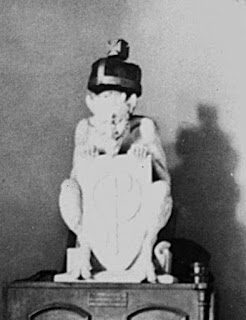
Devil on a desk.

A close-up of the devil on the safe reveals it to be wearing some kind of hat (a crown?) with a Maltese Cross (Queensland government symbol) on the top. Perhaps this was a bit of public service office humour.

I wonder where this rather splendid ornament is now?

Colonial Columns: ‘Observations made on a journey to the natives at Toorbal, August 1841’ (Part Two)

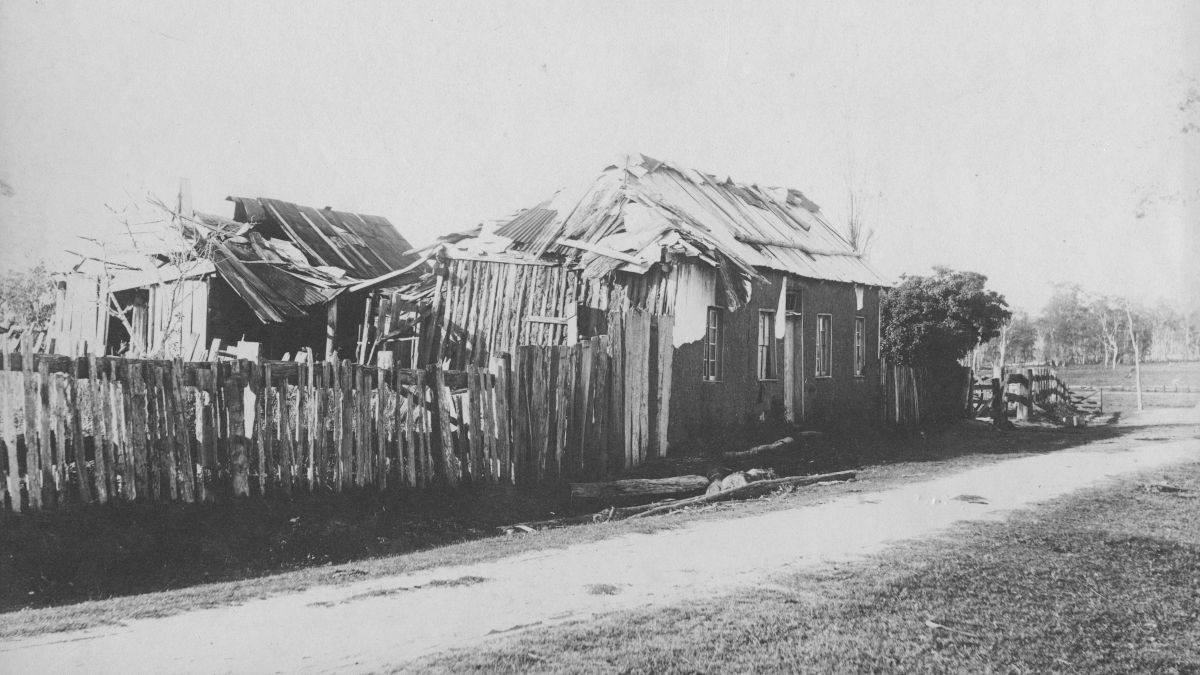
Above: Old missionary cottages on Zion’s Hill, Nundah, ca. 1895. John Oxley Library.

‘Observations made on a journey to the natives at Toorbal, August 1841 (Part One)’ can be seen here.

The Zion Hill Mission was founded as a Lutheran/Presbyterian/Pietist mission during 1838 in what would later become Nundah, Brisbane. This was the first free European settlement in the region, which was still the Moreton Bay Penal Settlement. The missionaries had limited success in converting the local First Nations people to Christianity.

In August 1841, the Rev. Christopher Eipper and Gottfried Wagner went north to a First Nations initiation ceremony at Toorbul. On this journey they were guided by Wunkermany and two other First Nations men from the Mission. The journal of this trip gives a valuable insight into the social landscape of the time, with some amusing incidents demonstrating a sense of humour on both sides. This is Part Two:

Colonial Observer (Sydney), 21 October 1841

‘Observations made on a journey to the natives at Toorbal, Aug. 2, 1841. By the Rev. Christopher Eipper, of the German Mission to the Aborigines at Moreton Bay.
(concluded from our last.)

Monday, August 9. – We went to have a view of the neighbouring island, Yarun*, to which its inhabitants had invited us. For this purpose we had to cross two arms of the bay in a canoe of the natives, which was just large enough to hold us both and two young men to row it. These canoes consist of one piece or sheet of bark, each end of which is gathered up into a bundle, a stick forced through it to form it into the shape of a bow. The edges of the sheet are strengthened with strong pieces of split cane, which are fastened on with small cords of cane wound over them and carried through small holes of the bark; two or three ties are fastened across these edges at different places; lest the sides should bend so low as to let the water in. Our vessels were thus certainly not very convenient, as we had to sit almost immoveable and could not stretch our feet; yet it was comparatively safe, at least, the natives, who love life as well as any one, consider it to be so; they know well that their vessel cannot stand against wind and waves, therefore they would not venture to cross if the sea were ruffled but slightly.

The natives of Toorbal had all along expressed a desire that we should cultivate ground at their own places of abode, and especially Naimany, the Lord of Yarun, wished us to do so on his island, but we found the soil very sandy, so that we could think of acceding to his wishes. We went across the island to the sea coast, when we found that we were about seven miles outside Moreton Bay, Moreton Island lying to the southwest from us. Our two natives had not taken the least provision with them; they had only tasted a little dangum on our arrival on the island in the morning, which some old women had given them ; they would therefore fain have stayed on the beach to gather nugire, a small shell-fish in a blue shell (in taste it resembles that of the oyster) and dig dangum in the neighbouring swamps. The sky was, however, threatening rain, and as we heard that on the beach opposite the mainland, large huts would be found, we crossed the island again, and spent the night in one of those huts. They were certainly the best constructed and largest huts we ever have seen, some about twenty feet in length and all well covered; the sticks which formed the frame-work were so nicely joined that they might remind one of a gothic archway. As a small fire could not be kept up inside without being incommoded by the smoke, we were very warm and comfortable, for without, the wind and waves were howling dreadfully, so that we had scarcely any hope to be able to cross Deception Bay the next morning. Here we took our last provisions for supper; of which our hungry boatmen also partook.

The next morning the wind blew very fresh, but fell off about ten o’clock; we had fortunately espied a canoe on the beach, in which we could at once cross over to the main land; otherwise we should have. been obliged to return by the same way by which we came over yesterday, and have lost therewith the whole day. Here we saw also the junction of Moreton and Deception Bay. Having crossed the latter, we went for some time along the beach, and then turned westward, but our guides took first their breakfast out of the swamps, and being young men th’y were very particular to dress themselves carefully before they made their appearance again in the camp, significantly replying to our enquiry, why they did so, the ladies will see us. 

In the afternoon our attention was suddenly arrested by a great noise, caused by beating sticks together, and as we saw all the women run with their long and pointed sticks, which are used in digging dangum; we ran also to ascertain what this meant. But what a scene did we behold! The whole of the women were engaged in a regular battle; it was quite overwhelming to look at this fight of women, than which no contest of men could be fiercer; some had actually froth before their mouth. Each had her antagonist, who parried her blow by holding, her stick between her fingers over head; and then immediately returned the stroke, which was parried in the same way; when they got close together, they took hold of one another, each endeavouring to throw the other down. Some had their fingers and elbows bleeding when we arrived; but unable to look at it any longer, we rushed betwixt them, and at last succeeded in separating them at the peril of getting a few blows; They then settled the matter seemingly with words. It was a love affair that had brought the whole sex to arms. Some old women, however, were very much displeased, and pointed their spears at ours; yea, one threw it at Mr. E.

The late execution of the supposed murderers of Mr. Stapylton has had thus far a salutary effect upon them, as they have a great fear of being brought before the Commandant at Brisbane Town; thus, when we wishing to know the cause of this quarrel used a word similar in sound to Brisbane Town, whether they were immediately frightened, and enquired if I would tell the Commandant of this quarrel they would be pulled up; on other occasions they begged we would not tell. the Commandant anything, because it was only a trivial thing. They seem nevertheless to have well understood the nature of the punishment and of the crime for which it was inflicted; for some said that next their king must be pulled up, who killed not less than ten black men.

Of the women, that soft sex, we could thus form no good opinion, especially when the next morning two were again found fighting, whose husbands were quietly looking on as the wives beat each other; we separated them, threatening we should tell the Commandant of their quarrels. The men were certainly upon the whole as bad in their way, with the exception of a few, who by their conduct gave us great joy; one, whose wife was sick, desired us to pray for her recovery, who. appeared to be really concerned for his partner, to whom with another sick woman we sometimes gave some rice and tea. Wunkermany used to kneel down with us to prayer. In the night the young men had a dance, for which they had painted upon their bodies stripes with clay; the women and girls beat time by clapping their hands against their laps as they were sitting upon the ground; they sang also, or rather repeated a few words in a singing tone. Their dancing does not exactly consist in jumping or moving about, but in a measured movement of arms and limbs to the right and left. We did not really expect to see so much propriety on such an occasion; we were much more disgusted with the appearance of. young girls and women, their nakedness appeared more offending than ever before.

When the Toorbal and Bonyer natives heard that we had not found the soil of Yarun eligible for cultivation, they seemed to rejoice in it, and invited us to inspect their own ground tomorrow. Accordingly we went on.

Wednesday, Aug. 11. – Went with a great number of the Bonya natives to their own ground – the distance is not very great, but as they were hunting kangaroo it was late in the evening when we arrived at the place where we were to spend the night. For the chase of kangaroo they have nets which they place across an open plain, wherever they have seen the walks of their prey. They prefer, and if possible, select a place which is enclosed by water, so that the kangaroos when driven and frightened by their shouting, are sure to come against the nets, where some men are stationed to despatch them with the spear or club. Whoever spears a kangaroo has the right to take the skin, to choose the best part for himself, and, to divide it as he likes, which is generally done neatly, but sometimes strife ensues through their greediness. Otherwise, without nets and driving it is a mere accident if they catch a kangaroo; We started two large kangaroos before the nets were put up, which the natives suffered to escape without troubling themselves to spear them.

On several occasions, and particularly in the following instance, we found the natives labouring under the mistake or rather superstition, that out of a book we could know what had happened at a distance or who had stolen any article. The party had separated itself into two divisions, one of which was joined by Mr. W. to continue the chase, whilst Mr. E., whose foot was sore, went with the other slowly, when at last they stopped by a fire to wait for the others. There they roasted some snakes, which they had killed, and a sucking kangaroo; but all at once they desired Mr.’ E. to look into his book, and to find out if Mr, W. with the other party, had killed a kangaroo; and when Mr. E., knowing what they meant, told them that he had no book with him, one of them untied Mr. W.’s bundle, and taking out his New Testament, opened it, saying, Mr. Wagner, large kangaroo, after which he shut and replaced it. This superstition has arisen from a very unpleasant circumstance: one of our brethren had his axe stolen by the natives, which another of the brethren mentioned to a third, who had a book in his hand, and was reading in the hearing of some natives, and as this person knew already the name of the thief, he mentioned it to the one who had addressed him, which led the natives to conclude that he had this knowledge out of his book. Thus we were applied to by Wunkermany to look into our book who bad stolen his pipe.

The ground over which we went this day was very good, and the natives were very particular in asking us for our opinion of it, and took great delight in pointing out to us their respective property. We spent the night on the edge of a large swamp, to which late in the evening our kangaroo hunters resorted. They had not been very successful, having killed only one small kangaroo, of which they gave us a bit of the tail and part of the leg; expressing at the same time their regret that we had so little to eat. Of the rest of the kangaroo more than ten men were participating; but some made up their meal with other animals they had met with on the chase; for one had an oppossum, another a snake, a third a guana, &c. When it was night we held our evening worship; most of them had never heard us sing, and they showed great delight at it, requesting to hear more, for it did them good in their belly.

Thursday, August 12. – The next morning it was resolved, that they would first go to the sea and catch fish, and gather oysters, and from thence they would conduct us to the mountains. But as our guides, when leaving Zions-hill, had only spoken of a weeks absence, and as our brethren might begin to be concerned for our safety; Mr. E. thought better to go back to Toorbal, and from thence to return home, whilst Mr. W. would make a longer stay in order to. visit the mountains. One of the natives was appointed to conduct Mr. E. back to Toorbal, where he arrived about noon. From thence Wunkermany and Jemmy Millboong conducted him to Twinshills. They took partly a different road from that by which we had come to Toorbal; the Deception River was crossed at its mouth by swimming across, but the place, where we had deposited wine and provisions, on the way to Toorbal, we were not able to reach that day, as my foot was still sore, and Wunkermany had run a thorn into his heel, since Monday last we had entirely been subsisting upon the natives’ food, viz, pounded dangum and Kangaroo flesh, which we boiled with a little salt. This day I had eat nothing except a small bit of Kangaroo flesh; and drank the water in which it had been boiled, I felt consequently very hungry, especially after travelling more than twenty miles and swimming across three Rivers; The night. also was the worst I have spent on this journey; as my clothes had got wet when swimming through the rivers, so that I had no cover for the night.

Friday, August 13. – On the morning, we continued our journey until we came to the spot where our provisions lay, where we made a hearty meal. In the afternoon we crossed the Pine River, and on approaching the second arm thereof were not a little surprised, to be overtaken by Mr. Wagner and two natives, who had this day come all the way from Toorbal. The natives had, after my departure changed their mind, and would not’ go to the mountains, because they had not their wives with them; Mr. W. therefore had returned with them to Toorbal the evening before, and early in the morning his brother Anbaybury had conducted him with two other natives to the Deception River by the road, which we had come to Toorbal; but when Anbaybury did not find there my footsteps, he insisted that I had not yet returned, but had gone fishing with the Toorbal natives, and declared his intention to return, whereby the two others became also wavering.,Mr. W. however, took up his bundle, saying he would go on, although he was sure to lose his way; this moved thereby these two so much, that they sprang up and took his things, saying they would go with him, When he joined me he had not tasted anything this day, but taking a crust of bread with his two companions, he went on at so brisk a rate that I with my sore foot and tired guides could not follow him; he reached Zion’s Hill a good while before me, having travelled this one day upwards of fifty miles.

This Anbaybury is a shrewd little man, as the following anecdote will show. He said one day to Mr W; that when he (A.) was at Zion’s Hill, he did everything for Mr. W., fetch wood and water, bark, prepare clay, chop wood, work the ground with the hoe, &c. Now, as Mr. W. had come to his abode, he ought to do the same for him ( A.) Mr. W. told him it was quite right that he had done so, for he had paid him well; but he ought to consider that he (Mr. W.) was a missionary and Anbaybury black fellow. Now, as he had come to him to Toorbal to visit him, it was a shame that he, as his brother, had never come to fetch wood or water for him, nor had he built a hut to live in it. When he heard this, he changed his tone, and said, he would have done all for Mr. W. if he had come to the place where his tribe had their camp.

Mr. W. crossed after my departure from him over a creek, on the other side of which the territory of the Bonya natives begins, to which his brother. Anbaybury belongs; the soil here is very eligible for cultivation, and more so, the farther we went. At this the natives evinced great joy, saying, if we would bring hoes and axes with us their women should work, and they should hunt for us, and when the crops were ripe, they would not sleep but watch them. But it was necessary to have fire-arms, lest strange natives should rob them. They quite exhausted themselves in making promises of good behaviour and industry; but their joy was not quite pure, for we had before observed the whole of them moved by jealousy which tribe should have tho benefit of cultivation amongst them; every tribe striving to lower the other in our opinion; the Toorbal natives had said that the Bonya natives were liars, they would starve us if we went to them, &c. And when Anbaybury had silenced them in this respect sufficiently, they said, as we were leaving Toorbal, that the Bonya tribes would kill us. It was therefore the interest of the Bonya tribes to make a good impression upon our minds in their favour.

Concluding remarks.
This journey has inspired us with new hopes, that if we have but mastered the language of these aborigines, much may be done for them under the Divine blessing; we trust we have advanced one step further to this desired end by this journey, and if the brethren who are to follow us do a little more, the mount of this difficulty will, with the help of the spirit from on high, by degrees be surmounted. With regard to residing among the natives we think it quite safe; and we found no difficulty to to live upon such food which the natives eat, as dangum, oysters, fish, kangaroo, but not every stomach is able to bear it; once a day it may be required to have an European meal, rice, peas, pork, &c. In the morning we went about begging some pounded dangum for breakfast, which we never were refused; but fish and kangaroo, are not so easily obtained from the natives. It will not do, however, for any long time, to be left at the mercy of many, it is much better to attach oneself to one family, who will provide as well as they can for their guest; my brother Dunkely’s wife was ever ready to pound dangum for me when I told her I was hungry, though she would have to borrow it.

We had opportunities to observe the manners and habits of the natives very closely, and found that the children are for the greatest part of the day idle at home, and that it would be proper to keep school with them, which we have recommended to the brethren who will have to go after us. Thus a sort of wandering school will in future be established among them. Of the wretched condition and degraded state of these heathens we have had additional experience; and our hearts have been stirred up within us to renew our exertions for their benefit, and to be more fervent in our intercessions at the throne of God for the outpouring of his spirit upon them. During the time of our absence our brethren at home have daily met for prayer; and since our return these exercises have been continued greatly to our refreshment, and we firmly believe to penultimate benefit, of these benighted heathen, God in his mercy and loving kindness will vouchsafe us an answer of peace to our supplications. May the day soon’ dawn when they will be visited by the day-spring from on high by the tender mercy of God; and when praise will wait for him, not only in Zion, but also in the wilderness, and from the mouths of the redeemed natives at Moreton Bay.’

* Bribie Island

Colonial Columns: ‘Observations made on a journey to the natives at Toorbal, August 1841’ (Part One)

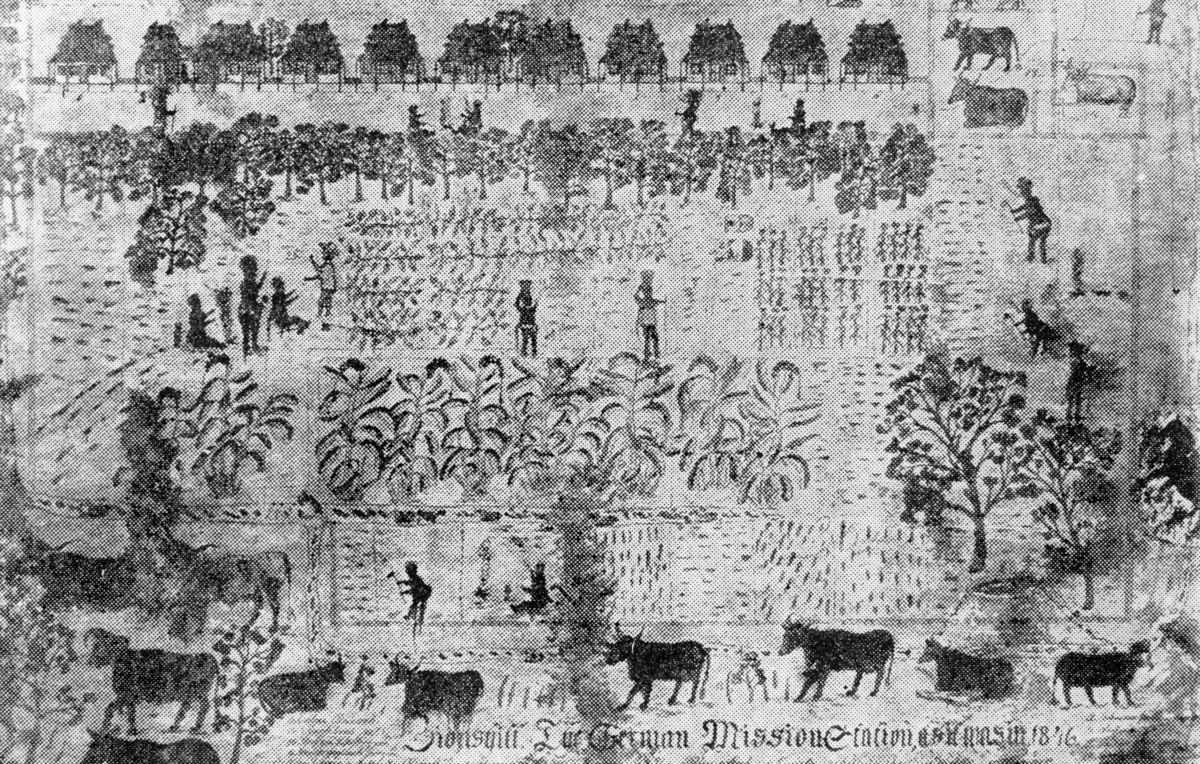
Above: Carl F. Gerler’s sketch of the German Mission Station at Zion’s Hill, 1846. (John Oxley Library)

The Zion Hill Mission was founded as a Lutheran/Presbyterian/Pietist mission during 1838 in what would later become Nundah, Brisbane. This was the first free European settlement in the region, which was still the Moreton Bay Penal Settlement. The missionaries had limited success in converting the local First Nations people to Christianity.

In August 1841, the Rev. Christopher Eipper and Gottfried Wagner went north to a First Nations initiation ceremony at Toorbul. On this journey they were guided by Wunkermany and two other men from the Mission. The journal of this trip gives a valuable insight into the social landscape of the time, with some amusing incidents demonstrating a sense of humour on both sides. This is Part One:

Colonial Observer (Sydney), 14 October 1841

‘Observations made on a journey to the natives at Toorbal, Aug. 2, 1841. (By the Rev. Christopher Eipper, of the German Mission to the Aborigines at Moreton Bay.)

MR. EIPPER left with Mr. Wagner, Zion’s-hill, about noon, under the guidance of three natives, Wunkermany and the two brothers, Wogan, who carried their provisions on their heads. The direction in which we went was nearly north. Our way led us this day over a soil similar to that which is found near our own place. Towards evening we reached a small creek, which we had to cross – as it was ebb-tide we could get over without being obliged to take off our garments. On the opposite side our natives made a little stay, because they had found a tree emerging out of the water, which was eaten through with worms called Coppra; and these worms appeared to afford them a delicious repast. Every worm had made his own channel; they are of a milk-white colour, with a brown stripe along the back; they taste not bad, although to a European palate they are not very inviting.

It is remarkable in what a variety of ways these natives find their support ; and it would be interesting to know how they first discovered the various objects which are now the constituent parts of their sustenance. The value of a tomahawk can only be estimated when all these ways are known. Here, for instance, they might have got some Coppras, without such an implement, by breaking as many branches off the trees as their strength would permit; but with the assistance of my tomahawk they cut the tree into pieces, and by clearing the same obtained every worm it contained. 

We were to encamp for the night near this river, but as the place where fresh water is generally found was dry, we were obliged to go three miles farther, until we came to the border of a swamp, where we halted. It is the custom of the natives to encamp in the neighbourhood of fresh water, although they do not always seem to consider their convenience, for sometimes they have to go a great length to fetch water. We had expected that our guides would have made huts for us, as they did for our brethren, who had made this journey before, but we were disappointed; they thought, probably, that in addition to our clothes we might be content to enjoy the same comfort which they had, viz.: that of a large fire. Mr. W. however knowing, from experience, that we should find it very cold to sleep without a shelter at this time of the year, set himself to the construction of a hut with sticks and grass, which we made the natives pull out of the ground. 

We soon found the comfort thereof; and were taking some cold food, when our attention was arrested by a very loud calling of our black friends. It was soon evident that no mortal foe disturbed them, for then they would have armed themselves, or called for our assistance. On enquiring about the cause, we were first told to be silent, for Wunkermany was speaking to the Devil; but when we persisted in asking, they replied, that the Devil was taking hold of the moon with his two arms, to eat it up, and would not let it go. They then began to call the name of every one of their tribes three times, fearful lest they should forget any one; which they did for two reasons – first, in order to frighten the Devil by naming all their mighty men and boys, and then to secure themselves against his power over them in death. For it is the Devil who would swallow up every soul, which rises into the air after its separation from the body; and nothing but their great lamentations for the dead, accompanied with cutting their bodies and beating their heads with sharp instruments, will move him at last to let the departed soul fly off to England. Their manner of treating with the Devil was, however, in this in-stance by no means reverential. From single expressions, which we could catch, it appeared that they scolded him, calling him every bad name their language afforded, and frequently cursed him, so that it is a wonder he is moved at all, by their thus speaking to him to let them off, and not rather provoked to destroy them. Deplorable as the condition of these wretched men is rendered by such superstitions, we could not keep our gravity when beholding and hearing them thus engaged to contend with Satan, as they were doing for nearly the two hours which this total eclipse of the moon lasted. Every where we were told this ceremony was performed by the natives on this occurrence. So great had been their fear and anxiety, that they would neither move nor eat anything while it lasted; but when it was over, they laughed themselves at the Devil. It was, however, in vain to endeavour to convince them of their error by a rational explanation of the phenomenon; this was, they said, what the white man believed, but it was not for the black man. 

Afterwards they requested us to speak very loud to some strange natives, whom they said they heard approach our encampment, for it was not now a proper time to come. When we told them that they were mistaken, they replied, that they had distinctly heard the noise of some men’s steps at a distance. We had our evening worship during this eclipse, and told them to be silent while we spake to God, which was much better than to scold the Devil, who had no power over those who belong to the Lord Jesus Christ; nor were such afraid that he would eat up the moon. Our rest was not interrupted; but when towards daybreak, the fire got low, we awoke with cold limbs, and had to search for wood to renew the fire. By this we were taught to provide for the future in the evening the wood for keeping up the fire at night, as we observed the natives themselves do. 

TUESDAY, AUGUST 3. – Early in the morning we continued our journey towards the second river, which we had to cross; it is called the Pine River, although there are but few pines on its banks; (we ascertained afterwards that this river empties itself into the Bay under the name Eden River, given to it by Mr. Petrie, who traced it from the Bay in his boat; and this river and the one we crossed yesterday are two arms of the Eden, which unite before they reach the sea.) 

After a tedious walk through high and wet grass, and crossing the river about nine o’clock, we stopped to take breakfast at a camp of the natives, some of whom were present. As we had yet a good supply of potatoes, we parted with a few, chiefly to make the burdens of our guides lighter. In these intervals of rest we were chiefly engaged in collecting words of the different tribes. Our path led us now through a more mountainous part, whilst hitherto we had gone over a rich alluvial soil. In the afternoon we beheld the Bay, and to the right the path to Umpie Boang or Old Settlement, was pointed out; but as there was no smoke visible, our guides concluded that the natives of that place had gone to Toorbal, which is the native name for Ninga Ninga. 

Towards evening, our direction being still the same, we came to the banks of another river or creek of the same breadth as the Pine River; it was however pretty deep, as it was flood tide. Having crossed it, we went over a tract of rich soil, followed by a marshy plain, until we arrived at the last river on our journey. Its native name is Kaboltur; among the whites it is called Deception River; its breadth is considerable; and it had risen to such a height that one of our guides, by whom we had been forsaken on account of a piece of pork, and who had wished to hasten on before us, had not ventured to cross the river alone, and thus we found him here again. 

The night was coming on, and the sky threatened rain, but we had no choice left, as we could not spend the night on the marsh on this side of the river, so we were obliged to cross it, and reached safely the opposite shore, although we had to go up to our chins into the water. When we had reached dry land, we encamped for the night; the natives joked again about the Devil’s eating the moon last night. In the middle of the day, when going down a hill, one of our guides missed a girl, which had been given to him as his future wife; all were thrown into the greatest consternation, for they said that the relations of the girl would beat them if they had permitted her to be stolen by strange natives. These poor creatures appear never to enjoy security; they would immediately have returned to the Pine River, or even to Zion’s Hill, if the girl, who had only missed the path, had not been fortunately found. This girl is now already fulfilling the duties of a wife to her future husband; and we have had occasion to observe what a useful commodity their women are to the natives, as they are chiefly expected to procure the necessary food, which it always more certain than that which the men are engaged to find. Single men, who would of course think it beneath their dignity to go in search of roots, we observed, were regularly supplied every day with a bundle of roots by one or other of the women, when returning from the swamps. 

WEDNESDAY, AUGUST 4. – The next morning we found that we had not been far from the coast; for after about one mile’s walk we saw the bay again, and were told that now our way would lead along the sandy beach to Toorbal. The bay assumes, with the promontory of the old settlement to Toorbal, a semi-circular shape. Moreton Island is seen at a distance running from south to north. Our guides took a little time here to gather the flowers of the honeysuckle tree, which they sucked. The stamina of this flower, or rather cob, are moistened with a clear and sweet juice, but as in sucking it so much of the pollen becomes mixed with it, it loses much of its good taste. About noon, after reaching the north corner of the bay, we turned west-ward, and soon met the lady of his Majesty the King of Toorbal employed in digging dangum, which is the native name of the root hitherto called bangwall. Here we stopped to take dinner; for our guides had told us we should not let our provisions be seen, as the natives were so greedy; it became, however, evident, by what we afterwards experienced, that none were more greedy than these worthies themselves. 

We then went still west-ward, and were saluted by a number of women, engaged in digging dangum, after having crossed a very disagreeable swamp well nigh a milelong. We were received very cordially, but were struck with the coldness and indifference which the natives evinced at meeting each other; we observed the same indifference on arriving at the camp, about four o’clock ; it was just the time when another division of women returned from gathering oysters, who freely gave us a good deal as they passed us. The first thing we had to do was to erect a good hut of sticks and grass, which by the approach of night was nearly finished, and then we left it alternately to pay our particular brothers our first visit. Our hosts gave us what their houses could afford, viz., oysters and pounded dangum; they would immediately have us sit down and chat with them. But we had soon occasion to witness some of the natives own ways: the king had stolen an axe belonging to one of our guides, which he had left in the keeping of his mother; he had all the way been talking that he would beat the king for it, but we gave no great heed to it; as soon, however, as the pounding of dangum had ceased, he arose, took his two waddies, and, standing at the side of our hut, commenced his charge with a loud voice, ending with a challenge to the king to fight him. All was immediately deep silence, and from a great distance an answer was returned; the words grew hotter on both sides, and one or two others added now and then a few remarks. Our guide now ran forward, but came soon back, saying that the king was a coward. Here the matter ended. Afterwards, the king paid us several visits when passing by without any sign of hostility on either side. Several evenings during our stay there such occurrence took place, but by our interfering between the contending parties, which they did not seem to dislike, the quarrels were settled without blows. Such was the eagerness of all to listen to what was spoken on such occasions, that whenever any one was heard to speak in that way after the evening meal had been taken, we scarcely could get any information from our neighbours or guides of the cause of the quarrel.

THURSDAY, AUGUST 5. – The next morning we went to the sea-coast, to the place where the natives gather oysters and catch fish; it was a part of the bay, apparently quite enclosed with land, but we afterwards ascertained that it has an outlet into the sea to the northward – Mr. Petrie calls it Deception Bay. Thus Moreton Bay has four openings, the south passage, which is only passable for boats; the passage at Amity Point, which is now used; the north passage, between Moreton Island and Yarun, and the passage through Deception Bay, ending at Head Petre. Opposite the main land, on a protruding point of which we stood, is a large island running from south to north, called Yarun by the natives; and another not so large lies westward, in which direction is the Glasshouse mountains; nine in number of very striking appearance and conical shape were visible. Some smaller islands, or rather groups of trees, are seen between Yarun and the mainland, where the oysters are found in the mud at low water. 

FRIDAY, AUGUST 6. – This morning we went with some of the natives to see the spot where the solemnity of making kippers is to take place; its distance from the camp is about one mile and a-half; no woman or child is permitted to come near. On the way, the natives killed a snake, but as it had no fat they did not eat it. This place is called Bool, and has the figure of a large basin twenty-one feet in diameter, surrounded by an earthen wall about two feet high ; the whole place is cleared of the grass, which is pulled up by the, roots; it has also an outlet to the southward, by a ditch about three feet wide and half a mile long. There the kippers are led to their huts, which during the time of their trial are separate from the rest. At one place along this trench are found the rude figure of a kangaroo and a seahog, by which it is intended the young fellows should be frightened when passing along. It appeared that the clearing of this ground was allotted to certain individuals in equal parts so the natives told us, adding, that some who were lazy had not yet done their work. 

The rest of the day we spent in visiting and conversing with the natives, as opportunities were offered. Daily some had gone to catch Kangaroos, but had not been successful; and from what we afterwards observed we may justly say that by the mode of life, which these natives lead, not only their whole time every day is taken up in procuring their food, but that even then they are not always rewarded for their toil. Besides the women’s time, is also entirely taken up in digging roots and gathering oysters but; what they general contribute to the sustenance, is surer to be obtained, and constitutes their main support. The men may be said to provide the meat, but the women the bread. As regularly as the former go a hunting, or fishing, so regularly do the latter go for oysters or dangum. But although it is certain that the men derive greater pleasure from the chase and from fishing than the women when drudging in the swamps, yet it is doubtful from their natural indolence, whether they would either hunt or fish, if they were not compelled to it by hunger. 

SATURDAY, AUGUST 7th. – Mr W – went to see the mode of the women in gathering oysters; they were at the same place, where we had been the day before. There was a canoe, in which they rowed to one of the small Islands above mentioned, where they gathered the oysters out of the mud into the boat. When they had thus gathered a great quantity, they went back to the shore, and made a fire, into which all the oysters were put, to cleanse them from the mud, and being thus stewed at the same time, they are eaten, and taste very well. The natives had been boasting, when inviting us to their places

The next day was Sabbath, the 8th… which we spent as quietly as we could. We cannot, however, refrain from saying, that as long as these natives have no other mode of life, they will never be able to keep a Christian Sabbath, though they were Christians; they cannot be expected to fast, yet they get scarcely sufficient for each day; it is true that at times they may have abundance of fish, but taking it altogether, it may with truth be stated that they have barely sufficient food for every day, and having no regular meals they are always hungry. This observation gives us, in one point of view, some satisfaction, as it is a confirmation, that the plan upon which our Mission is conducted, is fully adapted to their peculiar situation; for while endeavouring to impart unto them a knowledge of divine things, we are also teaching and assisting them to procure their livelihood in a laborious and surer way; and should the Divine Spirit move their hearts to believe the Gospel, their former mode of life will be no obstacle in the way of its acceptation. (To be concluded in our next)”

‘Observations made on a journey to the natives at Toorbal, August 1841’ (Part Two)

Personal Awards and the Power of Community

Above: Acceptance speech, Queensland Memory Awards, 2021. (State Library of Queensland)

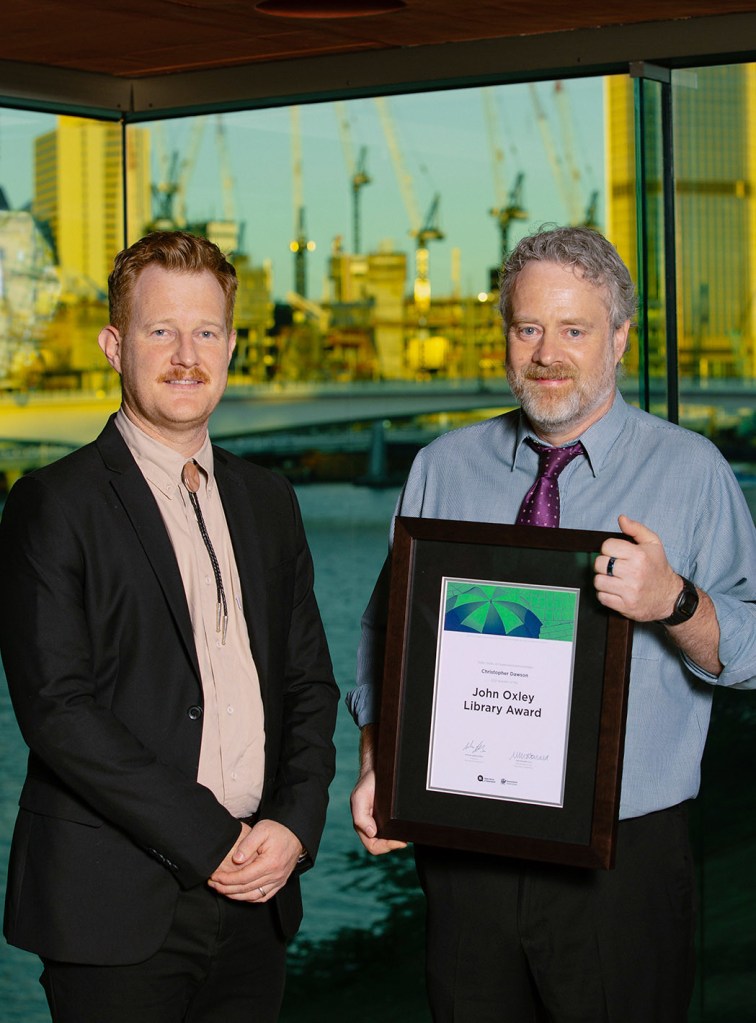
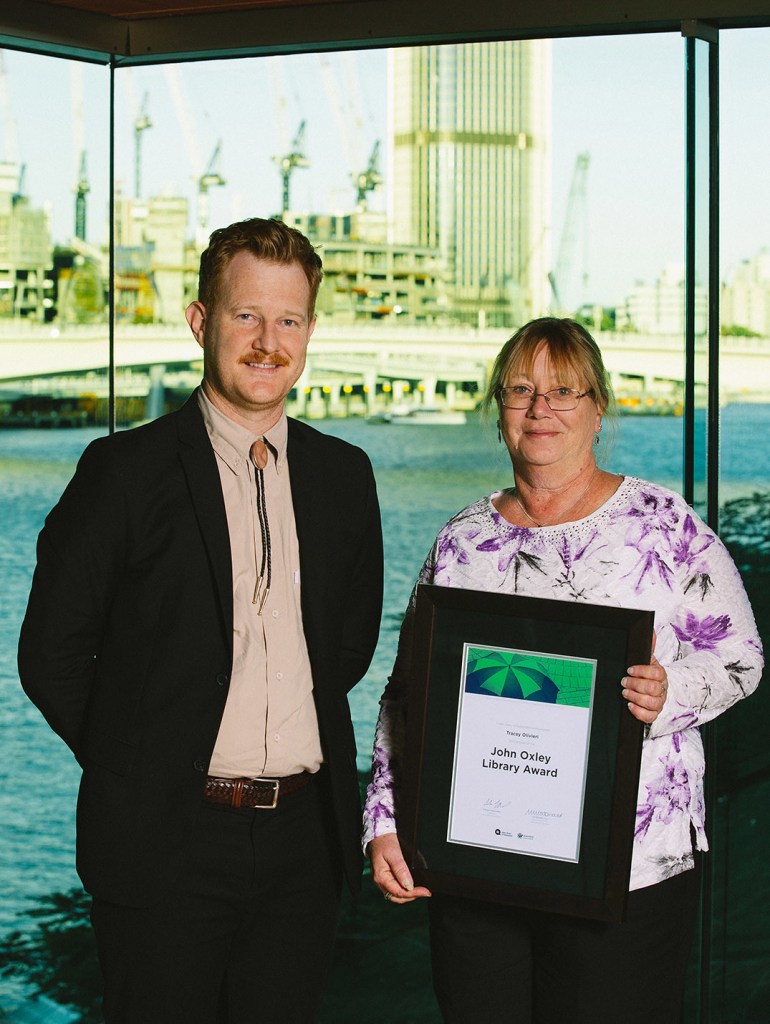
Some of the Public History work I do is unpaid, so the occasional pat on the back for my efforts can be welcome. The year 2021 was particularly good for that type of thing, with the cemetery work done by my colleague Tracey Olivieri and myself being recognised with two awards.

The first came in January when we received a Griffith Australia Day Award in recognition for the huge amount of work we have both done over the years with the Friends of South Brisbane Cemetery. This was presented by Terri Butler, the Federal MP for Griffith, in a lovely ceremony at the Gabba stadium in the company of other volunteers being acknowledged for a lot of valuable work.

Tracey and I receiving the Griffith Australia Day Awards.
Tracey and I receiving the Griffith Australia Day Awards. (Hannah Photography)

Then in June we received the John Oxley Library Award, one of the annual ‘Queensland Memory Awards’ described by the State Library of Queensland as their ‘most prestigious’ honours. This was an especially valued accolade.

Me with Gavin Bannerman, Director of Queensland Memory.
Me with Gavin Bannerman, Director of Queensland Memory. (State Library of Queensland)
Tracey Olivieri and Gavin.
Tracey Olivieri and Gavin. (State Library of Queensland)
The award winners with Library Board members.
The award winners with Library Board members. (State Library of Queensland)
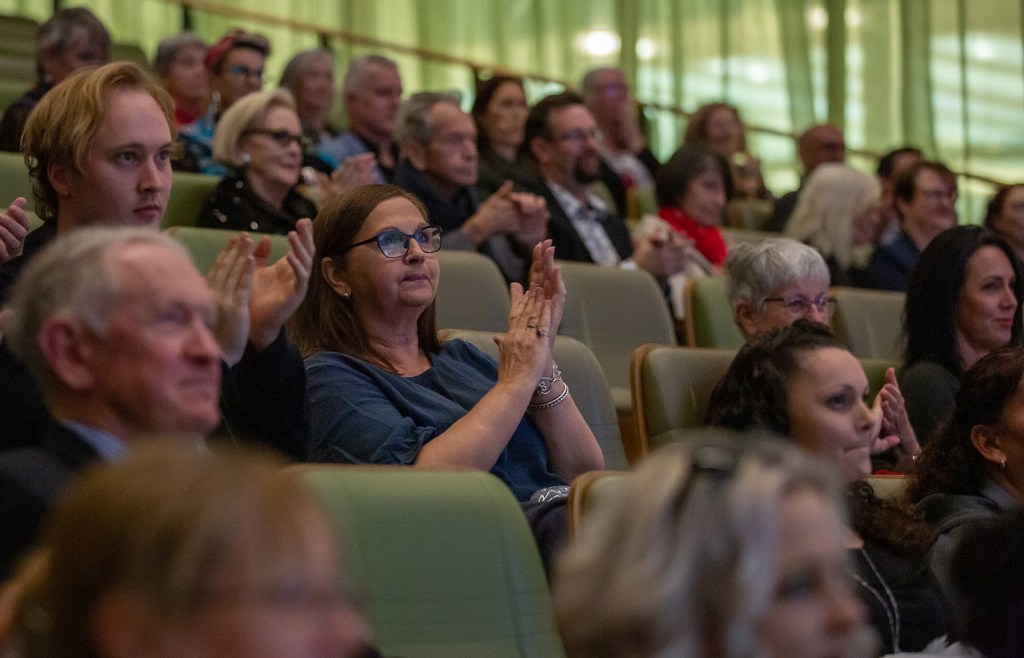
In the awards audience. (State Library of Queensland)

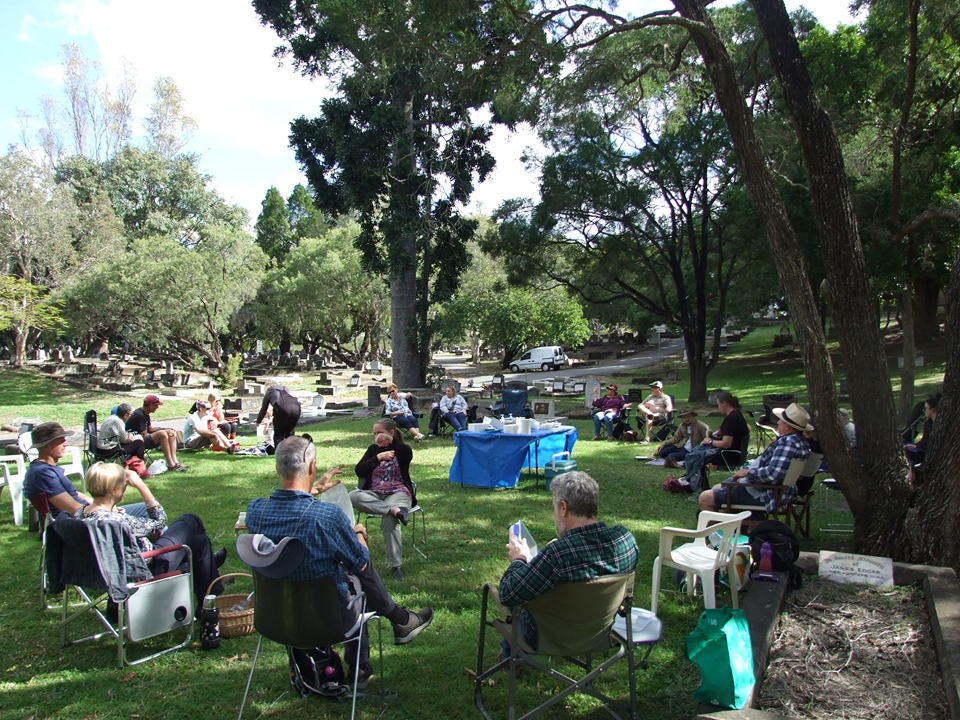
Both these awards recognised years of cleaning, research, tours, lobbying, writing, online development, resuscitating the FOSBC from near-death in 2017, and building an active community group at the cemetery. It is probably this last aspect that I personally value the most. 

There is something I say a lot, and I said it again during my acceptance speech, but the underlying philosophy of all this cemetery work has been the power of community: ‘The more people know about the cemetery, the more they will care about it, and the more likely they will then be to actively protect it‘.

Heritage is always a long-term challenge. Organisations such as the FOSBC need to prepare for the century ahead, to ensure that when those people who started the group back in 2005 cannot work any more, there will be others ready to take the baton and carry on that work. 

So far, we’ve done quite well in this regard. We have built up what I suspect to be the largest and most active cemetery-linked community organisation in the country. Maybe this success has involved a measure of what is described as ‘servant leadership’, organising in a way that puts the needs of the team before the needs of the self. In real terms, this has looked like:

  • Doing a lot of behind-the scenes work to keep people in the group connected and having plenty of opportunities to participate in diverse activities.
  • Quietly identifying individual talents and encouraging them and giving them space to show what they can do.
  • Stepping back to share credit and let others take the limelight.
  • Nurturing the next generation of leaders – our successors.
  • Encouraging a friendly, informal workplace atmosphere that volunteers enjoy working in.

Of course it doesn’t always work like this, and democracy can always be improved, but the intent should always there.

This is why I felt slightly awkward about the awards. Although Tracey and I put a lot of work in, but so much work is done by others. To tell the truth, I think the nomination should have actually been for the FOSBC group as a whole. Hopefully, in time to come, others in the group will be recognised in similar ways. For now, we’ll keep working on building the FOSBC. 

Maybe part of why I think belonging to a community is important is because I’m a migrant and have a need to feel like I belong somewhere (even after 35 years here). I was a third-generation council estate child with that sense of ‘people being in the same boat’, where ‘everybody knows your name’. I got that same vibe as a young adult living on a kibbutz commune in Israel, and again during my university years in Brisbane. All great times in my life, and the FOSBC is becoming the fourth community of my life. But I also like the feeling that I’m making a positive difference in the world, and being in a group is the best way to achieve that. The inspirational Liverpool FC manager and man-of-the-people Bill Shankly was asked in the early 1970s for his views on socialism, and his answer evoked what I see as the power of community

“It is a way of living. It is humanity. I believe the only way to live and to be truly successful is by collective effort, with everyone working for each other, everyone helping each other, and everyone having a share of the rewards at the end of the day. That might be asking a lot, but it’s the way I see football and the way I see life.”

And that is the way I see the South Brisbane Cemetery community, and the way I see life. But it still feels reassuring to have that work acknowledged and to be able to say it is ‘award-winning’.

FOSBC get-together.
FOSBC get-together, 2020.

The Joy of Public Talks in an Old Cemetery

Above: ‘History Among the Graves’ talk, South Brisbane Cemetery, July 2022. (FOSBC)

In mid-2020, at the height of the coronavirus restrictions in Queensland, in-person public history events were few and far between. I had previously been scheduled to deliver a couple of history talks during that time, but these were indefinitely postponed. The Friends of South Brisbane Cemetery were unable to present their regular tours, and unfortunately the 150th anniversary events we had lined up were also called off.

The easing of the restrictions allowed us to run limited tours from late June, but many indoor history events were still cancelled due to virus concerns. This presented an opportunity for a new idea of mine – outdoor public history talks in the South Brisbane Cemetery. The fresh-air setting was perfectly suited for a socially-distanced audience, and we had a nice shady, grassed open spot for this near the office and utilities. And so ‘History Among the Graves’ was born, the first event of this type in Australian cemeteries (as far as I know).

These were organised and presented with fellow FOSBC member Tracey Oliveri, the first one taking place in August 2020 not long after the 150th anniversary of the first official burial in the cemetery. The subject was, naturally, ‘150 Years of the South Brisbane Cemetery’ and it turned out to be a beautiful winter morning, with over 20 people turning up for the talk, followed by a 20-minute Q&A session, and then coffee, cake and a chat. Maybe it wasn’t a massive event, but it was a really enjoyable morning.

The success of this event resulted in several more ‘History Among the Graves’ taking place since then.

The format is for Tracey and myself to alternate short segments (or sometimes to do our own full presentations), with attendees using printed colour handouts to refer to images of the subjects we cover. The talks are much like a guided tour, except everyone gets to sit down on the chairs or blankets they brought, nibble from a picnic basket, and soak up the Sunday morning peace and quiet of a beautiful, historical setting. The attendees also get to hang back afterwards for a chat over tea and coffee, and we have an information stall set up to handle any other cemetery-related queries.

All in all, I find these talks to be a very enjoyable and productive way to talk about history with an audience. I would definitely recommend them to any other cemetery Friends group as a way of engaging with the public (we signed up several new members over the course of the three talks), and they are great for people with mobility issues who might not otherwise be able to attend a tour. We will definitely be doing more of these into the future (check the calendar here).

The State of South Brisbane Cemetery: A Groundbreaking Report

Above: A volunteer recording data for the ‘State of the Cemetery’ report, October 2022. (C Dawson)

Late in 2022 I initiated a project that had been on the drawing board for a couple of years – a Friends of South Brisbane Cemetery survey of the infrastructure within the South Brisbane Cemetery, recording any issues with footpaths, trees, drains, roads, seating, etc. In order to keep the workload focussed and manageable, the condition of the monuments was not recorded, but that might be a job for another day…

The cemetery opened in 1870, and much of the current infrastructure within there (such as thoroughfares, navigational signage, plantings, drains and amenities) is at least half a century old. The state of this aging infrastructure and its effect on continued public access and heritage protection needed to be thoroughly assessed.

The purpose of this ‘State of the Cemetery’ project is to create a historical record of current problems, with the results intended to provide a guide for future action. Addressing these issues will not only help to extend the long-term lifespan of the heritage fabric within the cemetery, but it would also enhance public safety, especially as any future ‘activation’ of the cemetery for community activities would likely increase visitation numbers. It will also improve visitor comfort, cemetery aesthetics, and tangibly demonstrate the value that the Brisbane City Council and the FOSBC place on this important heritage site.

How all this is achieved is something that we will be approaching Brisbane City Council to discuss. A long-term government/community partnership appears to be the best (and most affordable) hope for solving the problems we listed.

The survey was conducted during October-November 2022 by FOSBC volunteers. This was intensive work, as volunteers had to walk along each row in every section of the cemetery (a total of approximately 600 rows across 54 sections) to observe any relevant issues, which were recorded on survey forms and photographed, with the results then being transcribed into the final report. Subjective assessments were also made for each individual issue regarding ‘priority’ and ‘recommended action’. This was a massive job.

Below: Some the team involved in producing the ‘State of the Cemetery’ report.

  • Volunteers working in the South Brisbane Cemetery.

All in all, a total of 15 people were involved in producing the report. The experience of the ‘Friends of South Brisbane Cemetery’ volunteers in organising community cleaning days, researching and mapping graves, and conducting hundreds of guided tours, means they are uniquely placed to provide an assessment of its current condition.

The end result of all this work is a 358-page report listing (with images and maps) nearly 1,300 individual issues. Some are very bad and need immediate attention, while others probably just need monitoring over the years, but although some of these issues may appear to be quite minor now, it is a fact that they will only worsen over time if left unaddressed.

One of the 50+ maps produced for the report, showing the precise location of each issue in this section. These are reference numbers for issues described in the report. (FOSBC)

The main findings of this ‘State of the Cemetery’ report are (VERY briefly):

  • Many of the pathways within the cemetery are in poor condition and need to be improved. Some are quite dangerous, especially for people with mobility issues.
  • Tree management needs to be improved in the interests of public safety and heritage protection.
  • Visitors experience difficulties navigating the cemetery. Signage and directions need to be improved.
  • Traffic flow in the cemetery is problematic due to narrow roads.
  • Most of the drains in the cemetery are generally adequate, although some need better protection from debris, and some drain covers need repairing.
  • A few monuments are leaning dangerously.
  • Public seating in the cemetery is now generally adequate, although it is possible for more benches to be installed.
  • The cemetery needs a public shelter.
  • More landscaping should be carried out.
The type of problem seen on some of the paths in the cemetery. (FOSBC)

What happens next remains to be seen. The cemetery is heritage-listed and its historical significance only increases with age, so the heritage fabric needs to be protected for generations to come. It is also an active social space close to the inner city and attracts a variety of users – and will probably continue to do so for decades to come – so the safety of visitors also needs to monitored.

Apart from the basic information shared above, most of this report will be kept under wraps for the moment, while the FOSBC consults with BCC and seeks to initiate a long-term programme to start fixing the problems we found.

The FOSBC ‘State of the Cemetery’ Report is an innovative community-led project that lets all stakeholders know exactly where the problems are so we can start working together to make the South Brisbane Cemetery a better place in the years to come.

The Tiger Man of Brisbane

Above: Higgins’ paddock at Toombul, ca.1888. (John Oxley Library) Two tigers lie on the ground behind these people.

Charles Higgins, born in Ireland circa 1825, claimed to have arrived in Queensland after spending his youth in California, where he had a ‘pet’ grizzly bear, and he continued his interest in big fierce beasties after his arrival here.

Higgins had some land in Toombul where he kept ‘Jimmy’ and ‘Sammy’, two Bengal tigers that he had obtained in early 1885 when they were 3-month-old cubs. A third tiger, their sister, died while still young. Higgins kept them chained to a stake in the paddock while he was home, but they were confined in cages while he was away. In April 1886 Higgins told a reporter from the Brisbane Courier that he had trained them carefully and they were playful with him and sometimes lay around the house much like domestic cats. He also claimed that the tigers would follow him through the bush and respond to commands like dogs, and that boys from the nearby school would also stop off on their way home to visit the tigers. This article alarmed local residents and prompted a police investigation, with a magistrate stating his belief that Higgins could be charged with murder if his tigers killed anybody while loose.

Higgins obtained other tigers, including a female called Diana, and ‘Sir Roger’, billed as the ‘largest tiger in the Australian colonies’, and along with a range of other animals they formed part of ‘Higgins Great Menagerie of Wild Performing Animals’. By late 1887 this was based on the corner of Yundah Street and the Esplanade in Sandgate, and was open to the public. Higgins gave a daily tiger-taming performance there.

Brisbane Courier, 31 December 1887.

In August 1888 Higgins leased an allotment on the corner of George and Turbot Streets near the centre of Brisbane and kept his five tigers, five dingoes, a cheetah, a panther, a leopard, a bear, snakes and numerous monkeys there, to the despair of his new neighbour Arthur Jarvis. The wooden hoarding surrounding the allotment was insecure, the cages were not strong enough, and animals occasionally escaped, causing ‘great consternation and annoyance to the public’, especially Jarvis, who apparently lived with his family in a ‘continual state of terror’.

On one occasion the workmen in Jarvis’ on-site Venetian-blind workshop ran for their lives after a tiger strolled into their workplace. Dingoes also roamed the area, and Jarvis once woke up to find a monkey in his bedroom. The Jarvis family also had to contend with large piles of rotting animal dung outside their home, making the general stench emitting from the menagerie even worse. After several months of this torture Jarvis took the matter to court and Higgins was required to move his animals to a safer place. By that time Higgins’ tigress Diana had given birth to a pair of cubs, which he separated from her and proudly exhibited. Unfortunately, but perhaps not too surprisingly, they died soon afterwards, and became part of the collection at the Queensland Museum.

The most sensational incident to occur during that time was the near-escape of the tiger Jimmy, who got out of his cage while it was being cleaned one Wednesday afternoon in November 1888. Jimmy had been noted as one of the more dangerous of the tigers, and when Peter Bertram, one of the keepers, started to run away Jimmy knocked him to the ground. Panicked passers-by fled in terror, and Higgins later recalled what happened next:

“I heard… a scream and a roar, and looking round saw Jemmy after the man. The man was pulled down; got up again and managed to reach the middle of the street, and the tiger pulled him down again and opened its mouth to bite. A moment and the poor fellow’s head would have been cracked like a nut, but I jammed my arm between the jaws and shoved the man away with the other. Look at my arm.” Higgins bared his right arm and showed the healed wound, where the flesh had been cut out as though by a knife. “Jemmy held on to me for a bit, but I scolded him and he let me go. I felt sick, but got up and then started to try and get him inside. He walked about the street growling and licking the blood from his jaws. I walked after him, and regularly bundled him into the enclosure and shut the door. I hadn’t even my little whip, but at last got him to stand up with his feet against a fence; then I got his collar and chain and tied him up.” (Brisbane Courier, 29 July 1889)

Higgins steps in to rescue his employee. (Queensland Figaro, 1 December 1888)

After leaving George Street the menagerie found a new home at the Queensport Aquarium in Hemmant. This new resort had many attractions, and among them were tiger-taming performances by Higgins himself. It is not known how long the animals remained at Queensport, but when the tiger cages were blown into the river during a gale in 1892 they were reported as being empty. By this time Higgins was aged well into his 60s and had retired to live at Browns Plains. He died in July 1894 when a cart that he was driving along Ipswich Road overturned after his horse bolted at Chardon’s Corner. Charles Higgins, tiger tamer extraordinaire, was buried in Nundah Cemetery.

He had provided an insight into his job in an interview he gave to the Brisbane Courier in July 1889, which probably took place at the soon-to-be-opened Queensport Aquarium:

“I feel… when I go into the cage with my little whip in my hand that I am the master. I feel myself stronger than ever, and as cool as I could ever be. I seem to regard the tigers as rats, and feel as if I could shake them like rats. Why, look at Jemmy and Sammy. You know they think I could thrash them both… You know Sammy is pretty quiet, but that Jemmy is very sly. When I’m in the cage I have to watch him closely. He is always trying to slip behind me to get at me. That’s when I have to keep him under my eye. It is not my eye he fears, and I don’t believe that the eye itself has any power over animals, except that they know when they’re watched. I was never nervous in my life. If I once got nervous they would be on to me like winking.” (Brisbane Courier, 29 July 1889)

Asked if he ever ‘anticipated a struggle’ with his tigers, he said:

“I don’t drink, except perhaps a glass of beer. The people who are killed in cages either lose their nerve or are in drink. An animal knows at once if you are afraid of him, and – alluding to a terrible case in which a girl was torn to pieces by lions some time ago – that woman must have become nervous. A man sometimes under drink will go into the cage and send the animals flying round, but he forgets to be careful, and before he knows where he is a beast is on him. The great thing is to let them know you are watching them. When Jemmy tries to give me the slip I just shake the whip at him and say, ‘Ah, Jemmy, my boy, I’m watching you’.” (Brisbane Courier, 29 July 1889)

The tigers never did manage to get the better of Charles Higgins, but in the end it was the horse he should have been watching.