
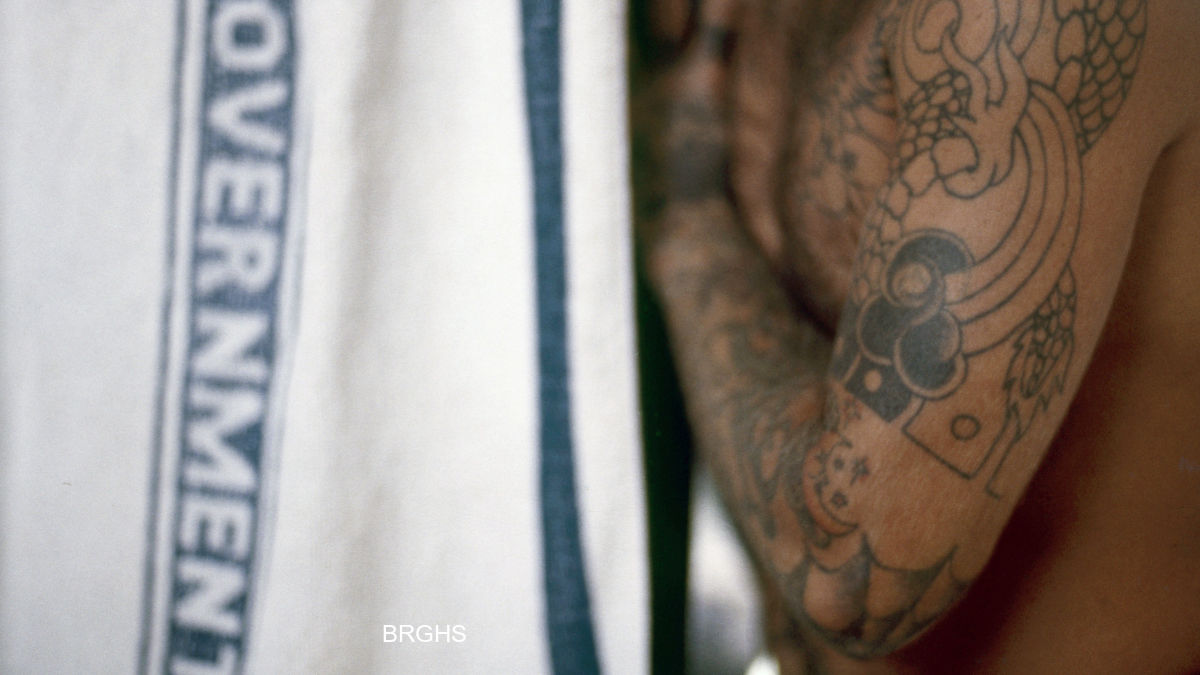
Above: Prisoner with tattoo in Boggo Road Gaol, circa 1989. (BRGHS)
Prison tats. We’ve all seen them. That dodgy tattoo with a prison vibe, obviously ‘home-made’ with improvised tattoo machines, or as they were also known by a few people, tattoo guns or ‘boob’ guns (‘boob’ being an old slang term for prison). My personal favourite was one I saw in Wynnum about ten years ago, a man walking down the street with one word tattooed down the back of each of his calves, in amateurish gothic font. The left side had ‘Fuck’, and the right had ‘Jail’. Short and to the point.
I became familiar with these contraptions when I was curating the Boggo Road Gaol Museum Collection, which contained a handful of complete tattoo machines and up to 100 loose components. These had been confiscated from inmates in the Queensland prison system during the 1970s-80s, and were eventually passed on to the museum.
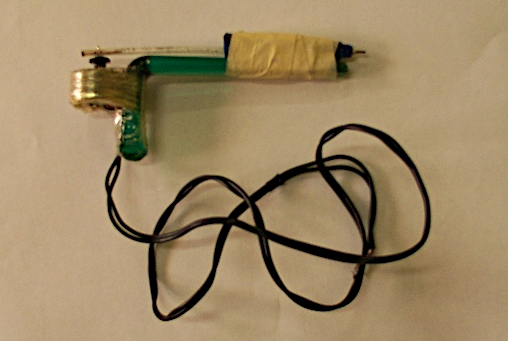
During the museums component of my undergraduate Anthropology degree at the University of Queensland we were required to design a single display for an item from the UQ Anthropology Museum collection. These displays would come together in an exhibition exploring the link between material culture and identity. At the time I was sorting and cataloguing the prison collection and decided to use an item from that collection instead. What I selected was an improvised tattoo machine.
The presence, provenance and number of these confiscated artefacts in the collection told me three things straight away. Firstly, they were illegal. There were a few reasons for this. Not only could they be used as weapons, but prisoners were required to maintain the same appearance during their sentence. It also became more important in later years to minimise the spread of communicable diseases such as hepatitis C through sharing the kind of needles used in these machines.
The second thing was that they were still made despite being banned, which made them objects of resistance to authority in a prison system that was in turmoil. This was an example of an object (material culture) expressing social identity.
Thirdly, the construction and sheer number of the machines were testament to the ingenuity and resourcefulness of some inmates in scrounging the various components that could be found around the environs of a late 20th-century prison.
I found this last aspect particularly interesting. How did these things work, how were they made, and where did the various components come from?
The first job was to work out exactly what each component was.

I then talked to a few former prison officers and an ex-inmate who were familiar with these items, and established the following:
The drive rods and the barrels were made from the ink chamber and barrel of a ball-point pen, which were issued for hobby work and writing in cells.
The needles and connecting pins were made from:
- sewing needles, pins, or sharpened wire from industry workshops, or
- paper clips issued as stationery, or
- diabetic needles from the prison hospital surgery, or
- mathematical compasses, issued for hobby work, or
- guitar string.
The spindles were made from buttons on prison clothing.
The frames were made from prison-issue toothbrushes, which were bent into a L shape using heat.
The motors and electrical wiring were extracted from audio-cassette players or transistor radios, which were allowed in cells.
The ink was either:
- India ink, issued for hobby work in cells, or
- charcoal which had been ground from spent matches and mixed with oil, or
- pen ink obtained from split tube of pen and mixed with margarine.
The binding for the frame and components was either cotton thread from prison clothing or workshops, or adhesive tape, glue or sticky tape from industry workshops.
As can be seen, these machines were cobbled together using bits and pieces surreptitiously found around a 1980s prison environment, a task that was quite an exercise in ‘scrounging’.

As for how they were used, the ink (or charcoal mixture) was applied to the skin prior to puncturing with the needle. Professional tattoo shops use special inks that do not irritate the skin and are unlikely to cause allergic reactions, but makeshift inks used in prison tattoos may be unsafe and damage the skin, causing permanent scarring. They can also contain dangerous chemicals.
Another danger – aside from the obvious risk that a person could leave prison with awful tattoos – was the serious health risks from unsterilised equipment. Apart from basic skin infections, deadly diseases like hepatitis and HIV/AIDS can be passed from one prisoner to another when needles are re-used.
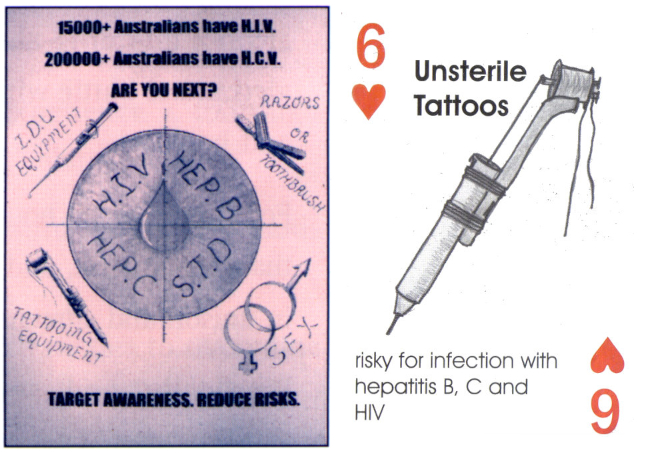
The playing card shown below (right) is from a deck issued to prisoners, raising awareness of health and safety. This is one of a number of cards I found strewn on the pavement outside my local primary school (yikes). The poster (below left) featuring a tattoo machine was also used in Queensland prisons.
I called my individual display for the Anthropology Museum exhibition ‘Clink Ink’ (‘clink’ being an old nickname for prison).* A couple of years later I recreated it as part of an exhibition I curated in Boggo Road called ‘Life in Prison’. They were also featured, of course, in my small book Shivs, Bongs and Boob Guns, all about the material culture of inmates in the old Queensland prisons system. The tattoo machines always drew a lot of attention, as they are a rare peep into a world that was not only locked off from public view at the time, but is now close to being a half-century in the past.
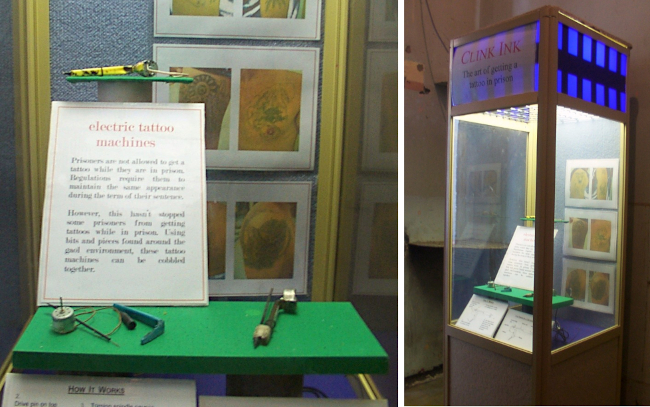
* I also came up with the overall ‘exploring identity through material culture’ exhibition title, which was ‘ID in 3D’.
 Christopher Dawson
Thank you Chris
factual and I love reading about our history.
regards Kellie Gozzard.
LikeLike